

You are using an out of date browser. It may not display this or other websites correctly.
You should upgrade or use an alternative browser.
You should upgrade or use an alternative browser.
OP Amp upgrades - OPA2604AP (obsolete)
- Thread starter Hyperion
- Start date
-
- Tags
- au-d11 ii op amp upgrade

Same here, but I think I'll be swapping mine out sooner rather than later. 
Before I fitted the replacements, I decided it would be a good idea just to verify that the connections to the single OP amps on the Brown Dog adapter were the same as for the one being removed. So I printed off a copy of the Dual OPA2604AP pinout, the Single OPA604AP pinout and the SIP8 M5219L pinout. Trying to do this turned out to be quite the task for my tiny mind at least.
At first I thought the connections referenced to the SIP8 Brown Dog were completely wrong, some head scratching later, and I deduced that the power was ok, but the inputs seemed to be swapped (inverting/non-inverting) - more head scratching - finally decided it was all ok after all. I tell you, for a while the problem seemed to me like it must have been decoding the WWII Enigma machine, with so many pin numbers requiring cross referencing - anyway it's all good.
Before I fitted the replacements, I decided it would be a good idea
just to verify that the connections to the single OP amps on the Brown Dog adapter were the same as for the one being removed. So I printed off a copy of the Dual OPA2604AP pinout, the Single OPA604AP pinout and the SIP8 M5219L pinout. Trying to do this turned out to be quite the task for my tiny mind at least. At first I thought the connections referenced to the SIP8 Brown Dog were completely wrong, some head scratching later, and I deduced that the power was ok, but the inputs seemed to be swapped (inverting/non-inverting) - more head scratching - finally decided it was all ok after all. I tell you, for a while the problem seemed to me like it must have been decoding the WWII Enigma machine, with so many pin numbers requiring cross referencing - anyway it's all good.
Last edited:

Great. Another reference to the Bastards of Bletchley Park, keeping it from becoming completely obscure to all of us who still have some semblance of long-term memory. Those bastards were very clever, and very dedicated indeed. That entire episode is a remarkable historical lesson that just when you are absolutely certain and confident that you know something, you just as quickly (and harshly) can discover that you are wrong. It's sad that far too many people have missed that lesson.

TupolevFan
Super Member
John can you please clarify why were you using OPA2604 (Dual version) instead of OPA604(single) ? Or I misunderstood something ?
The dual version was used because it was replacing a dual OP amp, you know, 'the old stereo one per channel' thing?John can you please clarify why were you using OPA2604 (Dual version) instead of OPA604(single) ? Or I misunderstood something ?
The OPA2604AP was recommended to me by Echowars (Glenn), as being the closest and best replacement available at the time. (The 'single' version was never even considered, also, at the time I don't think there was a twin, single channel OP amp to SIP8 Brown Dog adapter). I made the change and was happy, but in the back of my mind I was uncomfortable with how hot the replacement OP amps were getting.Move forward a couple of years and the makers of the OP amp have withdrawn it from production due to concerns about failures (or inability to hold specification) due to heat. Not being able to buy any of a device in one of my amplifiers which might fail at any time set me on a path to find a solution - this is where the single version of the same OP amp comes in.
Last edited:

gslikker
Super Member
I just put one in somewhere in a RIAA preamp, mounted vertically in a cool place, but if it gets hot I could glue a heatsink on it. (fortunately it is on a socket, too, if I could find a suitable replacement)
Nevertheless, I wonder if it supposed to get too hot when at max power voltage and low impedance driving only, or also during normal conditions (+/- 15V) and not driving a low ohms load.
Nevertheless, I wonder if it supposed to get too hot when at max power voltage and low impedance driving only, or also during normal conditions (+/- 15V) and not driving a low ohms load.
TupolevFan
Super Member
Ohh i did not realize that both channels go via same chip that is what "1/2 "meant. By the way how precise the +21.2 and -21.5 supply rails are? if they are i would also try LME49860. Ithink between OPA2604 and LME49860 at least 15 to 20 years (in terms when they were created). I know Voltages are close to max for LME but specs are very nice for LME. I recently restored Setton RS-660 and replaced TA7631P with LME49870 (single version of 49860 which is now obsolete but i do have around 16 chips of 49870) in phono. But i have to say Voldages there were +-18.7 VThe dual version was used because it was replacing a dual OP amp, you know, 'the old stereo one per channel' thing?
Move forward a couple of years and the makers of the OP amp have withdrawn it from production due to concerns about failures (or inability to hold specification) due to heat. Not being able to buy any of a device in one of my amplifiers which might fail at any time set me on a path to find a solution - this is where the single version of the same OP amp comes in.
Actually i just looked carefully into LME49860 and it says that absolute max rating is 46V (-+23V). So i guess you should be fine if you decide to try it
Last edited:

Karl vd Berg
Super Member
You may want to have a look at the new OPA1656 (see "detailed description" pag.14 for the feed-forward tech). It's a 40Vs (max. recommended ±18V) Fet input (fabricated in a CMOS process), high 100mA output current, very low offset (best for RIAA), and happy with common ±15V supplies.I just put one in somewhere in a RIAA preamp, mounted vertically in a cool place, but if it gets hot I could glue a heatsink on it. (fortunately it is on a socket, too, if I could find a suitable replacement)
Nevertheless, I wonder if it supposed to get too hot when at max power voltage and low impedance driving only, or also during normal conditions (+/- 15V) and not driving a low ohms load.
The only thing is that is available n 8-pin SOIC package, so you'd need a Brown Dog adapter.
Mouser: https://nl.mouser.com/ProductDetail/Texas-Instruments/OPA1656IDR?qs=vLWxofP3U2ztlJVp%2BbIcnQ==
Last edited:
Thank you for the suggestion, but I wont be trying other OP amps, I have my solution as previously explained. At least the spec voltage of the OPA2604AP was/is 48V or +/-24V, so trying to use an OP amp even closer to its limits would I think, be an 'out of the frying pan, into the fire' retrograde step.Actually i just looked carefully into LME49860 and it says that absolute max rating is 46V (-+23V). So i guess you should be fine if you decide to try it
Last edited:
TupolevFan
Super Member
Thank you for the suggestion, but I wont be trying other OP amps, I have my solution as previously explained. At least the spec voltage of the OPA2604AP was/is 48V or +/-24V, so trying to use an OP amp even closer to its limits would I think, be an 'out of the frying pan, into the fire' retrograde step.
Understood.
As i understand you will use OPA604 single version, you said there is an adapter on which you install 2 OA and it will imitate dual operational amp chip ?
Correct, the OPA604 is identical to one channel of the OPA2604AP, and the Brown Dog adapter enables its use where the PCB footprint is for SIP8.Understood.
As i understand you will use OPA604 single version, you said there is an adapter on which you install 2 OA and it will imitate dual operational amp chip ?
All of this is explained in this thread, all you have to do is read it.
TupolevFan
Super Member
Cool. I just did not realize there was such an adapter.
See the link in the first post.Cool. I just did not realize there was such an adapter.

stopkidding
Well-Known Member
Oh Great, just as when I was starting to sleep peacefully at night, you drop in this news....now I have to worry sleepless nights about failures and not extracting the maximum performance from the OPA2604s! You know how jarring that is to an audiophile!!Yes indeed, the high heat situation only occurs at the highest permissable supply voltages as far as I know. In the AU-D11 II this is only ~2V short of maximum. However it was only at these highest voltages that the best performance was available.
Geez!!

LWB
Well-Known Member
I replaced the single dual OPA2604 OpAmp on adapter with the pair of single OPA604's on adapter on my favourite AU-D11II's control amp board. Had a couple other housekeeping things to do - my balance control needed attention - so I had the amp apart and this was the opportunity to do the OpAmp switch. In truth, the swap can be done without taking the board out but I had lots of room this way to do the switch. Buttoned it all back up late in the day and powered on with DBT just to be careful, everything was normal, the amp even clicked out of protection under DBT, passing the power-on test with flying colours. Next morning, to check the pots settings, I powered up and the amp would not come out of protection. One of the new 604 chips failed. I switched the old dual OPA2604 back in and all is right with the world again. I think I'll just leave the dualie in place.
One of the new 604 chips failed.


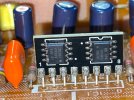
I’ve been having fits with my AU-D11ii phono section. When I originally restored it I did the EW mod with the phono mod. I never really used the phono much at all. A couple years ago I wanted to play vinyl and the one channel (L iirc) would become distorted and finally not play. I bought the new dual single channel pampas and had them installed on the new board and I’ll be damned the same channel slowly distorted and faded out. It’s still in the same state and I suppose I need to dig back into it.
Last edited:

JoseHH
Super Member
Can it be dirty contacts in the selector switch? Other than that, check for the solder joints of the equalizer board or other dry solder joints somewhere in the input board.It’s still in the same state and I suppose I need to dig back into it.
EDIT:
I just noticed that your OPA604 dont look like the Burr-Brown. In parts of this brand that I have seen, the BB is enclossed in a rectangle. Is there any chance they could be remarked/fake parts?. Considering that they will be operating at +/-20V or so, few operational amplifiers can function there, so a remarked part could potentially fail after some time.
Last edited: