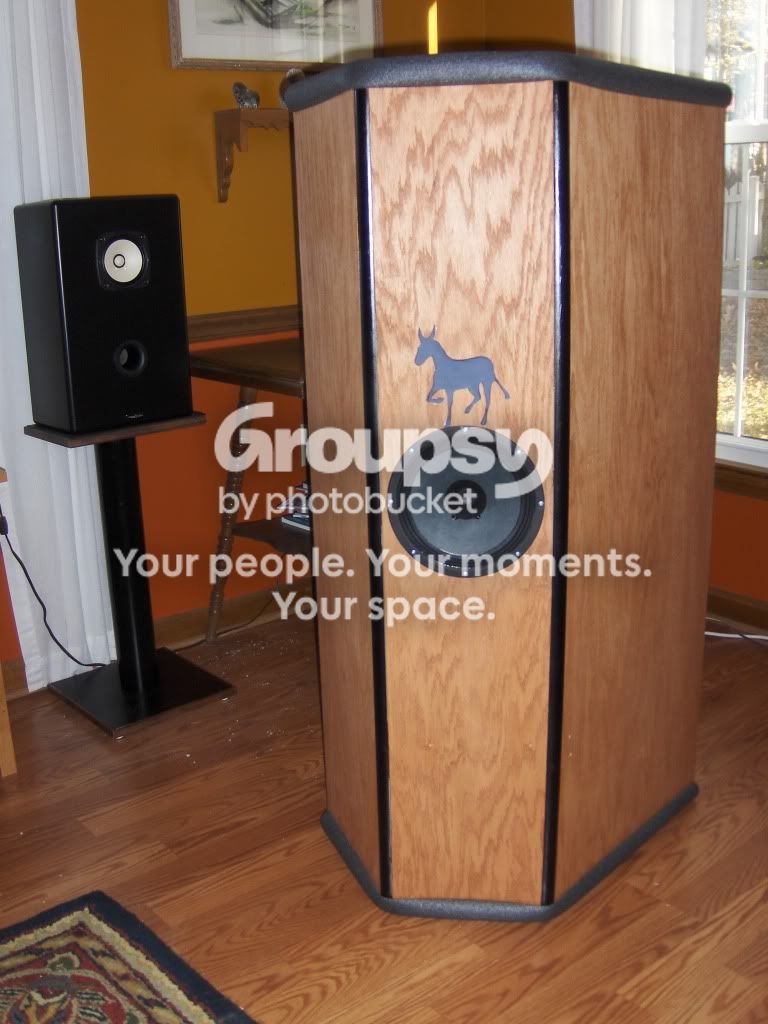
Excellent thread, Poultry; thanks for posting. I had to read it three times, but I think I get the gist. The keys are posts 7, 11, and 13. This confirms my intuition when I started fooling around with open baffles. I heard promise, but felt some need to boost the bass (or cut mids and highs, since I prefer not to use tone controls). Then I read about baffle diffraction loss, and wondered if it would apply equally to open baffles as to box speakers. I guessed it wouldn't be exactly the same, but it would rhyme, so BSC was a good starting point for experimentation. In post 7 of that DIY thread, the poster explains that with a box, you're dealing with the low frequencies disappearing behind the speaker, while in OB you're dealing with destructive interference between the front and back waves. In the first case you get 6db step loss below the baffle frequency, while in the second you get 6db/octave loss.
Yesterday I had that second part (the OB loss) mixed up in my head. I thought a 6db/octave low pass was what I needed. That just meant removing the resistor from my network and running only the coil. It sounded... "bad" would be too harsh, but clearly not right. It was just very dark. Now my mistake is clear to me: I don't need 6db/octave cut above the baffle frequency, I need 6 db/octave boost below the baffle frequency. A cookbook BSC will give me a 6db step at the baffle frequency, which will equalize the frequencies above the step with the first octave below, but the rest of the low end will still be too quiet.
Clearly I need a mini DSP, microphone, and software.
Here's the thing: my speakers sound great. I'm mostly interested in the microphone and software to check how well my tune-by-ear setup matches "ideal" response. I started with a cookbook BSC of 5mH and 6ohms (24" baffles and 6ohm DCR). I tried a few different coils and many resistance values. I came back to the 5mH coil and just kept adding resistance until the speakers weren't shouting at me anymore, but the OB magic was still there. I was at 18ohms for a few months. Then one day I asked myself, "What if I played these for Dad, what would he think?" He'd think the speakers were shouting at him. So now I'm at 20ohms. Since the inductance value is still defined by calculations using baffle width and DCR, I think I have a defensible rationale for my method. Oh yeah, Stephens Trusonic 120FR, no tweeter, no subs, just full-range single-driver magic. I've also tried some modern 8" full-rangers. Since they also happened to measure 6ohms, I kept the network the same and they also sounded good.