• The move to the new server is done. There are some software and database maintenance updates in process. This has us passing the hat around to help out. We appreciate any donations. Seriously, even a dollar helps. The payment page may be found here - https://www.audiokarma.org/support.html

Pairing different wattage speakers

jbebout67

New Member
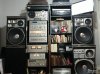
If I have 2 sets of 8 ohm speakers wired in series parallel to keep my 8 ohms , one set is 300 watts 150 Rms and the other pair 400 watts 100 watts Rms and my amp is 500 watts 250 on each side how many watts is each speaker receiving? And how much does the crossovers make a difference? Does it matter? Both sets are pioneer one is CS 903 the other is CS 907
 

Attachments

  • 20190611231812.jpg
    20190611231812.jpg
    109.4 KB · Views: 33
Register to hide this ad
If all 8ohm your amplifier will most likely be fine seeing a 4ohm load, and I believe those Pioneers are fairly sensitive so don't require a ton of power to get really loud. Just checked both are 99db @ 1watt so should sound fairly balanced and not too taxing on the amplifier driving them.

Have fun rocking the house.
 
As far as speaker power ratings go, those are generally just suggestions rather than being set in stone. A speaker rated for 300 watts will not blow up like a Ford Pinto if you run 301 watts worth of signal into it. Typically, speakers are more easily damaged by being underpowered rather than overpowered; a pair of speakers rated for 100 watts may get damaged by a 50 watt amp running into hard clipping, while a pair of speakers rated for 50 watts being fed by a clean signal from an amplifier with peaks hitting 100 watts may come out of it largely unscathed.
-Adam
 
Last edited:
Speaker watt ratings mean very little. I don't even know the watt rating on most of the speakers I own and I don't care. Impedance and efficiency are the more important specs which will determine how well your amplifier tolerates them and how loud each will play. According to the posts above, if they are 8 ohms each, and you are running 2 per channel, that is a 4 ohm load (approx, impedance varies by frequency), and your amplifier should easily be able to tolerate that. If, after playing them together for while, your amplifier is noticeably hotter than normal, then it's probably not a good idea to use 4 speakers and you should cut back to one per channel. If the efficiency spec is the same on both, and it sounds like they are, they should play even and balanced together. Hook them up and see how it sounds to you.
 
Last edited:
Not sure how you have this wired up but as was already said two 8ohm speakers combinew can only be 4 or 16 not 8. And I agree if it's worked for you so far I guess your amp is OK with it.
 
Most of the time we are listening at only a few watts, except for transients where demand on amplification increases.

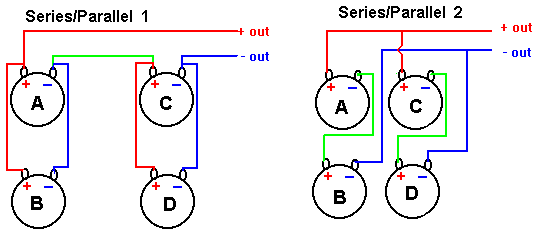
This series/parallel connection needs more explanation.
 
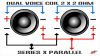
This is for subwoofers but the same applies.


View attachment 1535418

The key point of the picture above is the fact that each of those subwoofers have dual I'll say it again dual I'll say it again dual voice coils.

There are two connections plus and minus for each subwoofer and that results in a total of four connections.

With a total of 4 connections plus and minus for each voice coil it is possible to have a series parallel connection scheme that will result in 8 ohms impedance or whatever the intrinsic impedance of each driver is if they are all the same.


If he is running one of each model of speakers on the Left Channel and the right channel the result is he only has two connections plus and minus for the left channel and two connections plus and minus for the right channel there cannot be both series and parallel connections with that setup.
 
Competent car audio guys understand how a series/parallel wiring scheme works and yes, the load as described is 8 ohms.

Sure, if you are wiring dual VC speakers or a set of 4 speakers. But what does wiring for specialized auto speakers have to do with anything here?

sp-s-p.gif

http://www.regiscoyne.com/tech/spk_cab_wiring/

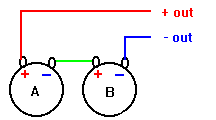
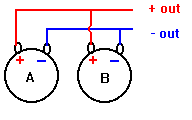
In OP's case, he has two sets Pioneer home speakers at 8 ohms each. They can only be wired in series or in parallel because each of the two speakers for each channel has only one amp connection. Those connections can only be wired in series or parallel as shown below.

sp-ser.gif
sp-par.gif


Wiring in series will result in a 16 ohm load for the amp. Many consider the SQ from such a connection to be less than ideal.

Wiring in parallel with result in a 4 ohm load. Many amps can handle such loads, but there are also many amps that do not provide optimum SQ with 4 ohm loads.
 
^^^^This.

And now to answer the original poster's question about how much power will go to each speaker.

If two speakers of the same impedance are connected in either series or parallel each speaker will receive half of the output power be put out by that channel of the amplifier.

If four speakers of the same impedance are connected in a series parallel Arrangement each individual speaker will receive 1/4 of the total power that particular channel of the amplifier is putting out.

To be clear for those that might bring it up the actual impedance of a speaker varies with the frequency of the music that it is producing.

Not all speakers behave the same way in terms of their impedance of any one given frequency and just to be clear it's possible in a series arrangement or parallel Arrangement or a series and parallel arrangement for one speaker to draw a somewhat more power than another speaker over a certain range of frequencies but that's digging down the rabbit hole pretty deep and is likely not what the original poster is interested in.


Please disregard any weirdness in the grammar and sentence structure of this post's I have to use voice recognition on my smartphone because of my health issues I'm not able to use keyboard and the phone doesn't necessarily print what I say exactly.
 
^^^^This.

And now to answer the original poster's question about how much power will go to each speaker.

If two speakers of the same impedance are connected in either series or parallel each speaker will receive half of the output power be put out by that channel of the amplifier.

If four speakers of the same impedance are connected in a series parallel Arrangement each individual speaker will receive 1/4 of the total power that particular channel of the amplifier is putting out.

To be clear for those that might bring it up the actual impedance of a speaker varies with the frequency of the music that it is producing.

Not all speakers behave the same way in terms of their impedance of any one given frequency and just to be clear it's possible in a series arrangement or parallel Arrangement or a series and parallel arrangement for one speaker to draw a somewhat more power than another speaker over a certain range of frequencies but that's digging down the rabbit hole pretty deep and is likely not what the original poster is interested in.

Please disregard any weirdness in the grammar and sentence structure of this post's I have to use voice recognition on my smartphone because of my health issues I'm not able to use keyboard and the phone doesn't necessarily print what I say exactly.

^^^^ This.

As for the impedance problems I LIKE MUSIC mentioned, that can be a serious issue in some cases. For example, some speakers have a low impedance dip at certain frequencies. If both sets of speakers have similar impedance dips at the same frequency, then a parallel arrangement could expose the amp to a dangerously low impedance at that frequency.

I avoid that problem in my setup by using a single preamp feeding TWO amplifiers, one amp connected to one pair of speakers. That way I ensure each set of speakers is driven to their best potential. Also, my amps have individual gain controls, this way, if I choose to play both sets at the same time or to A/B test the speakers or just want to switch between speakers, they will be volume matched regardless of speaker sensitivity.

 
^^^^ This.

As for the impedance problems I LIKE MUSIC mentioned, that can be a serious issue in some cases. For example, some speakers have a low impedance dip at certain frequencies. If both sets of speakers have similar impedance dips at the same frequency, then a parallel arrangement could expose the amp to a dangerously low impedance at that frequency.

I avoid that problem in my setup by using a single preamp feeding TWO amplifiers, one amp connected to one pair of speakers. That way I ensure each set of speakers is driven to their best potential. Also, my amps have individual gain controls, this way, if I choose to play both sets at the same time or to A/B test the speakers or just want to switch between speakers, they will be volume matched regardless of speaker sensitivity.

And if your pre is set for multiple amps you don't even need Y adapters.
 
It appears he is viewing this thread, maybe he will answer.
Do the Pioneers he is using have DVC woofers?
EDIT---looks like they do?
 
Last edited:
Wow Thank you All! After reading comments and looking at Diagrams I am at 4 ohms. So I switched my amp to 4 ohms. My main concern was wattage because I dont want to damage amp or speakers. I seen how if ohms are same the power is split equally but does the speakers crossover effect that
 
I'm surprised no one here has mentioned the problems with two full range speakers stacked on top of each other and both playing. Some might not mind, but I've know a few who have done this and the effects are detrimental for serious listening.
 
I'm surprised no one here has mentioned the problems with two full range speakers stacked on top of each other and both playing. Some might not mind, but I've know a few who have done this and the effects are detrimental for serious listening.
What do you mean?
 
Back
Top Bottom