• The move to the new server is done. There are some software and database maintenance updates in process. This has us passing the hat around to help out. We appreciate any donations. Seriously, even a dollar helps. The payment page may be found here - https://www.audiokarma.org/support.html

Pairing different wattage speakers

What do you mean?

In speaker design, The distance between the drivers and what frequency range they cover go hand in hand. There is a certain amount of overlap between the woofers and mids, mids and tweets. This is a function of any crossover and the overlap is dependent on the slope (6dB per octave, 12dB, 18dB, etc...). The combined output from the drivers causes interference patterns. The further they are apart the worse the effects of these patterns. This would be in a single enclosure, with just one driver handling a part of the frequency spectrum. Since you have two enclosures per side with both mids and tweets producing the same frequencies and very far apart, there are all sorts of reinforcements and cancellations occurring due to interference patterns.

If you really want to stack them, try turning the top speaker upside down. This will bring the higher frequency drivers closer and the above problems are most pronounced in that range. It's not the ideal situation, but I bet you'll notice an improvement in your system's sound.
 
Wow Thank you All! After reading comments and looking at Diagrams I am at 4 ohms. So I switched my amp to 4 ohms. My main concern was wattage because I dont want to damage amp or speakers. I seen how if ohms are same the power is split equally but does the speakers crossover effect that

Remember that the impedance of your speakers is not a constant 8 Ohms andit's going to vary with frequency.

As the impedance of the speaker changes the amount of power that the speaker will draw from an amplifier putting out a certain amount of voltage will vary.

The crossover Network along with the speaker drivers will play a part in this variation of impedance across the frequency spectrum.

The next step dance to this question I'm not able to do that search and because as I mentioned before I'm limited to this Smartphone is to see if one can find the impedance curve for each of your pairs of speakers.

It will be a graph going from left to right with lower frequencies that left side higher frequencies on the right side and the vertical stale will be impedance and ohms they'll be a line that'll be eight ohms the impedance of your speaker will likely be below that a dome line at some point me it's going to be a little more power than you would expect and it could be somewhat above that meaning at those frequencies it will be some draw somewhat less power than you would expect.

By looking at the impedance graphs of both pairs of your speakers it is possible to mathematically calculate the difference in power draw at different frequencies so you come up with a mathematically somewhat accurate determination of the power split is not going to be exactly half if they're in parallel.
 
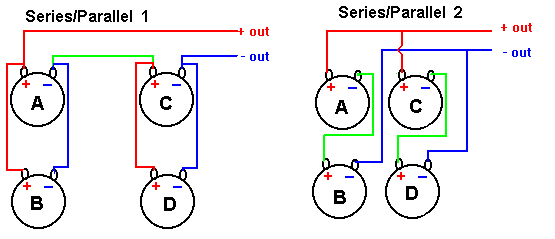
Sure, if you are wiring dual VC speakers or a set of 4 speakers. But what does wiring for specialized auto speakers have to do with anything here?

sp-s-p.gif

http://www.regiscoyne.com/tech/spk_cab_wiring/

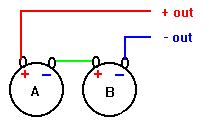
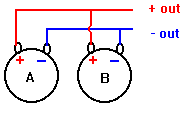
In OP's case, he has two sets Pioneer home speakers at 8 ohms each. They can only be wired in series or in parallel because each of the two speakers for each channel has only one amp connection. Those connections can only be wired in series or parallel as shown below.

sp-ser.gif
sp-par.gif


Wiring in series will result in a 16 ohm load for the amp. Many consider the SQ from such a connection to be less than ideal.

Wiring in parallel with result in a 4 ohm load. Many amps can handle such loads, but there are also many amps that do not provide optimum SQ with 4 ohm loads.
:oops: I didn't say I was a competent car audio guy (or any other subject) myself. :confused: Well it had to happen eventually that I would be mistaken about something. :dunno:
 
Back
Top Bottom