cecilk
Active Member
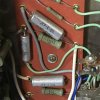
I'm working on a cool old tube guitar amp from the 50's that uses paper in oil caps (silver ones labeled "JCP-C-Oil" and yellow ones labeled "NCC").
(The circuit is similar to a Vibro Champ manufactured in Japan for the "Noble" brand)
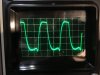
The amp exhibits gnarly signal distortion when I run a clean sine wave through it - here is the signal at output on volume ~1 and tone at noon:
My initial thought was that this could be due to DC voltage leakage through the PIO coupling caps.
I tested one 0.05 μf PIO cap out of circuit and it measured dead on at 0.04975 μf at 0.3% Vloss.
However, I also measured it with an old RC tester and measured 9.8 μA of leakage at 400v (its stated rating). From what I've read, leakage on coupling caps is never good and any measurable leakage is grounds for replacement.
There are about 14-15 of these PIO caps in the circuit. I was planning to replace them all with orange drops - but owner's musician friends got him concerned that he will "lose the vintage tone" if he does.
What is your rule of thumb with PIO caps? How much leakage is too much?
(The circuit is similar to a Vibro Champ manufactured in Japan for the "Noble" brand)
The amp exhibits gnarly signal distortion when I run a clean sine wave through it - here is the signal at output on volume ~1 and tone at noon:
My initial thought was that this could be due to DC voltage leakage through the PIO coupling caps.
I tested one 0.05 μf PIO cap out of circuit and it measured dead on at 0.04975 μf at 0.3% Vloss.
However, I also measured it with an old RC tester and measured 9.8 μA of leakage at 400v (its stated rating). From what I've read, leakage on coupling caps is never good and any measurable leakage is grounds for replacement.
There are about 14-15 of these PIO caps in the circuit. I was planning to replace them all with orange drops - but owner's musician friends got him concerned that he will "lose the vintage tone" if he does.
What is your rule of thumb with PIO caps? How much leakage is too much?