• The move to the new server is done. There are some software and database maintenance updates in process. This has us passing the hat around to help out. We appreciate any donations. Seriously, even a dollar helps. The payment page may be found here - https://www.audiokarma.org/support.html

Phillips 312 Left Channel Out - What to Try Next?

J English

Super Member
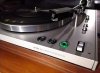
Hey, AK vinyl lovers - wanted to ask for your help in diagnosing a Phillips 312 TT in good condition, but with the L channel out (hum only).

I bought this table last week from one of my local record stores for the princely sum of $20 with the channel issue known and no cartridge. They had done a little pre-work and thought it was just a bad RCA cable, but were not completely sure. It ran fine and even had good bulbs on the touch controls, so I thought it was definitely worth the risk. The RCA jacks were pretty corroded so I planned on replacing both of those anyway, they were the worst cosmetics on the unit, otherwise it was very clean.

A week on, I'm stumped. I added a known good Ortofon cartridge and with my multimeter tested continuity is good for all 4 leads (L pos, L ground, R pos, R ground) in the following places:
1. Cartridge pins to headshell slide pins
2. Headshell slide pins to fixed headshell leaf springs
3. Headshell leaf springs to fixed solder points at back of headshell
4. Fixed solder points back of headshell to solder points/pins in undercarriage
5. Pins in undercarriage to slide connectors at RCA cable end
6. RCA slide connectors to RCA jacks
7. Also, black ground wire connects properly to ground pin in undercarriage, thence to the ground wire coming out of the unit.

I fully replaced the RCA cable as I had no new solderable jacks yet (those are coming) so used a known good low capacitance cable, cut off one set of jacks, and soldered on new slide connectors to mate with the undercarriage pins.

Same result as when I started - R channel good and strong, L channel hum only. I tested on different preamps and get the same result.

Any advice on what to try next? Logically, I can't see where I've missed a link in the signal chain.
 
Register to hide this ad
Looks like you covered this, but I'll throw it out there anyway. Sometimes the adhesive holding the top cover on the headshell loosening. The result is that there is poor contact between the slide and the tonearm.
 
From the headshell slide to the solder points inside should make contact. If the whole run makes contact it's not broken. But none of them should make contact either. If the cable got pinched and the + and - of 1 channel make contact you won't get any signal on that one.

I've been looking at that headshell and it is just feeble plastic, with several joints in the signal wire. But still, it works OK. If the wire is damaged it shouldn't be that hard to rewire. If you look on ebay a rewire set is not expensive. I got a set for €10 or less. With clips a bit more.

Before pulling out the old you need to attach the ends of old and new firmly together so you can pull in the new while you pull out the old. Attach clips and done. I would prefer a single run from plugs all the way to the clips. That will avoid those slide contacts and avoid problems and improve sound. You can't switch carts with the slide anymore but you only got 1 anyway I presume.

I tried to avoid soldering new plugs on an old cable and used a new cable and cut off 1 end. And got greeted by a terrible hum. So don't just use any old cable.
 
Last edited:
From the headshell slide to the solder points inside should make contact. If the whole run makes contact it's not broken. But none of them should make contact either. If the cable got pinched and the + and - of 1 channel make contact you won't get any signal on that one.

I've been looking at that headshell and it is just feeble plastic, with several joints in the signal wire. But still, it works OK. If the wire is damaged it shouldn't be that hard to rewire. If you look on ebay a rewire set is not expensive. I got a set for €10 or less. With clips a bit more.

Before pulling out the old you need to attach the ends of old and new firmly together so you can pull in the new while you pull out the old. Attach clips and done. I would prefer a single run from plugs all the way to the clips. That will avoid those slide contacts and avoid problems and improve sound. You can't switch carts with the slide anymore but you only got 1 anyway I presume.

I tried to avoid soldering new plugs on an old cable and used a new cable and cut off 1 end. And got greeted by a terrible hum. So don't just use any old cable.

Hmmm. I think I follow this. I'd rather avoid the rewiring if I can, as that looks pretty delicate with the flimsy headshell. I'm going to look for any visible crimping of the white and yellow wires inside the chassis. I've verified there is no cross-wiring (no continuity) between the + and - pins, or between the + and - slide leads for that channel.

I've also got solderable RCAs now, so will try to reconnect the old cable and see if that changes anything.

Symptoms do seem consistent with this, as I get no sound and just a faint hum on the L channel. So if there is any point of contact between the + and - anywhere in the signal chain, that would cause this, right?

Frustrating! Such small wires. Such a flimsy headshell. A tough surgery candidate.
 
Last edited:
Im fortunate to have a Dutch Philips fan forum to fall back too. I've got two 212's now and both are better than I expected. It's well worth to fix it.

PSX_20190714_042425.jpg

PSX_20190310_193650.jpg
 
Last edited:
Boy, alas, no progress. I have now looked over all of the places the headshell wires are visible, and I a) get continuity on all 4 leads, from headshell to RCA ends, and b) see no wire breaks or cladding breaks where the white and yellow wires could be touching and cancelling signal. I have very carefully used a microtip to check the wires at the back of the headshell to make sure no touching or cladding breaks there (seemed a possible point, since all of the wires are smooshed when you push in the headshell slide). And, I undid the crimp point at the bottom of the arm where the wires cross and checked to make sure nothing was frayed inside the little grey hose. The only, and I mean only, not perfect thing I see is a slight wire exposure from the cladding right at the point the white + wire is soldered to the interior connection pin, that the RCA slides mate with. But there is no other wire around it and the wire looks unbroken, just a slight cladding loss there. I may have to take this one in to our local TT specialists and see what they would charge for a diagnostic. I'm truly and deeply stumped. I've run out of logical things to test...
 
Have you checked the headshell leads from where they contact the cartridge pins? Or from the arm contact point without the headshell in place. It could be a bad headshell with intermittent wire contacts.

If that's not it, I would just replace the two RCA plugs with new ones. They could be intermittent as well.
 
IIRC the wires on the cartridge carriers on these Philips decks are crimped to the wires and some examples use IDC type terminals that pierce the insulation to make contact with the wires.
On my GA312 one of those was intermittant. A gentle squeeze with pliers cured it.
I've had O/C connections in more than one Ortofon mm cartridge.
 
Don't know the turntable but something you can try:

At the clips that normally attach to the back of the cartridge, with the headshell/slide in place, test continuity of each of the 4 leads to the metal of the tonearm. There might be a short or path in that direction. Beyond that, I got nothing.

Good Luck.
 
IIRC the wires on the cartridge carriers on these Philips decks are crimped to the wires and some examples use IDC type terminals that pierce the insulation to make contact with the wires.
On my GA312 one of those was intermittant. A gentle squeeze with pliers cured it.
I've had O/C connections in more than one Ortofon mm cartridge.
What are O/C connections, Gary? I don't know that acronym.
 
IIRC the wires on the cartridge carriers on these Philips decks are crimped to the wires and some examples use IDC type terminals that pierce the insulation to make contact with the wires.
On my GA312 one of those was intermittant. A gentle squeeze with pliers cured it.
I've had O/C connections in more than one Ortofon mm cartridge.

Yeah, they are that type, because I can see at the very end of the wire, there's no soldering. The wire just ends. Yet I get continuity. So it must be a prick-pin type of connection. I will try giving the L channel ones a little extra pressure and see if that does anything...thanks for the thought.
 
At the clips that normally attach to the back of the cartridge, with the headshell/slide in place, test continuity of each of the 4 leads to the metal of the tonearm. There might be a short or path in that direction. Beyond that, I got nothing.

This is a good idea. I guess that would reveal if there is any internal shorting for the wires within the arm itself. I've been thinking that's unlikely, but at least it's easy to test with the meter.
 
SUCCESS, I am pleased to report. Thanks for all of the suggestions. Glorious (well, adequate) two-channel stereo this morning, piped into my NAD 1020 and listening on headphones. Not sure whether it was the small squeeze on the cartridge slide connectors for the L channel, or the replacement cartridge (I swapped in a pretty new Ortofon Omega that I had in the parts box). I did test the arm for a connection and got nothing on all 4 leads, so guess no short inside the arm.

I am going to test that other Ortofon cartridge tonight on another table and see if I get both channels. I suppose it's possible that the original problem with the table was the old RCA cable, and then I successfully replaced that, but then put in a bad cartridge. Unlikely, I think, since the L channel was implicated pre and post - but never say never, I guess.
 
I’d be inclined to suspect that recrimping it did the trick, but you could always put the Ortofon back in and see if the problem comes back.
 
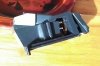
I tried other cartridges but my original slide only fits the original Philips G400 cartridge well (because of the height of the bolt support where it's clamped) so they insert so that the pins touch the slide contacts in the back. Not really versatile.

IMG_20190725_190125.jpg
Nothing better than a photo to explain. I slid it slightly forward so you can see it better
 
Last edited:
Back
Top Bottom