• The move to the new server is done. There are some software and database maintenance updates in process. This has us passing the hat around to help out. We appreciate any donations. Seriously, even a dollar helps. The payment page may be found here - https://www.audiokarma.org/support.html

phono stage - huge input capacitance (?)

mschool

Active Member
On the advice of a friend, I purchased an Onkyo A-9010 Integrated Amp because it was highly reviewed and had an internal PHONO preamp. In searching for an upgrade cartridge for my TT, I was advised to learn the capacitance of the preamp on the Onkyo. Onkyo Japan would only reply back to me with: “As for the capacity of the built-in phono equalizer, as described in the URL above, Only “94 mV (1kHz 0.5%)” is available. I could only find one board where posters looked at the service manual and discovered on their own that has high input capacitance (1000pF). One person on another board indicated that this is a huge design flaw, if true. It’s now been recommended that I purchase a standalone phono pre-amp. I don’t know what to do; ditch the Onkyo, do nothing, or buy a phono preamp. This is maddening.

https://www.avforums.com/threads/a-9010-phono-stage-huge-input-capacitance.2125416/
 
Register to hide this ad
With 1000pF plus cable capacitance, the sound is likely to be very rolled-off, i.e. dull. How does it actually sound to you?

It could be an error with an extra '0', as 100pF would be a reasonable value :)

If it is true, a separate phono pre-amp would be the way to go.
 
I won't be surprised if it's 100pF instead of 1000pF.

Stop worrying! Have you noticed anything fishy with the sound before reading that panicky post???

FWIW: You could always desolder those two caps out and put in whatever you want instead.

You can even eliminate them altogether and settle for the cable's capacitance. That's a couple of dollars worth of a fix.

No need for another external phono-stage.

EDIT: I snuck a peek at some other similar Onkyo model service manual (e.g. A-9050) schematics and this 1000pF
capacitance loading value seems to be consistent with their phono stage design for this line. It's an unusual choice, but like I said earlier,
it's not terminal and easily modifiable, if found disrupting.
 
Last edited:
With 1000pF plus cable capacitance, the sound is likely to be very rolled-off, i.e. dull. How does it actually sound to you?

It could be an error with an extra '0', as 100pF would be a reasonable value :)

If it is true, a separate phono pre-amp would be the way to go.

It sounds very good. I am listening through headphones only, and I find myself toggling between direct, loudness, and loudness turned off. I have been enjoying well produced albums like Bonnie Raitt's "Give It Up", Pete Sinfield's "Still", Pink Floyd's "Atom Heart Mother", and Carole King's "Tapestry". All sound rich and clear with nuances I have never heard before. But this all comes down to "you don't know what you don't know", and from what I have read, sonics can improve, but I have a 62 year old man's ears. But it is not dull. The only album that cuts out on the left or right side during specific moments is Blind Faith, which was my impetus in looking to upgrade the needle in the first place. I mean, honestly, should I pursue speakers first and then the cartridge, or vice versa? And again, thank you everyone taking the time to research this. I'll likely lift the cover tomorrow and look at the capacitors and report back.
 
I won't be surprised if it's 100pF instead of 1000pF.

Stop worrying! Have you noticed anything fishy with the sound before reading that panicky post???

FWIW: You could always desolder those two caps out and put in whatever you want instead.

You can even eliminate them altogether and settle for the cable's capacitance. That's a couple of dollars worth of a fix.

No need for another external phono-stage.

EDIT: I snuck a peek at some other similar Onkyo model service manual (e.g. A-9050) schematics and this 1000pF
capacitance loading value seems to be consistent with their phono stage design for this line. It's an unusual choice, but like I said earlier,
it's not terminal and easily modifiable, if found disrupting.
No, I didn't notice anything fishy with my set-up, but then again, I was focused on learning about MM versus MC and I had been eliminating MC from my search. Now it appears I don't have to do that. I was saving my soldering iron for exploring an eventual upgrade capacitor fix on the TT, when it eventually needs it. I built Heathkits as a kid, so I know I have the skills.
 
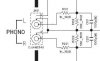
Onkyo A-9010 phono input.jpg

Here's the relevant section of the circuit - as you can see, it shows 1000pF (C101 and C201) in parallel with 56 kilohms (R102, R202). The 56kΩ is pretty standard (it should nominally be 47kΩ, but it's close enough that there'll be no audible difference), but the 1000pF is way too high. That sort of figure sometimes gets used on those for sale in Europe, but there weren't any alternative values shown, so they've obviously decided that due to European laws on EMI they'll penalise everyone around the world, rather than have a different circuit exclusively for Europeans.

Somewhere between 47pF and 270pF would be more appropriate for most cartridges, with around 100pF a good compromise value (if there's not a switchable choice) for most modern cartridges, which usually need around 250pF (add typically 70-150pF for the turntable leads).

It's fitting that in the specifications, they didn't give one for the RIAA tracking, which I'll bet is lousy at the top end! They probably don't want anyone to know that, so they left it out.

By the way, R101 and R201 are used in conjunction with the input load capacitors and resistors to provide RF filtering, so don't remove them, or you might start picking up radio stations (or nearby radio amateurs)!
 
Last edited:
View attachment 1652867

Here's the relevant section of the circuit - as you can see, it shows 1000pF (C101 and C201) in parallel with 56 kilohms (R102, R202). The 56kΩ is pretty standard (it should nominally be 47kΩ, but it's close enough that there'll be no audible difference), but the 1000pF is way too high. That sort of figure sometimes gets used on those for sale in Europe, but there weren't any alternative values shown, so they've obviously decided that due to European laws on EMI they'll penalise everyone around the world, rather than have a different circuit exclusively for Europeans.

Somewhere between 47pF and 270pF would be more appropriate for most cartridges, with around 100pF a good compromise value (if there's not a switchable choice) for most modern cartridges, which usually need around 250pF (add typically 70-150pF for the turntable leads).

It's fitting that in the specifications, they didn't give one for the RIAA tracking, which I'll bet is lousy at the top end! They probably don't want anyone to know that, so they left it out.

By the way, R101 and R201 are used in conjunction with the input load capacitors and resistors to provide RF filtering, so don't remove them, or you might start picking up radio stations (or nearby radio amateurs)!
Well that makes sense because the claim to fame for this amp was that it was designed in Europe and not in Japan. That was the differentiator when it was released. I appreciate your research but I’m a layperson; what types of cartridge should I be looking for?
 
Most MM or MI cartridges will be OK – the better ones have either elliptical or (extended) line contact styli, but they cost more. They may also have higher quality, lighter cantilevers, including tapered and/or telescopic aluminium tube, boron, sapphire or ruby.

Line contact styli include names like ‘Line Contact’, Fine Line, Shibata, Hyperelliptical, or somewhat better, van den Hul, Fritz Gyger, Replicant, MicroRidge or Microline. The line contacts have longer and thinner contact patches with the vinyl record, so they read high frequencies better (lower distortion), and because of the increased contact patch length (up the groove walls) they provide reduced record and stylus wear, and can also often contact unworn bits of records above or below areas worn by styli with shorter contact patches (conical or elliptical styli).

Typically, some current MM or MI cartridge manufacturers, and their recommended loads, include:

Ortofon 2M-series: 150-300pF
Audio-Technica (all MM models): 100-200pF
Goldring (E-series, 2x00-series): 100-200pF
Goldring (10xx-series): 150-200pF
Nagaoka (all models): recommended capacitance not specified
 
Most MM or MI cartridges will be OK – the better ones have either elliptical or (extended) line contact styli, but they cost more. They may also have higher quality, lighter cantilevers, including tapered and/or telescopic aluminium tube, boron, sapphire or ruby.

Line contact styli include names like ‘Line Contact’, Fine Line, Shibata, Hyperelliptical, or somewhat better, van den Hul, Fritz Gyger, Replicant, MicroRidge or Microline. The line contacts have longer and thinner contact patches with the vinyl record, so they read high frequencies better (lower distortion), and because of the increased contact patch length (up the groove walls) they provide reduced record and stylus wear, and can also often contact unworn bits of records above or below areas worn by styli with shorter contact patches (conical or elliptical styli).

Typically, some current MM or MI cartridge manufacturers, and their recommended loads, include:

Ortofon 2M-series: 150-300pF
Audio-Technica (all MM models): 100-200pF
Goldring (E-series, 2x00-series): 100-200pF
Goldring (10xx-series): 150-200pF
Nagaoka (all models): recommended capacitance not specified
Thank you! This is clear guidance and very helpful !
 
Thank you! This is clear guidance and very helpful !
Let me ask you one last question; in researching my TT, the Denon DP-47F, based on the tone arm and user experience, the Denon DL-110 MC was highly recommended. The remainder were MM cartridges being the, Audio Technica AT120eb, NAGAOKA MM (MP) Cartridge MP-110, Audio Technica At440MLb, and Shure m97xe. Based on what you know about the internal preamp on my device, would you recommend eliminating any of these as considerations?
 
Well, the Denon DL-110 will work with any capacitance, due to its very low inductance, but most of the others don't like high capacitance. I'm unsure about the Nagaoka, because of the fact that they don't recommend a capacitance, but I'd guess that it probably doesn't need anything more than 400pF. I have seen some specification sheets for some old Nagaoka cartridges which showed 100pF as being the ideal load, but I don't know if the latest ones are similar, due to the fact they don't specify a value. I also found an old Hi-fi News review of a previous model (MP-11), which recommended 100pF or less as being best.

However, if you're prepared to change those two input capacitors, then most of the other cartridges should work well. For the AT cartridges, I'd recommend less than 100pF (and possibly the Nagaoka, if it requires 100pF total load), while 100pF should be OK for most others, including the Shure, although bear in mind that the Shure is no longer being manufactured. You can always add more capacitance in parallel if necessary, but it's impossible to reduce it, without changing the input capacitors.
 
Last edited:
If you are experienced with soldering and confident in your work, maybe consider fixing that amp. Very bad design to make the capacitance that high IMHO. My guess is they heard vinyl was trendy now so threw in a phono preamp as an afterthought and didn't bother to consider it would incompatible with most high output cartridges. Unfortunately this kind of thing happens today.

If you don't want to take your soldering iron to the Onkyo, you can buy an ART DJ Pre for $50. It's good enough to get you started and will let you at least load your cartridge(s) properly.

Let me ask you one last question; in researching my TT, the Denon DP-47F, based on the tone arm and user experience, the Denon DL-110 MC was highly recommended. The remainder were MM cartridges being the, Audio Technica AT120eb, NAGAOKA MM (MP) Cartridge MP-110, Audio Technica At440MLb, and Shure m97xe. Based on what you know about the internal preamp on my device, would you recommend eliminating any of these as considerations?

The 120E was replaced with the VM530EN, the 440 was replaced with the VM540ML, and Shure is out of the cartridge business now. You may still find these old models at certain retailers but I don't really see the point, especially if you have to pay above retail for them.

In any case, I agree with @ETI_5000 that the DL-110 is the only one that "might" work okay with the ridiculously high input capacitance of input capacitance of the Onkyo in-built phono preamp. FWIW I don't really care for the sound of this cartridge, but it does have its fans.
 
Last edited:
Well, with 1000 pF at least you shouldn't have an RF pickup problem! Does seem very high. If you remove it, be careful that the phono stage doesn't oscillate or have some other problem. Almost any mod can have unanticipated consequences.
 
It sounds very good. I am listening through headphones only, and I find myself toggling between direct, loudness, and loudness turned off. I have been enjoying well produced albums like Bonnie Raitt's "Give It Up", Pete Sinfield's "Still", Pink Floyd's "Atom Heart Mother", and Carole King's "Tapestry". All sound rich and clear with nuances I have never heard before. But this all comes down to "you don't know what you don't know", and from what I have read, sonics can improve, but I have a 62 year old man's ears. But it is not dull. The only album that cuts out on the left or right side during specific moments is Blind Faith, which was my impetus in looking to upgrade the needle in the first place. I mean, honestly, should I pursue speakers first and then the cartridge, or vice versa? And again, thank you everyone taking the time to research this. I'll likely lift the cover tomorrow and look at the capacitors and report back.
I find it hard to believe that you're getting a clear and nuanced sound with a capacitive load that high. There's something strange here. Anyway, I would suggest a cartridge upgrade before a speaker upgrade in that improving a source component should always yield sonic benefits while improving the speakers may actually show up deficiencies in the existing cartridge. And if you're going for a separate phono pre-amp, I agree that the ART DJPre II is a good starting point for a small outlay - it has selectable capacitance between 100pF and 200pF.
 
The low source impedance of most low output MC carts should not allow 1000pF worth of capacitance to have much effect on the HF response of the cart.
 
View attachment 1652867

Here's the relevant section of the circuit - as you can see, it shows 1000pF (C101 and C201) in parallel with 56 kilohms (R102, R202). The 56kΩ is pretty standard (it should nominally be 47kΩ, but it's close enough that there'll be no audible difference), but the 1000pF is way too high. That sort of figure sometimes gets used on those for sale in Europe, but there weren't any alternative values shown, so they've obviously decided that due to European laws on EMI they'll penalise everyone around the world, rather than have a different circuit exclusively for Europeans.

Somewhere between 47pF and 270pF would be more appropriate for most cartridges, with around 100pF a good compromise value (if there's not a switchable choice) for most modern cartridges, which usually need around 250pF (add typically 70-150pF for the turntable leads).

It's fitting that in the specifications, they didn't give one for the RIAA tracking, which I'll bet is lousy at the top end! They probably don't want anyone to know that, so they left it out.

By the way, R101 and R201 are used in conjunction with the input load capacitors and resistors to provide RF filtering, so don't remove them, or you might start picking up radio stations (or nearby radio amateurs)!
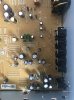
IMG_0256.jpeg IMG_0261.jpeg
 
I focused on the lower right of the CB image, right behind the PHONO inputs. As someone suggested pictures would help...
 
I find it hard to believe that you're getting a clear and nuanced sound with a capacitive load that high. There's something strange here. Anyway, I would suggest a cartridge upgrade before a speaker upgrade in that improving a source component should always yield sonic benefits while improving the speakers may actually show up deficiencies in the existing cartridge. And if you're going for a separate phono pre-amp, I agree that the ART DJPre II is a good starting point for a small outlay - it has selectable capacitance between 100pF and 200pF.
I'm not sure if ART DJPre II is sold in Japan. I lobbed a query into the company. So, my choice of action is as follows: bypass the PHONO Preamp with a 3rd party preamp, and I have my choice of most any cartridge and then buy speakers. OR purchase a Denon DL-110 and try it out with the existing onboard preamp. If I get a demonstrable sound improvement, go on to speakers. If I want to try out other cartridges, get 3rd party preamp.
 
Well, the Denon DL-110 will work with any capacitance, due to its very low inductance, but most of the others don't like high capacitance. I'm unsure about the Nagaoka, because of the fact that they don't recommend a capacitance, but I'd guess that it probably doesn't need anything more than 400pF. I have seen some specification sheets for some old Nagaoka cartridges which showed 100pF as being the ideal load, but I don't know if the latest ones are similar, due to the fact they don't specify a value. I also found an old Hi-fi News review of a previous model (MP-11), which recommended 100pF or less as being best.

However, if you're prepared to change those two input capacitors, then most of the other cartridges should work well. For the AT cartridges, I'd recommend less than 100pF (and possibly the Nagaoka, if it requires 100pF total load), while 100pF should be OK for most others, including the Shure, although bear in mind that the Shure is no longer being manufactured. You can always add more capacitance in parallel if necessary, but it's impossible to reduce it, without changing the input capacitors.
I'm not prepared to change the two input capacitors. I'd sell the unit first or go with the 3rd party preamp
 
Back
Top Bottom