

You are using an out of date browser. It may not display this or other websites correctly.
You should upgrade or use an alternative browser.
You should upgrade or use an alternative browser.
Pickering brush conundrum?
- Thread starter Chuck awker
- Start date
Chuck awker
Active Member
You would think,I would recalibrate whichever way I goI still think there may be some upward force on the arm when the bristles are on the record surface.

Doug G.
Lunatic Member
To further illustrate, say the arm is lowering and it has a certain weight as it approaches the record surface. That's a given. Now, the brush bristles hit the record surface first. The bristles are going to take a certain mount of force to "bend" them as the arm lowers the rest of the way, thus taking some of the effective weight off the arm and so, off the stylus.
Doug
Doug
Chuck awker
Active Member
I get that so leaving it off until I hear something,or not hear something.To further illustrate, say the arm is lowering and it has a certain weight as it approaches the record surface. That's a given. Now, the brush bristles hit the record surface first. The bristles are going to take a certain mount of force to "bend" them as the arm lowers the rest of the way, thus taking some of the effective weight off the arm and so, off the stylus.
Doug

Coolhandjjl
Embiggened Pompatus
Brush in the back? I gotta see that.I have 2 Pickering stylus with the brush and one has the bristles opposite the other one. Short bristles in the front compared to short ones in the back. The brushes took cool but I take them off. The stylus w/o brush are $3 more for some reason.

AudioFeline
Super Member
I often used both Stanton and Pickering cartridges with the brushes removed, particularly after learning about Linn in the mid 1980's. Linn said, "Most record cleaning devices do more harm than good. The dust that inevitably collects on records is not harmful: it's on the surface, not in the grooves containing the signal. Attempts to remove the dust usually force the dust down into the grooves, where it does damage. The best method of cleaning records is to let the stylus remove the dust then clean it."
A stylus can't force dust lying on the surface of the record down into the grooves because the stylus's point of contact with the record is below the surface. A brush attempts to pick up dust from the surface as well as from in the grooves and, according to Linn, usually ends up pushing at least some dust that was lying harmlessly on the record surface down into the grooves where it can be impacted by the stylus as it plays. A stylus "cleans" the record in the sense that some of the dust on the record surface will cling to the stylus shank during play. For many years the only record cleaning I did was to give the stylus a couple of swipes with a dry brush or Linn's green sandpaper after each side of play.
Once used records became a significant part of how I obtained new music, I followed my Linn dealer's advice to get a Nitty Gritty record cleaner, which he had found to be safe and effective.
I agree and disagree with this.
First, the agreement - brushes that track the grooves are not a good way to clean a record. The concept of dirt being dragged through the entire record groove does not sit well with me, which is why I hate "Dust Bugs" and similar devices with a passion.
However, my disagreement lies in my understanding that despite it's appearance, I have heard that the Stanton/Pickering cart brushes aren't to clean the record. They are a part of the cart's design, to assist with tracking (particularly with warped records). I have heard that the sound better with the brush.
I agree and disagree with this.
First, the agreement - brushes that track the grooves are not a good way to clean a record. The concept of dirt being dragged through the entire record groove does not sit well with me, which is why I hate "Dust Bugs" and similar devices with a passion.
However, my disagreement lies in my understanding that despite it's appearance, I have heard that the Stanton/Pickering cart brushes aren't to clean the record. They are a part of the cart's design, to assist with tracking (particularly with warped records). I have heard that the sound better with the brush.
Vwestlife posted this in a past thread. Cleaning and resonance damping were both claimed advantages for the brush.
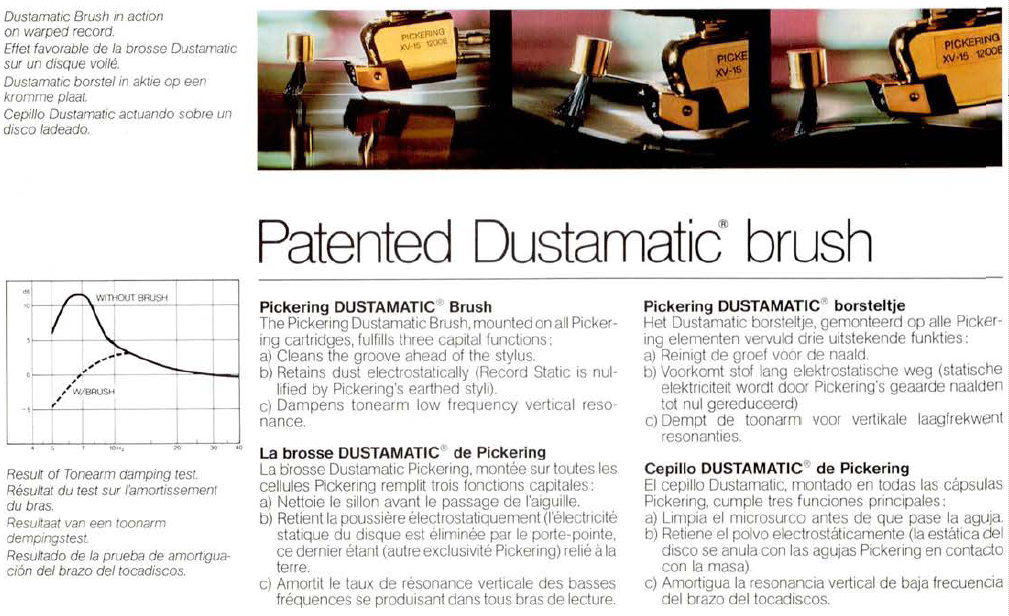

While I am no expert, my experience is that the brush is self supporting on the record, but obviously not in free air, so if you balance the arm and then increase the tracking force by a gram, you have set it up correctly. I also believe that the the brushes increase skating force, so I increase it a gram.
It seems obvious to me that having a brush that is held onto the stylus assembly by pressure will couple the masses slightly, and that this will help to damp the cartridge/arm resonance.
I don't see the brush as a cleaning device, I see it as a damping tool.
It seems obvious to me that having a brush that is held onto the stylus assembly by pressure will couple the masses slightly, and that this will help to damp the cartridge/arm resonance.
I don't see the brush as a cleaning device, I see it as a damping tool.
The bristles were backwards, brush in the front. It is a pickering not generic.Brush in the back? I gotta see that.