• The move to the new server is done. There are some software and database maintenance updates in process. This has us passing the hat around to help out. We appreciate any donations. Seriously, even a dollar helps. The payment page may be found here - https://www.audiokarma.org/support.html

Pickering V-15 brush does not clear the headshell

Couple items - the recommended tracking force for the cartridge should be adjusted down one gram if you use the cartridge without the brush. That's in the small print of the manual.

Also, your overhang adjusted to spec? Moving the cartridge forward in the shell would certainly allow improved clearance on the brush.

And ... an OEM brush has drain wires in it to dissipate static - an aftermarket brush, not so much.

I did that. It is mentioned in the picture without the brush.

Yes, overhang is adjusted to spec. The Elac Miracord 50H II has a stylus position gauge built in. The stylus is lined up in the head shell correctly based on that gauge.

This is an OEM brush. It is a NOS Pickering stylus.

Thanks for the reminders. It is appreciated.
 
It will make a difference and this is proven it is why we have oil damping in arms which does similar, but the brush does it better. This is not an arguable point it is proven the brush helps the stylus track the groove, this was worked out decades ago, the only reason more companies did not use it was copyright, but Shure managed to do something similar spring loaded maybe that is how they got round it.
Chris

I've been using this and other Stanton/Pickering styi for 40+ years on all kinds of tables and have never noticed a difference, other then perhaps some static residue that the brush would leave/remit on certain recordings. If there is better tracking it probably owes as much to the increased tracking force that is used when using the brush as the brush itself. Some people are so afraid of pushing tracking force to the higher limits of the manufacturers recommendation for fear of record damage when of course the only concern should be damage caused by mistracking caused by too little tracking force. The brush forces them to nudge up.

But again I would suggest that people experiment and let their ears help with the decision.
 
And ... an OEM brush has drain wires in it to dissipate static - an aftermarket brush, not so much.
Actually that's wrong. A Pickering or Stanton OEM stylus has a tie wire that grounds the stylus and acts like a drain wire that helps dissipate static while most aftermarket styli don't. The Dustamatic/Longhair brush actually relies on the static electricity the nylon bristles produces to help attract surface dust and debris into the brush fibers. (At least that was how they described how the brush worked.)

It was Shure's Dynamic Stabilizer that had the conductive carbon fibers in the bush that helped drain off static.
 
It will make a difference and this is proven it is why we have oil damping in arms which does similar, but the brush does it better. This is not an arguable point it is proven the brush helps the stylus track the groove, this was worked out decades ago, the only reason more companies did not use it was copyright, but Shure managed to do something similar spring loaded maybe that is how they got round it.
Chris
Pickering started touting that the brush acted as a damper only after Shure came out with it's dynamic stabilizer. Before that it was never mentioned as a feature.

And the reason why is because it DOESN'T add any appreciable damping. I've tested this in many arms with numerous Pickering/Stanton carts with OEM styli with their respective brushes. Unlike the Shure system where you can see (and hear!) the effects with and without the stabilizer using the resonance test bands on the V15 test disc(s) and similar unambiguously, the Pickering/Stanton shows little to no difference. When the arm/cart combo hits that sweet spot, the arm jiggles like mad, brush or no. It also does not help with warped records the way the Shure system does, IME.

How can it damp? The brush is on a hinge that has no damping compound like Shure. It's designed for the least amount of friction possible, negating any serious damping properties the brush could have.

It was designed as a way to help keep records clean, no other reason. And that's okay! I love them and use them all the time.
 
Last edited:
I always take the brushes off my Stantons and Pickerings. I never trusted the add one gram to the VTF bit and feel that it creates a whooshing noise that can be picked up by the stylus.
 
Pickering started touting that the brush acted as a damper only after Shure came out with it's dynamic stabilizer. Before that it was never mentioned as a feature.

And the reason why is because it DOESN'T add any appreciable damping. I've tested this in many arms with numerous Pickering/Stanton carts with OEM styli with their respective brushes. Unlike the Shure system where you can see (and hear!) the effects with and without the stabilizer using the resonance test bands on the V15 test disc(s) and similar unambiguously, the Pickering/Stanton shows little to no difference. When the arm/cart combo hits that sweet spot, the arm jiggles like mad, brush or no. It also does not help with warped records the way the Shure system does, IME.

How can it damp? The brush is on a hinge that has no damping compound like Shure. It's designed for the least amount of friction possible, negating any serious damping properties the brush could have.

It was designed as a way to help keep records clean, no other reason. And that's okay! I love them and use them all the time.
You are wrong, there was a Stanton engineer on VE a while back and the brush does a lot for damping and it was nothing to do with Shure. There is no way the brush cant help it is why Townsend put an oil trough at the stylus end to try and achieve the same. The brush maybe on a hinge but it will damp, LATERALLY for sure and as is dragged VERTICALY too, it has to it is simple physics. This is a known concept, you can deny it all you want, but the brush is a damper and Stanton called it one link shown, Pickering called it a damper, Shure was a damper and they all always were and advertised as such. Shure was the best damper but they all damp.
Chris
 
Last edited:
I always take the brushes off my Stantons and Pickerings. I never trusted the add one gram to the VTF bit and feel that it creates a whooshing noise that can be picked up by the stylus.
No noise with original brush or the Pfanstiehl one. Adding 1g is only as that is what it takes to balance the arm with the brush. When the arm is lowered the brush stands on its own so wont affect the tracking force.
Chris
 
I've been using this and other Stanton/Pickering styi for 40+ years on all kinds of tables and have never noticed a difference, other then perhaps some static residue that the brush would leave/remit on certain recordings. If there is better tracking it probably owes as much to the increased tracking force that is used when using the brush as the brush itself. Some people are so afraid of pushing tracking force to the higher limits of the manufacturers recommendation for fear of record damage when of course the only concern should be damage caused by mistracking caused by too little tracking force. The brush forces them to nudge up.

But again I would suggest that people experiment and let their ears help with the decision.
Tracking force with brush is not higher it is exactly the same. You dial in more to balance out the brush, but tracking force is not affected.
Chris
 
For anyone interested the topic of the brush acting as a damper and proof there of has been discussed hundreds of time over at VE. The conclusion is not only does it damp, but it also extends compliance.
Chris
 
For anyone interested the topic of the brush acting as a damper and proof there of has been discussed hundreds of time over at VE. The conclusion is not only does it damp, but it also extends compliance.
Chris
All interesting points, CL. I may have to rethink this whole brush thing...
I only have one aftermarket stylus with aftermarket brush for an XSV3000 that I got from LP Gear. All of my other brushes/stylus are originals or retips.
I remember discussing this with Marc one time and he recommended removing the brush. He said he could hear the noise of the brush in the grooves. Honestly, I could never hear it.
 
All interesting points, CL. I may have to rethink this whole brush thing...
I only have one aftermarket stylus with aftermarket brush for an XSV3000 that I got from LP Gear. All of my other brushes/stylus are originals or retips.
I remember discussing this with Marc one time and he recommended removing the brush. He said he could hear the noise of the brush in the grooves. Honestly, I could never hear it.
As said above the Shure design was better that really damped well. From my research the Stanton brush needs to be cut at an angle like the original to work, cant remember reasoning, cant find the Stanton engineer thread where I think it was mentioned. Re noise Jico, and LP gear are noisy, Pfanstiehl are not and almost as good as originals. I have seen a thread where someone cut bristles from a shaving brush and used those in the Stanton brush which seemed to work well. I dont have a Pickering, but concept is similar.
Chris
 
You are wrong, there was a Stanton engineer on VE a while back and the brush does a lot for damping and it was nothing to do with Shure.

I'd love to see that thread. Link to it? And as to nothing to do with Shure, I stand by what I said. Go to https://worldradiohistory.com/index.htm and do a search through the old PDF's of Stereo Review, Audio, and High Fidelity. There are no ads or promotional blurbs from Stanton/Pickering claiming damping from the brush until 1978 after Shure's introduction of the V15 type IV. Even the equipment reviews through the years (which always parroted from copy provided by the manufacturers) don't ascribe damping to the Longhair/Dustamatic brush until post V15 Type IV.
There is no way the brush cant help it is why Townsend put an oil trough at the stylus end to try and achieve the same.
Townshend came out with that design in 1988, post-Shure Dynamic Stabilizer, just to put it in perspective.
The brush maybe on a hinge but it will damp, LATERALLY for sure and as is dragged VERTICALY too, it has to it is simple physics. This is a known concept, you can deny it all you want...
Then I must be doing something wrong because, as I wrote above, on my Technics SL-1200Mk.II using the Shure test record, and a Stanton 681EEE body with an OEM DTL-2S stylus with the Pickering/Stanton brush, the arm goes wild at resonance (13Hz) with and without the brush, which indicates little to no damping. Using a Shure V-15 Type IV with OEM stylus in the same setup under the same conditions shows wild arm shaking at 8Hz without the stabilizer in place, and none at the same frequency with the stabilizer in place, indicating damping as advertised. :dunno:
...but the brush is a damper and Stanton called it one from the start, Pickering called it a damper, Shure was a damper and they all always were and advertised as such.
Chris
I've just gone through a search of Audio magazines from the link I posted above while writing this and I cannot find a mention by Stanton or Pickering about their brush being anything more than a record cleaner in their ads until 1978 after Shure's introduction of the V15 Type IV. In fact, if you look at this ad (https://worldradiohistory.com/hd2/IDX-Audio/Archive-Audio-IDX/IDX/70s/Audio-1978-09-OCR-Page-0007.pdf#search="longhair") Stanton quite slyly uses the term "dynamically stabilizes" which I'm sure was quite intentional. And this ad from 1965 seems to be the first mention of the Longhair brush (https://worldradiohistory.com/hd2/IDX-Audio/Archive-Audio-IDX/IDX/60s/Audio-1965-08-OCR-Page-0061.pdf#search="longhair") and it touts all the benefits of it, but doesn't mention damping.

Also, I'd like to make it clear that I'm not saying this to put down Stanton/Pickering or trying to say Shure was better. I love BOTH brands and always have! :)

If you have evidence to the contrary I would love to be proven wrong. (And I really do mean that!)

 
Last edited:
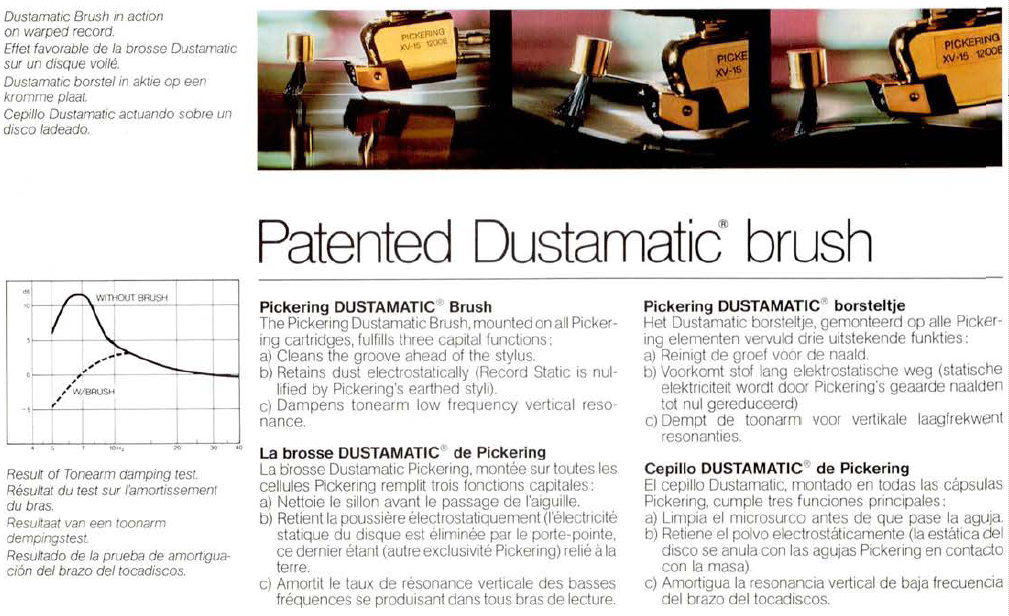
Here's Pickering's explanation of what the brush does:

pickeringbrush.png
 
Can somebody explain to me the concept of adding 1 gram to the VTF when using the brush? Since the brush floats on it's own axis, so to speak, why do you add 1 gram? If I put the stylus point on my digital scale and dial in 2.1 grams instead of 1.1 grams, is not the record groove seeing 2.1 grams? I could never wrap my head around this...
 
^ b/c the brush bristles are pushing the whole contraption upwards by their compliance. They're like little springs that require about 1 gram of force to resist. Although the record sees the combined VTF, it's actually distributed between two points - the tip of the stylus - and the bristles. To exert the required vertical force on the stylus - you add one gram, so now the groove 'feels' the expected VTF under the stylus, plus one gram under the brush.
 
I'd love to see that thread. Link to it? And as to nothing to do with Shure, I stand by what I said. Go to https://worldradiohistory.com/index.htm and do a search through the old PDF's of Stereo Review, Audio, and High Fidelity. There are no ads or promotional blurbs from Stanton/Pickering claiming damping from the brush until 1978 after Shure's introduction of the V15 type IV. Even the equipment reviews through the years (which always parroted from copy provided by the manufacturers) don't ascribe damping to the Longhair/Dustamatic brush until post V15 Type IV.

Townshend came out with that design in 1988, post-Shure Dynamic Stabilizer, just to put it in perspective.

Then I must be doing something wrong because, as I wrote above, on my Technics SL-1200Mk.II using the Shure test record, and a Stanton 681EEE body with an OEM DTL-2S stylus with the Pickering/Stanton brush, the arm goes wild at resonance (13Hz) with and without the brush, which indicates little to no damping. Using a Shure V-15 Type IV with OEM stylus in the same setup under the same conditions shows wild arm shaking at 8Hz without the stabilizer in place, and none at the same frequency with the stabilizer in place, indicating damping as advertised. :dunno:

I've just gone through a search of Audio magazines from the link I posted above while writing this and I cannot find a mention by Stanton or Pickering about their brush being anything more than a record cleaner in their ads until 1978 after Shure's introduction of the V15 Type IV. In fact, if you look at this ad (https://worldradiohistory.com/hd2/IDX-Audio/Archive-Audio-IDX/IDX/70s/Audio-1978-09-OCR-Page-0007.pdf#search="longhair") Stanton quite slyly uses the term "dynamically stabilizes" which I'm sure was quite intentional. And this ad from 1965 seems to be the first mention of the Longhair brush (https://worldradiohistory.com/hd2/IDX-Audio/Archive-Audio-IDX/IDX/60s/Audio-1965-08-OCR-Page-0061.pdf#search="longhair") and it touts all the benefits of it, but doesn't mention damping.

Also, I'd like to make it clear that I'm not saying this to put down Stanton/Pickering or trying to say Shure was better. I love BOTH brands and always have! :)

If you have evidence to the contrary I would love to be proven wrong. (And I really do mean that!)
If you think about it the brush has to damp, it cant not in lateral plane it must and it must help tracking to it is a physical impossibility that it is not assisting. Vertical too but brush apparently needs to be cut correctly (in that thread) which many aftermarket brushes are not. The drag along will exert a vertical damp as the connection to the brush is not friction-less, but more to it with angle of brush exerting a rotational force or something giving more vertical damping.
I might have another look tonight while listening to music see if I can find the thread as the Stanton guy went into a lot of detail.
I agree the Shure brush is a better damper, but the Stanton one does a good job at damping all the same.
Chris
 
Back
Top Bottom