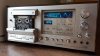
There is one Achilles heel on these decks, and that is the heads. Specifically, the ferrite combination REC/PLAY head. Ferrite is a hard but brittle material and under the wrong conditions the head gap can fracture, whether played or not. To the naked eye these heads look fantastic, usually mirror like surface. However, look under a high power microscope at the gap edge and you will often find large chunks of metal missing, effectively making a very wide gapped, jagged, irregular edge, which absolutely decimates the high frequency potential of the head. Most of these heads that have passed through my bench are like this but fortunately there have been exceptions. I would say maybe one in five have still been good.
Some of the worst condition heads I have seen have the high frequencies start to drop off as low as 4kHz! At 10kHz it might be -10dB, at 15kHz -20dB and above that? Forget it! However, even heads like this can still be enjoyable to listen to, especially to us older folks whose hearing has dropped off somewhat. The real test of the head is done with a playback frequency response tape. A simple visual inspection is usually not revealing enough to know what the potential of the head is. Some of the heads can be lapped to possibly bring back some performance. I sent three of these heads to JRF Magnetics for such service. Two of them were junk as they had cracked cores but the third was successfully lapped and picked up +6dB at 10kHz. Unfortunately, it is not just the CT-F1250 that uses this head, it is also found in the CT-F1000 and some of the Japan only model CT-A1 flagship decks, known to the rest of the world as the Phase Linear 7000mkII. So be forewarned if contemplating one of these decks. Yes, they are highly sought after, ultra-cool pieces of machinery, but just understand that the head may be toast and there are no easy replacements available.