• Please note that Audiokarma will be offline briefly for updates early on Monday morning, September 28th.

Pioneer FM Tuner Alignment

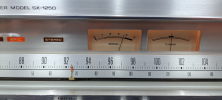
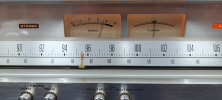
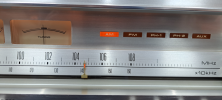
Hello, Just finished a complete restore on a SX1250. B=/B- and bias all ok. Solid and stable. FM tuner works, falry well.. Do see an alignment is needed to calibrate stations to lined up with dail markings. some are off a few hundred Khz. Reading this thread has helped but before I start playing I dont have all the meters, signal generators, and o scope....used to at work, but am retired so the "poor mans" procedure @Tom B has detailed is MUCH appreciated.

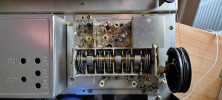
Here is a pix of the top of the FM Tuner and Vaiable cap enclosures"

The terms used like TCA, TCR, TCO, LA, LR, and LO arent on these covers.

1695307904200.png

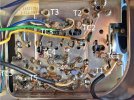
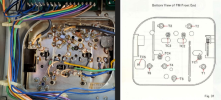
The service manual has me adjusting coils etc from the bottom of the variable cap enclosure on the above right:
1695308368422.png

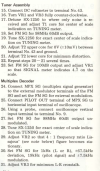
Here is the service manual procedure:
1695308415315.png1695308447535.png

My thinking is do perform the FM Front end procedure and this should get the dial calibrated?
Maybe try the Tuner Assembly procedure.
Not to muck with the Multiplex decoder at all.

Right now the tuner seems just fine with the exception of its needing to have the dial station part aligned?

After changing out 270 + parts I dont want to muck it up at this stage!!

Many thanks for guidance and opinions.
Alex
 
@Tom B
I guess I am asking for the correct coil/inductor/cap to adjust that might help fix this issue?
Looking at the schematic for the IF section there are 5 adjustments, T1, T2, Y3, T4 and T5.
Looks like peaking T5, followed by T1 thry T4 allows for best output...done at a low FM freq then
a High Fm freq...IMO this is good but I dont think this would shift the locations on the dial...
This magic is elsewhere I think...
So that is what I am looking for...I dont see any screw type cap adjustments topside like in many of the photos.
Help!
Alex
:>)
 
Alex,
First you need to see if the drift of the FM is related to the dial cord being stretched, and the needle has changed location, or is the drift a result of detuning.
First check the travel of the dial pointer, and make sure it travels to both ends as it should, or does it move lower than it should, or higher than it should. Then figure out if this is why the pointer is not pointing correctly (See how far off you are from a known station, and then see if this difference matches up to the mechanical travel error if any). This same mechanical drift usually reflects the error on both AM and FM.
It is not so easy to move the dial pointer as the dial cord is usually wrapped aroung tabs on the pointer, and then sealed with an enamel like nail polish.
If the mechanical error is not too bad I would attempt to mobe the pointer, because inproper attempts can result in breaking the dial cord which is a pain to redo.
Second thing to check is to turn FM muting off, and move slowly from the bottom end to top end, listening carefull to any areas that seem very scratchy almost like a dirty volume control. While you will have static in between station, tuning shouuld gor from one station, to static, to another station withough any scratchiness. If scratchiness is found, it means that the tuning cap bearing surfaces in between section is dirty, and needs to be carefully cleaned (Usually a deoxit liquid solution). If the top tin plate of the front end tuner can be removed, access to those bearing can be made. But not sure if the SX-1250 gives you that access.
So now we get to the electronic adjustments for FM
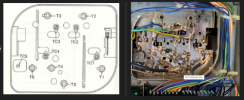
First things to note are that the pictures, and component layouts for the fm tuner are 180 degrees out of phase. You can compare one picture to the other by referring to TC5 which is the oscillator adjustment for the high end. (TC5 shows on the far right in the left picture, and as far left on the right hand picture) TC5 adjusts the FM high stations (Find a known high station near 106mhz, and adjust TC5 so that the station matches the dial pointer positioned on the known station).
T5 is located on the right side upper area on the left picture, and shows on the far left side lower area on the right picture. T5 is used to adjust the low end stations. After you have adjusted TC5 for the high end, check a know station on the low end (like near 92mhz). Its probably ok after your high end eadjustment, but if not, you can adjust T5 to bring it in line with the station and dial pointer. If you make this adjustment, verify that the high end is still ok. If not, you may need to readjust the high end, and low end a few times to get it exact.
Once the dial pointer is now aligned properly you can tweak the other adjustment for the best possible signal strength.
Go to that high end station near 106mhz, and you can adjust TC1, for best signal indication, then TC2, Then TC3, and finally TC4.
Then go to the low end station near 92mhz and adjust T1 for best strength, then T2, Then T3, then finally T4.
As with the oscillator adjustment, recheck strength on the high end and verify that signal strength is still high as it was. If not readjust, and then recheck the lower end.
No need to adjust T6, as you really requires other test equipment like distortion analyzer. This adjustment usually doesnt drift
It is extremely important to use only "Alignment Tools" for these adjustment, as you can damage the components attempting to use other standard tools. These sets are available on the auction site if you need a set. They have all the align ment tools you will need for less that $16. Search on this listing
Radio & TV Alignment Tool & Trimmer Tool Set NEW FREE SHIPPING 63-910 & 8454

Good luck. That SX-1250 had one of the best most sensitive tuners of that era
 
Tom, @Tom B

I cant thank YOU enough for taking the time to write this response!
I rotated the diagram from the service manual which is the bottom underside view of the FM Tuner.
So now the cores correlate! T5 lower left in both pix!

1695383694901.png

I do have access to the variable cap and its bearings. I dont hear any scratchy stuff.
I will do a end to end check for dial linearity and see how much the offset really is.

1695383861673.png

One other thing I did notice is I hear the station at 103 Mhz, and then I hear the same station at two other places near this spot on the dial? One is very strong, clear etc, the others are less strength, The strong clear station broadcasting at 103Mhz is the one that is upstream about .5Mhz...

That said I do not have a directional yagi antenna or a balanced 300 ohm antenna, just a long wire attached to the unbalanced FM ant input. Maybe this is a multipath issue? Will try this again with a 300 ohm antenna.

Again Many thanks!
Alex
AG1Q
 
If you dont hear any scratch sound as you turn the tuning from end to end, then you are fine, and no need to clean or lubricate. The scratch sound sometimes only appears in a few small areas, so make sure to check the entire band.
 
@Tom B
Took a second receiver with digital readout.
No scratchiness.
Did an end to end check for dial calibration.
24 stations.
from 88.1 to 107.9 Mhz
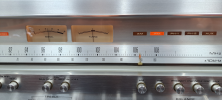
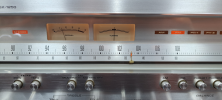
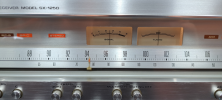
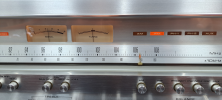
All stations are .4 Mhz on the high side.
Example: 88.9 was 89.3, 98.1 was 98.5, 106.1 was 106.4
So its not off alot, signals strong, clear and nice.

So now is it worth it to try the alignment?
I ordered the plastic adjustment tools.

Alex
 
@Tom B
Took a second receiver with digital readout.
No scratchiness.
Did an end to end check for dial calibration.
24 stations.
from 88.1 to 107.9 Mhz
All stations are .4 Mhz on the high side.
Example: 88.9 was 89.3, 98.1 was 98.5, 106.1 was 106.4
So its not off alot, signals strong, clear and nice.

So now is it worth it to try the alignment?
I ordered the plastic adjustment tools.

Alex
how does AM look? same thing as far as high and low
 
@Tom B
Well, all it took was a minor tweak on T5 and TC5 to get the dial spot on at 88.1 and 106.1 and stations inbetween.
AM is ok now as well.

So thanks again, I really just needed to know which cap and coil to adjust for the dial calibration.

So far its just great, good restoration excercise.

Great receiver!

Alex

:>)
 
I would suggest doing the other FM calibrations, as you can probably up the strength to 4 or even a little higher
 
Those pix were with stations that were not the strongest just to get a representative idea of how the linearity was across the band.
I don think I had an antenna attached, not wanting to overload when peaking.
So now with a proper 300 ohm twin lead antenna the signal strength is almost peaked to 4+ and 5 for most stations in the area.
I will peak up the others as well and see how that goes.

Thanks
Alex
 
Back
Top Bottom