• The move to the new server is done. There are some software and database maintenance updates in process. This has us passing the hat around to help out. We appreciate any donations. Seriously, even a dollar helps. The payment page may be found here - https://www.audiokarma.org/support.html

Pioneer PL570 Bearing noise? How to Access?

May be try and clean up the grease, I mean clean it all out properly and add just one drop of sewing machine oil.
I wish I could help.
I'm not up to speed on turn tables as such, even though I have a few Pioneer units.
I've not had any motor issues with either.
 
[IOTE="Awesomeaudio, post: 10560755, member: 135378"]May be try and clean up the grease, I mean clean it all out properly and add just one drop of sewing machine oil.
I wish I could help.
I'm not up to speed on turn tables as such, even though I have a few Pioneer units.
I've not had any motor issues with either.[/QUOTE]

I may very well try oil instead. Thorens used a 20 weight oil. So I may try a synthetic oil I used there. Just don't want it to drain through and foul electronics etc.
BTY, your service manual come with table?

Edit: I don't think dare use much oil. Might spill over on to motor windings. Not good.
 
Last edited:
Unfortunately the service manual didn't come with the TT.
I downloaded it from vinyl engine.
I may have an original copy here somewhere. I'll need to dig it up from somewhere. The copy is just as good though.
 
Unfortunately the service manual didn't come with the TT.
I downloaded it from vinyl engine.
I may have an original copy here somewhere. I'll need to dig it up from somewhere. The copy is just as good though.

I have a copy from Vinylengine. May be the same.
Thanks
 
When I first did mine, I used oil but over time it leaked out and was rather difficult to clean up. It will run fast until the motor has settled down to the correct height.
Do not run the motor without the platter on or it will "seek" back and forth.
 
Can you hear the noise whet the cart is NOT touching the record and you put your ear really close?
Could the noise be coming from somewhere else, cart bottoming out perhaps?
 
Do you see any scuff marks on the plastic cover or the plinth that might indicate rubbing?

I don't know if the mechanisms are the same but when I serviced my Pioneer PL-71 I removed the ball at the bottom (using a magnetized screw driver) and replaced it with a new one since the original was showing some wear (TT was not making any odd noises though). I may be worth checking that the ball in your has not worn down.
Memory also has me replacing a plastic disc under the ball, but I may be confusing that with another table.
 
Last edited:
Can you hear the noise whet the cart is NOT touching the record and you put your ear really close?
Could the noise be coming from somewhere else, cart bottoming out perhaps?
Jack,
Yes I can hear it with ear close and no cart in use. Could it be from some where else. Good point.
thanks again,
 
Last edited:
Do you see any scuff marks on the plastic cover or the plinth that might indicate rubbing?

I don't know if the mechanisms are the same but when I serviced my Pioneer PL-71 I removed the ball at the bottom (using a magnetized screw driver) and replaced it with a new one since the original was showing some wear (TT was not making any odd noises though). I may be worth checking that the ball in your has not worn down.
Memory also has me replacing a plastic disc under the ball, but I may be confusing that with another table.

Steve,
All good ideas. Maybe next, clean out grease. Inspect ball and plastic disc. Look for rubbing on plastic cover close to motor and platter as you and Jack say. Plith has plenty of clearance to platter.
Work through the possibilities. When solved, I may use moly grease. It's messy, but good anti wear.
Thanks

I'll put on some tunes today and take apart again. Gotta love audio projects. Best kind.
 
Last edited:
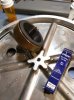
Shown is spindle assembly and bottom of platter. The 5mm bearing ball does not look damaged, but will find new one Monday at a bearing supply. The plastic disc it seats against has a 1/16" dimple at its center. Going to let it go for now. Don't know how it would come out anyway. The spindle shaft has a couple marks on it. But can't feel any high spots.
On the other hand, the tapered inside diameter of the aluminum platter has some marks on it. I'm concerned they might not be letting it seat properly, and might pivot on high spots. I'll put some High-Spot Blueing on spindle taper. Spin in platter taper to see if there's high spots. Tomorrow.IMG_20170520_204826.jpg
 
Last edited:
Ordered a couple each 5mm and 6mm ball bearings. They usually sell in 800 quantity.
The 5mm is the original size. But, think will start with 6mm. It should contact virgin material in ground center of spindle end.
 
Are you sure the thrust plate isn't causing the problem?

The ball bearing with have created a dent in it over the years, resulting in more friction and/or noise and the entire platter could be riding lower and possibly touching the plinth at some point in the rotation.

Flip the thrust washer over or place a thin brass washer under the thrust washer to lift it up a fraction.
 
Are you sure the thrust plate isn't causing the problem?

The ball bearing with have created a dent in it over the years, resulting in more friction and/or noise and the entire platter could be riding lower and possibly touching the plinth at some point in the rotation.

Flip the thrust washer over or place a thin brass washer under the thrust washer to lift it up a fraction.

John,
I'm really not sure of where the noise issue is coming from. I tried a dab of tap on end of screwdriver to pull up the disc. No luck. l can't clearly see if disc diameter is smaller than bushing ID or larger. Maybe access disc from underneath? All else fails, I'll look at the service manual. See if it shows.
Thanks. was going to ignor 1/16" dimple in disc because could not easily remove it.
 
Last edited:
Are you sure the thrust plate isn't causing the problem?

The ball bearing with have created a dent in it over the years, resulting in more friction and/or noise and the entire platter could be riding lower and possibly touching the plinth at some point in the rotation.

Flip the thrust washer over or place a thin brass washer under the thrust washer to lift it up a fraction.

John,
Are you familiar with these Pioneer tables? The service manual is unclear to me how to access the plastic disc. It does show a small cover at bottom of motor. Turn turntable over snd remove bottom plate?
 
Sometimes they can be pulled out from the top, but mostly, one has to remove the cap/plate on the bottom of the bearing housing itself (underneath). Usually Japanese tables have a small steel disc with three small No#0 Philips screws that are held on tight, often with threadlock compound. You need a very tight tolerance screwdriver in most cases to 'crack' the threadlock without damaging the screw head. Sometimes they are easy. Sometimes they are not. You can always dab acetone on a threadlocked screw to dissolve the adhesive, but usually it is a constant force that will loosen them. If one screw doesn't move, remove the other two and pivot the plate a little, that will likely loosen the last screw.

Take off the thrust washer plate cover, there may be a few washers in there- sometimes you even get a bonus new washer underneath and you can swap their position or simply flip the old one to expose a new flat surface. Clean out the well, really well, and use a suitable viscosity oil for the amount or wear or play in the bearing.

Someone who has pulled down a PL-570 recently may be able to be more specific, my advice is general and is what I've done many, many times with Japanese DDs.

Hope it helps. :)
 
Sometimes they can be pulled out from the top, but mostly, one has to remove the cap/plate on the bottom of the bearing housing itself (underneath). Usually Japanese tables have a small steel disc with three small No#0 Philips screws that are held on tight, often with threadlock compound. You need a very tight tolerance screwdriver in most cases to 'crack' the threadlock without damaging the screw head. Sometimes they are easy. Sometimes they are not. You can always dab acetone on a threadlocked screw to dissolve the adhesive, but usually it is a constant force that will loosen them. If one screw doesn't move, remove the other two and pivot the plate a little, that will likely loosen the last screw.

Take off the thrust washer plate cover, there may be a few washers in there- sometimes you even get a bonus new washer underneath and you can swap their position or simply flip the old one to expose a new flat surface. Clean out the well, really well, and use a suitable viscosity oil for the amount or wear or play in the bearing.

Someone who has pulled down a PL-570 recently may be able to be more specific, my advice is general and is what I've done many, many times with Japanese DDs.

Hope it helps. :)

Thanks, your info should help.
 
Back
Top Bottom