• The move to the new server is done. There are some software and database maintenance updates in process. This has us passing the hat around to help out. We appreciate any donations. Seriously, even a dollar helps. The payment page may be found here - https://www.audiokarma.org/support.html

Pioneer SA-9500II - Tingling Sensation when touching faceplate or lid

Moncho

Member
Hi guys,

I have had a beautiful Pioneer SA-9500II in my possession for a couple of weeks now. The amplifier was cosmetically in perfect condition although I could tell that it had been forgotten in a warehouse for many years. So I have cleaned it inside and out and adjusted the bias current. I tested it with the oscilloscope, to later connect it safely to my speakers. It sounds pretty good, although I can tell it needs some restoration, which will be done in the next few weeks.

A few days ago I wanted to move it a little and I felt a tingling sensation when I touched the lid. I immediately unplugged it and searched AudioKarma to see if anyone else has had this problem. I found this thread where a member suggested trying plugging the amp in one direction and then the other. This has helped, the plug is not original. Someone has cut the end off and replaced the plug, without changing the power cord (see picture). The original power cord only has two prongs, so looking at the schematic, when plugged in one position the hot wire goes to “ground/chassis” and that is where I feel the tingling. If I reverse the plug, the neutral goes to amp ground and the hot wire to the power switch.

So my questions are:
Is this “normal” or safe? What should I do?


Thanks guys, any suggestions will be appreciated.
Have a nice day :)
 

Attachments

  • power cord.PNG
    power cord.PNG
    678.7 KB · Views: 18
Register to hide this ad
Been lots of discussions about this over the years on AK. Yes it is normal for gear of this vintage. Plug it in so you don't feel the tingle. And welcome to AK!
 
Doesn't Europe have 3 prong grounded plugs? If you do, I'd start by replacing the cord with a 3 prong grounded plug. You'll just need to use a suitable chassis ground on the inside.
 
Wow! I had no idea! Post #13 by Markthefixer just nails every point on the head. Mark is as sharp as any - if what he says is true and I would bet that is is - wow! thank you.
Hi Lux Man,
thanks for your reply but I should have written my post with more clarity.
Change the original 2 Prongs power cord for a 3 Prongs will be my last option. I understand the benefits if you do it right, but to do it correctly, you have to pay attention to many details and the original circuit was designed for a 2 Prongs cable. I assume, that those engineers knew better than me :p , so if everything is ok in the amp there is no need for that mod.

So I should have asked like:
- It is normal? safe?
- If it's not normal, could you guys please help me to identify the problem and how to fix it?


@markthefixer : Sorry to tag you directly, but do you have any suggestion?

Thanks again guys and have a nice day.
 
Dunno about this one, but many service manuals I've seen include a leakage current test.

If you want to definitively ascertain safe then do that test.
 
Last edited:
Dunno about this one, but many service manuals I've seen include a leakage current test.

If you want to definitively ascertain safe then do that test.
Hi whoaru99,

cool, but I have 3 docs (attached); service manual, additional service manual and operating instructions. In non of them is a "leakage current test" mentioned :confused:
For which model did you see (in the service manual) such test? Perhaps, I'll be capable of adapt it to my amp.

Could you guys suggest how to execute a "leakage current test" on this amp?

Thanks and have a nice day :)
 
Tingle means danger may be present. A normal 10 megohm input impedance DMM will report that voltage at say 60 volts,
but as long as the C33 0.01uF UL "death cap" is operating correctly everything is OK. If not, the "tingle" current will make huge flashes
as it burns the wire away, or electrocutes you if your body resistance happens to be lower.

For accurate testing, connect a 1500 ohm resistor across the DMM test leads and repeat your tingle voltage measurement.

I called C33 a "UL death cap" because that cap has to be UL certified to fail safely in a non-dangerous manner, as an open circuit instead of a short circuit..

Omitting leakage current tests can be explained as not encouraging untrained personell to probe in potentially lethal areas. Training is in safety for certain areas.
as well the liabilities of letting that dangerous condition loose upon the world. Think manslaughter charges, or houses burning down on YOUR dime.
 
Last edited:
Hi whoaru99,

cool, but I have 3 docs (attached); service manual, additional service manual and operating instructions. In non of them is a "leakage current test" mentioned :confused:
For which model did you see (in the service manual) such test? Perhaps, I'll be capable of adapt it to my amp.

Could you guys suggest how to execute a "leakage current test" on this amp?

Thanks and have a nice day :)

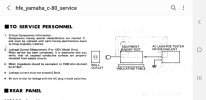
This is from a Yamaha service manual.

Screenshot_20241128-080730_Samsung Notes.jpg
 
@Moncho
This isn't quite what I hoped for in sending you here to the Pio forum---rather I was hoping you would hear from folks with the same (or closely related) amp so you could see whether what you have is true of those others. Nonetheless, there are some useful comments here. I'll post a further comment later or tomorrow.
 
This is from a Yamaha service manual.

View attachment 3356604
Hi whoaru99,

Thanks !!!!
I just did the measurement, this method of measurement coincides with the one suggested by @markthefixer

Additional Info: I live in Germany so the electrical net delivers 220V AC

Results:
- If the power cord plug is connected in the tingling position: the voltage measurement fluctuates between 120 and 140 mV AC (never higher than 140mV (but it may be that my DMM is too slow to capture the peaks.
- If the power cord plug is connected in the NOT tingling position: the voltage measurement is 0V AC

While performing the measurements (with the amp plugged in the tingling position) I noticed that my pc monitor (plugged into the same set of wall sockets) was not very happy, every 20 seconds or so it did generate a black screen.

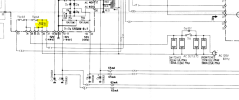
@markthefixer : I'm about to restore this amp and had in mind to replace the C33 (see attached picture to confirm) for this safety cap (0.01uF 300VAC safety rating: X1,Y2). Is it a suitable replacement? or do you have another suggestion?

So ... guys ... , with this results under the Yamaha method the amp should be safe but what do you guys think?

Thanks and I wish you all the best :)
 

Attachments

  • c33_safety_Cap.PNG
    c33_safety_Cap.PNG
    124.5 KB · Views: 6
The leakage measurement is current, not voltage.
Sorry guys ... stupid mistake :rolleyes:. Now I have measured right.

Results:
- If the power cord plug is connected in the tingling position: the current measurement using the 2m scale fluctuates between 0.075 and 0.090 mA AC (never higher than 0.090mA (but it may be that my DMM is too slow to capture the peaks.
- If the power cord plug is connected in the NOT tingling position: the voltage measurement is 0mA AC

My questions are the same as before:

@markthefixer : I'm about to restore this amp and had in mind to replace the C33 (see attached picture to confirm) for this safety cap (0.01uF 300VAC safety rating: X1,Y2). Is it a suitable replacement? or do you have another suggestion?

So ... guys ... , with this results under the Yamaha method the amp should be safe but what do you think?

Thanks :)
 

Attachments

  • c33_safety_Cap.PNG
    c33_safety_Cap.PNG
    124.5 KB · Views: 1
Which version of the amp do you have? KU, KC, HG, or S?

- If the power cord plug is connected in the NOT tingling position: the voltage measurement is 0V AC
This seems to indicate that you have done the test with the power switch in the off position.
 
I cant do the research to evaluate x-1 or x-2, x-3 or x-4 is appropriate for German 240v and their electrical standarss.
 
Last edited:
Which version of the amp do you have? KU, KC, HG, or S?


This seems to indicate that you have done the test with the power switch in the off position.
Hi Audiotemp

thank you very much for following up on my case, it is very kind of you :)

My amp y a "S" version.
I have repeated the measurements, this time including when the equipment is turned on and when it is plugged in “correctly the measurement does not change, it remains at 0mA. While when it is plugged in the position that generates “tingling”, when turned on the measurement value decreases and remains stable at 0.063mA.

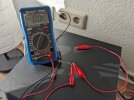
I have attached two photos, of how I am measuring
- setup: one 1470ohm resistor between the 2 DMMs leads, then the black caiman goes to GND in my flat and the red goes to the amps lid. The DMM is in the 2mA AC scale.
- Method: The amp sits (literally hahahaha) on a plastic chair and the red caiman lead makes contact with the amps lid, giving the results.
Am I doing it correctly?

In summary
Results: (current measurement using the 2m scale on DMM)
- If the power cord plug is connected in the tingling position:
* Amp turned off: fluctuates between 0.075 and 0.090 mA AC (never higher than 0.090mA (but it may be that my DMM is too slow to capture the peaks).
* Amp turned on: 0.063mA AC (stable)
- If the power cord plug is connected in the NOT tingling position:
* Amp turned off: 0mA AC
* Amp turned on: 0mA AC

With these measured values, can I be sure that the equipment is safe to use? (If I have measured correctly)

Thanks a lot and have a nice day :cool:
 

Attachments

  • Method.jpg
    Method.jpg
    84.8 KB · Views: 5
  • Setup.jpg
    Setup.jpg
    143.3 KB · Views: 5
I said "cant", I missed the apostrophe... can't means CAN NOT

phrased differently:

I am NOT ABLE to do the research.
 
I said "cant", I missed the apostrophe... can't means CAN NOT

phrased differently:

I am NOT ABLE to do the research.
Sorry, I read it too fast and with too much enthusiasm. English is not my mother tongue but I understand what “can't” means :rflmao:

Anyway, I appreciate what you have helped me with so far.

Have a nice day.
 
Back
Top Bottom