• The move to the new server is done. There are some software and database maintenance updates in process. This has us passing the hat around to help out. We appreciate any donations. Seriously, even a dollar helps. The payment page may be found here - https://www.audiokarma.org/support.html

Pioneer sx-1050 no voltage at output caps problem

You are welcome!
Did the Surge killer relay pull in? Did the Protection relay pull in? May both be a bit slow on DBT.
See if the DC offset is adjustable. It should adjust even without the output transistors connected.
Then, make sure the bias pots are set to minimum (0Ω), connect the output transistors and power up on the DBT.
Recheck and set dc offset.
Then, still on the DBT, see if the bias adjustment for one channel causes the bias to increase close to its spec. It may not go that high while on the DBT. You are just checking circuit function adjustability here. You may see the DBT bulb brighten as the bias adjustment test is made, that is normal. Turn it back to minimum.
Then do the same an the other channel.
Both should be at minimum before you go to full mains. If you leave them where they set up on the DBT they WILL be too high on full mains.

Then go to full mains. Both relays should pull in quicker. Recheck power supply voltages, including C1, C2. Recheck/adjust dc offset. Then set the bias properly for each channel. Monitor bias for a few minutes to verify it is stable.
If it is happy with those settings try some music at a low level. Use sacrificial speakers just in case. If it continues to be happy play it at a higher level and let it warm up. After the heatsink has warmed up a bit stop the music input and recheck the bias and offset. Both will vary some as it warms up.
Yes
You are welcome!
Did the Surge killer relay pull in? Did the Protection relay pull in? May both be a bit slow on DBT.
See if the DC offset is adjustable. It should adjust even without the output transistors connected.
Then, make sure the bias pots are set to minimum (0Ω), connect the output transistors and power up on the DBT.
Recheck and set dc offset.
Then, still on the DBT, see if the bias adjustment for one channel causes the bias to increase close to its spec. It may not go that high while on the DBT. You are just checking circuit function adjustability here. You may see the DBT bulb brighten as the bias adjustment test is made, that is normal. Turn it back to minimum.
Then do the same an the other channel.
Both should be at minimum before you go to full mains. If you leave them where they set up on the DBT they WILL be too high on full mains.

Then go to full mains. Both relays should pull in quicker. Recheck power supply voltages, including C1, C2. Recheck/adjust dc offset. Then set the bias properly for each channel. Monitor bias for a few minutes to verify it is stable.
If it is happy with those settings try some music at a low level. Use sacrificial speakers just in case. If it continues to be happy play it at a higher level and let it warm up. After the heatsink has warmed up a bit stop the music input and recheck the bias and offset. Both will vary some as it warms up.
I did hear the relay click after a few seconds of powering it up. Remember the last power up was no longer on DBT. I will now go and connect to DBT and do as you said. I will give you a update shortly
 
Boy these pots are terrible, very touchy. Im working on adjusting dc offset again after having turned bias pots down to 0 and plugging connectors for transistors
You are welcome!
Did the Surge killer relay pull in? Did the Protection relay pull in? May both be a bit slow on DBT.
See if the DC offset is adjustable. It should adjust even without the output transistors connected.
Then, make sure the bias pots are set to minimum (0Ω), connect the output transistors and power up on the DBT.
Recheck and set dc offset.
Then, still on the DBT, see if the bias adjustment for one channel causes the bias to increase close to its spec. It may not go that high while on the DBT. You are just checking circuit function adjustability here. You may see the DBT bulb brighten as the bias adjustment test is made, that is normal. Turn it back to minimum.
Then do the same an the other channel.
Both should be at minimum before you go to full mains. If you leave them where they set up on the DBT they WILL be too high on full mains.

Then go to full mains. Both relays should pull in quicker. Recheck power supply voltages, including C1, C2. Recheck/adjust dc offset. Then set the bias properly for each channel. Monitor bias for a few minutes to verify it is stable.
If it is happy with those settings try some music at a low level. Use sacrificial speakers just in case. If it continues to be happy play it at a higher level and let it warm up. After the heatsink has warmed up a bit stop the music input and recheck the bias and offset. Both will vary some as it warms up.
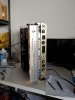
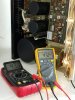
At this moment everything is going good so far. Them pots for DC offset shure are touchy. I am currently monitoring the bias on both channels. After this I will try some music like you said. Everything is looking great so far
 
@merlynski How do you spell success= I spell it = merlynski
Yes, there is music. Woo hoo!! Oh yes, Thank You very very much for everything!!! It is playing FM radio right now. I had cleaned all switches and pots prior to starting this thread. I will let it play a lil bit then check DC offset and bias again like you told me to do. You the man merlynski!!!! 20211215_141348.jpg
 
Thanks! Glad it went well!
You did a great job following instructions and not getting ahead of the procedure in progress, that makes a successful outcome much easier to achieve :bigok:.
Enjoy!!
 
Thanks! Glad it went well!
You did a great job following instructions and not getting ahead of the procedure in progress, that makes a successful outcome much easier to achieve :bigok:.
Enjoy!!
Well let me tell you I could not have done it withough your help. I thank you for being patient with me and instructing me on what and where to look for. I knew I wasn't too crazy when I said music was coming out distorted and a very low output volume. I really want to thank you the most and I also want to thank everyone else that put towards the repair in this thread. Now I need to send you the transformer If you are still interested in dissecting it. Please let me know if you do want to and a address for me to ship it to. I am not good at all with this internet stuff so If you want to send me a message with address that be great. I cant thank you enough and sending you the transformer is the least I can do. Thank you and everyone else. This receiver is now functioning.
 
Here it is. The last picture you can see the yellow and red transformer wires that were not used. They were zip tied and had some shrink tube at the ends just to be extra careful. 20211215_170907.jpg 20211215_170805.jpg 20211215_170934.jpg
 
@merlynski Hi, I just dripped off the transformer at the post office. Should be there bi next Wednesday. I updated the electrolitics and some transistors on the power supply boards,phono board, and also replaced the 1 electrolitic on the surge suppressor board I believe its called. It has been working great so far. All the electrolitic caps and transistors I replaced have tested good. Not sure I should replace the ones on all the boards. Any thoughts?
 
Thank You!
When I rebuilt my SX-1050 I was originally going to just replace failed parts and transistors on the Top Ten Worst Transistors - noisy, failure-prone, whatever... list.
When I dug in and realized how much work needed to be done to access them I decided to do a full refurbishment. That meant ordering more transistors. I also decided to replace all the signal path electrolytic with film caps, so I had to order them also. Every electrolytic cap in the signal path got changed to film, even the 10µF ones. There are some small 10µF electrolytics, that are power supply decoupling caps, on individual boards, that I kept as electrolytics.
I found some completely open electrolytics in the power supply regulator, but no hard failed ones on the audio boards. I tested every cap when I removed it, I did find a few that were higher capacitance than their rating, even a few actually out of spec. I have read that (small) electrolytics increase in capacitance as they dry out from age, so I felt good about my extra work. Still have the phono board to rebuild and a couple of bulbs to replace to get it done.
My surge suppressor was the newer AWX-108 version that did not have a cap on it.
The only truly failed part I found was the negative side main filter cap, completely open. The Protection relay had pretty badly burned contacts, I almost did not replace it. After I took it apart to look at it I was glad I did.
So I went from a repair/slight update to a full refurbishment.
 
Last edited:
Thank You!
When I rebuilt my SX-1050 I was originally going to just replace failed parts and transistors on the Top Ten Worst Transistors - noisy, failure-prone, whatever... list.
When I dug in and realized how much work needed to be done to access them I decided to do a full refurbishment. That meant ordering more transistors. I also decided to replace all the signal path electrolytic with film caps, so I had to order them also. Every electrolytic cap in the signal path got changed to film, even the 10µF ones. There are some small 10µF electrolytics, that are power supply decoupling caps, on individual boards, that I kept as electrolytics.
I found some completely open electrolytics in the power supply regulator, but no hard failed ones on the audio boards. I tested every cap when I removed it, I did find a few that were higher capacitance than their rating, even a few actually out of spec. I have read that (small) electrolytics increase in capacitance as they dry out from age, so I felt good about my extra work. Still have the phono board to rebuild and a couple of bulbs to replace to get it done.
My surge suppressor was the newer AWX-108 version that did not have a cap on it.
The only truly failed part I found was the negative side main filter cap, completely open. The Protection relay had pretty badly burned contacts, I almost did not replace it. After I took it apart to look at it I was glad I did.
So I went from a repair/slight update to a full refurbishment.
Well I guess I will go ahead and continue upgrading each board. Thank you
 
You're Welcome.
It was posts on AK that convinced me it was the right thing for me to do, especially the film caps.
Hi Merlynski. Unfortunately I had to sell the sx-1050 receiver that you helped me troubleshoot and repair. Last month I aquired another pioneer sx-1050 all original and in pretty good external condition and everything works great. My question to you is do you think I should do a restoration on it due to the age of electronics etc? I do have have the parts to do it except for the big can caps. I have owned it for a month and use it daily. Thanks in advance, Ben
 
I suppose you mean the main filter caps? Maybe an open bridge rectifier on the power supply board (the one at the bottom of the amp)? I’d also check the voltages on the transformer secondary.
Big Ben, you were right on the money with transformer secondaries. Thanks
 
Back
Top Bottom