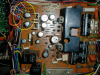
That wire actually does little, with it broken, the power resistors intended to empty the capacitors when the unit is turned off won't drain the capacitor - the resistor will be cold.
The hum will have nothing to do with that, although it is a good idea to repair the broken wire and get that resistor back into operation.
The important fact is the power failure, and the mischief it could have done in the old, tired power supply.
I can just about close my eyes and call the damage (or at least the start of the damage). There is a little part from a semiconductor manufacturer that had a 30v rating, that Pioneer hand selected to find those that can work to 50v. When it works, it reduces hum ~60 db which is 1 part in 1000. A very worthy reduction. But the years Proved to Pioneer that the little part was very very vulnerable to mischief upon power up or power down, so they added a bunch of parts around it to try and protect it.
At the least, that part has failed and hum is getting through. A more serious problem is that when failing, that little part usually hurts the voltage regulator it is part of. That's not good. In fact continued usage with a damaged voltage regulator will continue the damage.
The only way to confirm would be to take voltage readings while it is operating, on it's side with it's bottom chassis open and exposed.
This may be beyond your comfort level. It would not be a good idea to ignore the fault, it has a strong possibility that the +80v (or -80v) regulated power supply has failed and the voltage is closer to 100v. The loss of voltage regulation lets even more hum through, while the higher voltage starts other damage.
Long ago others figured out a robust replacement for that fragile part - we call it the echowars (his name) current source. A rebuild of the power supply board coupled with the substitution of two of these echowars current sources will result in a robust reliable power supply. I have talked many many people through these rebuilds over the years, as have others on this forum.
BUT that's not the end of the story.
Two other members have designed and produced replacement power supply boards that could be dropped straight in and connected by the far less technical (a rebuild is quite stringent in it's needs - this is one unforgiving power supply!!)
One person's board I have not seen on eBay for a while, the other's (rcs16 - delta9electronics in Canada) IS currently on eBay.
Look for SX-1980 AWR-154. It may seem expensive ($600 Canadian, $475 US) but it isn't... Parts costs, other costs etc....
IF you decide to take the voltage measurements:
(please don't be insulted at the detail I go to, until I have a better idea of your electronics experience and know which details you know)
Use a DMM set on a 100v DC VOLTS scale, ground the black dmm lead to a bare metal chassis ground.
probe with the red lead, INSULATING all but the tiniest end of the tip of the probe (with tape is fine)
so that when the probe slips (we ALL slip when we read the meter) no damage is done by short circuits.
+ / - 5% tolerance on voltages:
awr-154 pin 17, red wire +80v DC
awr-154 pin 18, brown wire -80v DC
awr-154 pin 9, thicker red wire +34v DC
awr-154 pin 11, thicker orange wire -34v DC
awr-154 pin 13(14)(pink wire?) +13.5v DC
awr-154 pin 16 blue wire +8.0v DC
awr-154 pin 15 violet wire +5.0v DC