• The move to the new server is done. There are some software and database maintenance updates in process. This has us passing the hat around to help out. We appreciate any donations. Seriously, even a dollar helps. The payment page may be found here - https://www.audiokarma.org/support.html

Pioneer SX-6000 repairs

Led-Zep

New Member
This is my first post on the forum. I bought an SX-6000 several years ago and used it only for FM. Then I bought a turntable and found the phono inputs 1 + 2 work however there is some noise. I plugged the turntable into the aux and tape monitor jacks and the is barely enough volume to hear anything, even when the volume knob is turned to 10.

There is one repair shop I'm aware of on Oahu (Hawaii). The repair man checked out the receiver and told me the charge is $400 to repair. He did not detail exactly what needed repairs, it's hard to know if it's worth the money.

So I'm thinking of trying myself. I've read this post and several others. https://audiokarma.org/forums/index.php?threads/sx-6000-teardown-and-repair.650448/

Checking Mouser.com, I noted some of the parts in the google docs parts list have increased in price significantly after five years. There's a seller on e-bay selling the complete kits, maybe it's worthwhile to buy this instead.
https://www.ebay.com/itm/Pioneer-SX...057744?hash=item23d0084310:g:tUAAAOSwSlVeRbNL

What do you think?

I have a soldering iron, used mostly for motorcycle wiring harnesses and I've done a few electronic repairs. This would be my biggest electronic repair to date, if I take it on.
 
Register to hide this ad
Turntable cartridges put out a low voltage signal that gets amplified and shaped (RIAA equalization curve) by the phono circuit. Plugging into a high level input like AUX and the tape monitor you would have to jack up the volume and it still would not be that loud and probably sound odd. Unless you get an external phono preamp you need the phono circuit working right.

If you are not familiar, Deoxit treatment can sometimes do wonders. Just got a HK 330C sold with feeble output cleaning the controls, pots, and switches good brought it back to life. Replaced some lighting now have a working 330C.

But if background noise is the issue often those old "low noise" NPN type transistors become noisy with age. I have had first hand experience with some of them doing varying levels of broadband hiss similar to the noise between FM stations if you have the muting off. Replacing those transistors can really quiet a unit down. I think on that one you should have the 2SC871 and 2SC870 on the head amp board (W21-004). Often the On semiconductor (formerly Fairchild) KSC1845 is the normal recommended replacement on the 2SC871, and a transistor sub list document I downloaded in the past also has the KSC1845 as the replacement for the 2SC870. Just watch the configurations, the pinout of the replacement may differ from the originals. In some cases the KSC1845 is installed rotated 180 degrees from the original. In other configurations I will usually kink the middle leg forward or backward and rotate as needed so I don't have to cross the legs. Put in a transistor the wrong way, at best it does not work at worst effectively creates a short blowing something up. I am sure the 2SC871 is a Mitsubishi transistor and should have their classic three diamond symbol on it. I believe the 870 was theirs too. The 2SC871 has a reputation as a potential problem transistor. The blocky Hitachi 2SC458LG has an even worse reputation.

I am listening to the SX-1500TD right now that I just restored with new electrolytic (and some film) capacitors and a number of replaced transistors. It is now a nice sounding low noise vintage receiver. I like the sound of the old Pioneer. I think its one generation older than the SX-6000 but more similar to the output power of the higher end SX-9000. I believe at least one board in the 1500TD used the 2SC871 and 870 combination and I used the KSC1845 as the replacements.

Can do the caps much cheaper, that seems rather high. Often have used the rule of thumb Nichicon UKL in the signal path, UPW for the power supply and ones not in the signal path, film caps for 3.3 uF or smaller they start shooting up in price at that value, Wima MKS02 and Kemet R82 are two that I have used the former seems a much more popular choice. At 3.3 uF may go electrolytic or film, depends on the unit, and films below that value. Watch the model number parameters, some will have much longer legs some may only have 5 mm long wires sticking out the bottom and may not be able to span the spot the old electrolytic did. Used the Wima in the 1500TD. Filter and output caps I may up the capacitance some and the voltage can go up a good bit trying to find one that will fit where the old ones did especially ones that fit in brackets or have to solder into a board. Don't have as much of a preference there, the options that will fit will often be limited and cost a big factor. Remember they have upped the voltage a bit over the years, so can step up the voltages a standard level, ie what originally was 16V might replace with a 25V.

Others should come along and give their thoughts. And you have the past suggestions on threads about the SX-6000.
 
Last edited:
Update - I found another tech who checked it out and the phono inputs were fine at that time. We played a record and the noise was gone, although he didn't change any parts.

That lasted several months and now the SX-6000 has developed a hiss noise on the right channel on phono 1 and phono 2. The hiss exists whether or not a turntable is connected to the receiver. The noise only comes out on the phono inputs, the others seem to be fine.

I've researched other posts in this forum and I believe the head amp is the problem. Since my electronics skill level is about a 3 out of 10, I'm thinking of buying a used head amp on e-bay and buying the parts from mouser, using the SX-6000 parts list excel file from this forum. I want to buy the spare head amp so that I can work on it as time permits without having the receiver out of service for an extended period.

Do others agree it's likely the head amp?
 
Last edited:
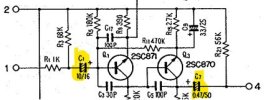
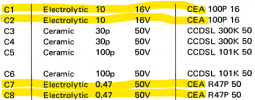
I know this thread is a few years old but I wanted to bring up something that confuses me about the head amp board. I know that Pioneer refers to caps as CEA, CEANL, CSSA, CSYA, etc. On this board C1, C2, C7 and C8 all appear to be in the signal path but are designated as CEA in the service manual. Shouldn't these be something besides CEA? I didn't notice this until I already started my recap and it seems to be working okay using UPW's for C1 and C2. I used films for C7 and C8. I mostly would like clarification that my thought process is correct and that the service manual possibly should have designated these as CEANL, CSSA or CSYA. Meaning I would have gone with UKL's or film caps for C1 and C2. Thanks.
 

Attachments

  • head_amp.jpg
    head_amp.jpg
    24.7 KB · Views: 4
  • head_amp2.png
    head_amp2.png
    43.8 KB · Views: 4
there IS a stereo repair in OAHU or at least there was. STAY WELL CLEAR OF IT and do the repairs yourself forget kits use mouser or digi key
 
Back
Top Bottom