I'm not sure I'll get all of this right, but I'm sure others will chime in.
Here's how I set up an arm for a new cartridge.
- Align the cartridge (This is its own process altogether. Audiokarma has plenty of threads about it as do several excellent websites. Just Google align a phono cartridge.)
- Once the cartridge is alined, ignore the numerical dial in front of the counterweight. It means nothing yet.
- Hold the headshell with one finger and begin finding it's balance. You do this with the counter weight at the backend of the tonearm. The precise balance will be pretty exact and you'll feel when you're getting close. Once you're close, slowly turn loose of the headshell to make sure the arm isn't going to flop down and wreck you stylus. You'll want to balance your tonearm so that the stylus is horizontal to the record's surface. When properly balanced, the tonearm will just "hover" with the stylus at the correct position.
- Now is the time to worry about that dial at the front of the counter weight. Turn it so that it reads zero. Be careful not to turn the actual counterweight, however. The weight and the dial should move independent of one another.
- Once the dial is set to zero, you can apply tracking force, in your case between 2.5 and 3.5 grams. (I always start in the middle.) As you turn the counterweight, the dial should move along with it. Keep turning until you reach three grams.
- Set your anti skating dial to the same number as your tracking force.
- Now it's time to play a record! Sit back and listen for oddities in your sound. If you hear trebles that are distorted (sibilance) or too harsh, lighten the tracking force and make the corresponding adjustment to the anti skate setting. (Remember, the anti skate should be set to the same number of grams tracking force.) If the bass is muddy or "too fat," lighten the tracking force and adjust the anti skate setting accordingly.
This last may take time to get right. Don't be afraid to play with the tracking force within the cartridge's limits. Every cartridge reacts differently to different tonearms, platters, motors, etc. Setting up your tonearm for a new cartridge is 25% process (the steps above) and 75% the art of finding what sounds right to you.
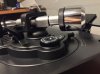
Now, as for those numbers at the base of your tonearm, I'm not sure what those are. If you change the value of the number, does your tonearm's height increase or decrease? If so, your tonearm is capable of having its vertical tracking angle (VTA) adjusted. (Lucky devil.) The best way to learn how to make this adjustment would be to go here:
http://www.vinylengine.com/tonearm_database.php. This site gives access to the owner's manual for hundreds of tonearms. Once you get the tonearm's owner's manual, follow the instructions for setting the VTA. I'll bet you will need to make this setting before doing any of the steps above.
If the dial does not set the VTA, honestly I have no idea what it does, so.... that's right - go get the owner's manual. It will surely tell you what those numbers are for.

Let us know how you're doing!