• The move to the new server is done. There are some software and database maintenance updates in process. This has us passing the hat around to help out. We appreciate any donations. Seriously, even a dollar helps. The payment page may be found here - https://www.audiokarma.org/support.html

Please take a look at this capacitor

Brian302

Member
Hi everyone. I have a Harman Kardon HK3480. It works fine except for a volume knob problem that there's a TSB for. I opened it up yesterday to replace the knob and saw one of the two main capacitors looking as though it's leaking. Curious as to opinions on this. The unit still works, but I assume it's a bad idea to continue using it with this cap? Would any of you replace the cap or just get a new unit? Have a good day, folks.Harman Kardon HK3480 Board.jpg
 
Register to hide this ad
That's odd. Looks like rust.

In 100s of units I've seen, I've never seen that.

The caps are aluminum cans with plastic covers.
The vent is on the connection plate, which is on the bottom of the ones in the photo.

What does the bottom of the top cover look like?
I would think moisture collected on the top of the cap and rusted the cover.
 
Of the pair i'm not sure which one should cause more concern.

Bulging is not a good sign.

Replace them both, soon.

The cap is not bulging. That is just the plastic cover.
The plastic may get deformed from heat that builds up in the whole unit.
 
Weird. What does the inside of the cover look like? It would be unusual for that type of capacitor to have chemical leakage at the top, yet the rusty gunk looks like it was attracted to moisture. Somebody spilled their beer? No way to tell the condition without testing, so just replace 'em.
 
To answer a couple questions..

The underside of the top cover is remarkably clean. I saw no evidence of anything spilled into. Btw, I'm the original owner of this receiver and have never had it apart before. I looked over the board for any other signs of corrosion and didn't see anything. The bottom of the case is clean too. It spent a few years in the basement so maybe it was more humid and that affected the one cap? I agree that replacing both is the way to go. Another question...is there anything I should check for residual voltage before proceeding?
 
The underside of the top cover is remarkably clean. I saw no evidence of anything spilled into. Btw, I'm the original owner of this receiver and have never had it apart before. I looked over the board for any other signs of corrosion and didn't see anything. The bottom of the case is clean too. It spent a few years in the basement so maybe it was more humid and that affected the one cap? I agree that replacing both is the way to go. Another question...is there anything I should get for residual voltage before proceeding?
Leave it unplugged for a minute or two. The capacitors won't retain any significant charge.
 
My guess is that the assembly glue must have made a perfect seal at the base and the solder joints completed the seal so any venting (which is normal, a little off gassing from the electrolytic process) must have creeped up the can under the plastic liner and reached the top and reacted with the moisture in the air.

Note. When you go to replace them, the assembly glue is quite strong and snapping those off after desoldering will take some force. It’s not uncommon to actually tear the plastic cover when snapping those loose.

Thank you. I just ordered replacements and unless I'm wrong, only one company still produces these: United Chemi-Con. You mention desoldering, and again, I'm new at this, but the new part is listed as "snap-in." I assume that doesn't mean simply pop it in...I still have to solder it, right?
 
Thank you. I just ordered replacements and unless I'm wrong, only one company still produces these: United Chemi-Con. You mention desoldering, and again, I'm new at this, but the new part is listed as "snap-in." I assume that doesn't mean simply pop it in...I still have to solder it, right?

The "snap-in" aspect of it would take care of the mechanical mounting. Soldering wires to the terminals (or the lead wires to the appropriate connection points) would take care of the electrical connectivity.

BTW, if this were my unit, I defenitely would replace both of those power caps.
 
The "snap-in" aspect of it would take care of the mechanical mounting. Soldering wires to the terminals (or the lead wires to the appropriate connection points) would take care of the electrical connectivity.

BTW, if this were my unit, I defenitely would replace both of those power caps.
Thanks. That's exactly what I'm going to do. Well, attempt to do. It's one of those projects where if I mess it up, it'll just give me an excuse to buy something new!
 
I'm still learning the terminology. What do you mean by electrolytics?
It's short for "electrolytic capacitors". The large capacitors shown in your picture are electrolytic capacitors. They are a known failure point in electronics.

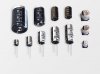
There are smaller ones on the circuit board(s) too. They generally look like this:

electrolytic-capacitors01.jpg

The cases often have different colours, but general markings and shape are a clear indicator.
 
Personally I would detach one or both of the old caps beforehand and compare pin spacing with specs of the new caps. Excellent chance you will need to adapt them to fit. Knowing what needs to be done in advance will give you time to ponder the options.
 
Electrolytics are usually polarized and have a "-" sign on one side designating the negative lead. There are non-polarized electrolytics (NPEs) which show up in speaker crossovers in particular. And of course all the film types that are non polar also. And ceramics and tantalums and Bumblebees and...a world of capacitance.

The big power supply electrolytics are always polarized so watch the polarity when replacing. Mark the negative terminal on the board if it isn't already.
 
Personally I would detach one or both of the old caps beforehand and compare pin spacing with specs of the new caps. Excellent chance you will need to adapt them to fit. Knowing what needs to be done in advance will give you time to ponder the options.

Thanks. I'm curious about that since when I ordered the new ones, it appeared all the specs, including size, were identical.
 
Back
Top Bottom