• The move to the new server is done. There are some software and database maintenance updates in process. This has us passing the hat around to help out. We appreciate any donations. Seriously, even a dollar helps. The payment page may be found here - https://www.audiokarma.org/support.html

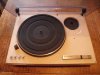
Plinth for Dual 1229

T.O.S.

Active Member
Hello everybody !
I was searching in the last tie some info about the idler drived tt and got some interest about the 1229 /1219 Even found some technically overhauled samples , wich is interesting because these babies need such attention more than others as far I understand.The question is : are the original plinths good enough for getting a great sound fro these turntables or they need soething more consistent( wooden ,plywood, heavier) .The 1229/ 1219 came in various odels of plinths from Dual,Grundig, Nordmende and others . Is there any better than others ?
 
Register to hide this ad
The proper answer to your question is 'Any turntable can benefit from a heavy base.' This is why Kenwood, for example, offered a model that is moulded in something resembling cement.
 
Once a Dual is properly serviced they run for years. Afterwards, about once a year, clean the connections in the head shell, the mute switch and RCA jacks. About every 3 years, oil the motor bearings and clean/re-lube the cam.
 
Hello everybody !
I was searching in the last tie some info about the idler drived tt and got some interest about the 1229 /1219 Even found some technically overhauled samples , wich is interesting because these babies need such attention more than others as far I understand.The question is : are the original plinths good enough for getting a great sound fro these turntables or they need soething more consistent( wooden ,plywood, heavier) .The 1229/ 1219 came in various odels of plinths from Dual,Grundig, Nordmende and others . Is there any better than others ?
What really makes the "sound" of a Dual turntable is the tonearm with its decoupled counterweight. Just park the turntable on a platform that doesn't resonate, and you'll be fine.
 
The offer is tempting :
-fully overhauled (cleaned , lubed ,adjusted,idler restored,)
-12months warranty
-14days returning

image.jpg
 
I think I'll get this and see what happends, then I'll try to see if I can find a a source for better/nicer plinth for a reasonable price.Many Dual owners wrote to me that ,being a sprung chassis design it is not affected by the weight of the plinth....contrary to the Lenco L75 wich benefits from a heavy plinth....wich I thought it would be the case in Dual tt also. A heavier plywood plinth can cost at least 120€ mmmm ....a bit too pricey!
 
I do not know what country you are from, but each and every one on this little ball of dust has fantastic artists who can make you a base from anything you may want.
 
If you are handy and have the tools, you can build it up yourself like I did.

http://audiokarma.org/forums/index.php?threads/andy-pimps-a-dual-1219-base.449245/

index.php
 
Andy, the one thing you did not do is double the masonite mounting board. Masonite is nothing but a fancy name for paper board.
But a very nice job for certain.
 
I thought about doing that, but decided that snugging up that 1/2" plywood under it around the inside perimeter would also stiffen it by reducing the effective length of the edge.
How well it works, I don't know, but it is much stiffer to my hand.

index.php
 
Last edited:
I think I'll get this and see what happends, then I'll try to see if I can find a a source for better/nicer plinth for a reasonable price.Many Dual owners wrote to me that ,being a sprung chassis design it is not affected by the weight of the plinth....contrary to the Lenco L75 wich benefits from a heavy plinth....wich I thought it would be the case in Dual tt also. A heavier plywood plinth can cost at least 120€ mmmm ....a bit too pricey!

I think it's a sprung chassis design not because it's the best option sonically, but because it's a convenient design you can strap on to a really flimsy plinth (some if not most of the plinths Dual offered with these were really pitiful, mostly bendy plastic affairs with some nice veneer strapped on them for good looks) and still expect it to perform well enough under most circumstances. Also especially the smaller Dual models were also used in all sorts of consoles and what not, where some kind of suspension like that was mandatory. IMO a Dual can do a lot better by getting rid of the springs and mounting it onto a solid plinth. IME the biggest sonic improvement was in the bass, the stock arrangement I found sounded a bit bloated, in other words the bass was bit overblown and overshooting, getting rid of the springs really tightened things up, not less bass, just better controlled. Bass control is where high torque/heavy plattered idler drives excel compared to most belt driven designs (and some direct drives as well), so to me it seems a bit of a waste to mess that up with a not all that great spring suspension. And now before the Dual enthusiast get all fired up, I do think a good example sounds just fine with the stock arrangement, and some people might even prefer it that way because it tends to sound a bit more 'friendly' with that nice, big, soft bass. The problem is it makes all bass sound a bit like that, even when what's on record is tight and controlled.

There's really not all that much between a good Dual and a good Lenco when both are similarly plinthed and using the same tonearm - and the Dual tonearms are far better than their looks might make you think. That said what there is between them probably warrants the effort to reach a step or two higher than the Dual for most people that go through the trouble to replinth etc. If there ever had been a 1019 or 1219 "motor unit" with a different platter bearing and no tonearm or changer mechanics, I believe they would fetch really good money these days. What really kills the Duals for a lot of people are the changer mechanics and the resulting bearing design, which was executed pretty well in the 1019 but less so in 1219/1229. The 1019 I have has a sort of 'ridged' surface on the bearing sleeve which really helps when using regular oil, the 1229 has a completely smooth sleeve and seems it relied on the special 'adhesive oil'. Now that stuff seems difficult to source and using a regular oil it seems it just doesn't stay as well lubricated as the 1019 bearing. It might also be the 1019 bearing is just in a better condition adding to the feeling it's superior. Build quality is better on the 1019, the chassis is more solidly made and combined with the fact it's smaller, it's a lot more rigid. The only problem I have with my 1019 is the motor isolation doesn't do the job 100%, for some reason seems a pretty common issue with the euro models at least. The motor runs really well and silently but I suppose the rubber grommets are not doing their job anymore, because some 50Hz vibration gets through to the chassis directly through the mounts. It's not intrusive at all, but it's there if you raise the volume a bit and listen. The 1019 tonearm isn't bad, if not exactly great - the one on 1219/1229 is quite a bit better.

If automatic functions are important to you, then you can't do much better than a good Dual, and if the big boys ever come over they might be in for a surprise after you hit the start lever :)
 
If you're referring to the platter support dowel, the early 1219 dowel had the same machined ridges. I think that this design was abandoned because it hastens wear of the platter sleeve bearing that it is in contact with. I have repaired enough Dual to know this to be so. The 1019 now on my work bench had enough wear to require a 'new' platter.
And, the crazy mechanisms under-chassis do absolutely nothing to alter the sound. The motors on either model have the same suspension, as well as a similar armature [the 1219 has a ceramic magnet added for even better speed accuracy] , so I do not know why you hear noise.
 
If you're referring to the platter support dowel, the early 1219 dowel had the same machined ridges. I think that this design was abandoned because it hastens wear of the platter sleeve bearing that it is in contact with. I have repaired enough Dual to know this to be so. The 1019 now on my work bench had enough wear to require a 'new' platter.
And, the crazy mechanisms under-chassis do absolutely nothing to alter the sound. The motors on either model have the same suspension, as well as a similar armature [the 1219 has a ceramic magnet added for even better speed accuracy] , so I do not know why you hear noise.

I know the mechanism doesn't alter sound, but that doesn't mean the turntable wouldn't fetch more money on the used market without it :) Even with the Lencos, a Goldring G88/G99 which is a motor unit without a tonearm (and I suppose in some respects better built than the stock Lenco) will fetch many times the price of a standard L75/L78. Also not having something feels better for most people than having something that doesn't work, even if the end result is the same for all practical purposes -> a Dual seems needlessly complex, and they are not nearly as much fun to work on than simple manual tables, which I'm sure puts many people off. There's also the perceived notion that a manual turntable sounds better than an automatic by default. In the Dual's case it might even be true, though not because of the automatics per se but the bearing design is compromised for having to accomodate the changer spindle.

Re the 1019 motor noise, I'm not sure why it happens, but it's there and digging the issue up in the past I found some threads where people experienced the same with 1019, but no one seemed to be able to really figure out why. The only reason I can think of is something wrong with the rubber grommets, though they seem as good as any I suppose. Going by feel and ear, the motor certainly doesn't seem to vibrate excessively, and actually it's the most silent motor between that one and the three 1229 motors I have. The vibration is finding it's way to the chassis directly through the motor mounts, the drive system is not to blame. Interestingly I think all the Duals in question were European models, might be just a coincidence or just more critical listening Dual owners this side of the pond :) It would be interesting to have someone who really knows their Duals to encounter a few motors/TTs like that and have their take on what's going on. Frankly I lost interest, it's not that bad and the table is currently doing bedroom duty where the volume never approaches levels where it would even be audible. I was on a mission for a while to make the ultimate audiophile machine out of the 1019, it's such an endearing design, I even had a Fidelity Research FR-54 mounted as a second tonearm on it. I eventually got a Lenco and came pretty quickly to the conclusion it was better suited for what I was after and my 1019 attempt was a bit too heroic for me and making things more difficult than they need to be.
 
Why does an AK member from Finland have an equal, and possibly better command of English than some American-born members?
 
No Transistors ,muovimies,Andyman
Pretty clear answers ,lots of interesting info, thank you !
1. What about the material ? Plywood plates MDF plates or hardwood ? I spotted manufacturers for all three variants
The alternative of doing it myself is out of question for various reasons

2. Another question :how bad is that bearing problem in the 1229/1219?
That means I should ask the seller in what shape is the bearing and also the motor gommets ... and not be interessed as much in the plinth , since sooner or later I'll probably change it...

3. Should I understand that the main bearing construction is some limiting factor in SQ and I should search maybe another type of Dual ? 621 or 721 ? Or the things are not as radical ?
 
Last edited:
No Transistors ,muovimies,Andyman
Pretty clear answers ,lots of interesting info, thank you !
1. What about the material ? Plywood plates MDF plates or hardwood ? I spotted manufacturers for all three variants
The alternative of doing it myself is out of question for various reasons

2. Another question :how bad is that bearing problem in the 1229/1219?
That means I should ask the seller in what shape is the bearing and also the motor gommets ... and not be interessed as much in the plinth , since sooner or later I'll probably change it...

3. Should I understand that the main bearing construction is some limiting factor in SQ and I should search maybe another type of Dual ? 621 or 721 ? Or the things are not as radical ?

I've built 3 plinths for various TTs, I think all the materials you mentioned can work well. It's really a bit of a black arts to be honest, but I don't think you'd go wrong with any of the materials you mentioned.

I've had no issues with the grommets or vibration from any of the three 1229 motors I've encountered, that's not a large sample size but enough for me to think it's probably not going to be an issue. As for the main bearing, the "problem" is the design - because of the way the changer mechanics work, instead of using a point bearing or whatever the right term for it is (this is the type of bearing you find in pretty much every TT apart from changers) it's constructed a bit differently and uses a bearing race at the bottom. I wouldn't say the issue is radical but I also don't think this type of bearing can ever be as good as a good point bearing. Friction is not an issue, all Dual bearings of this type I've seen have been very freely spinning, but they tend to be a bit more noisy - maybe I'm missing some servicing magic, but if so, to me that again speaks to the bearing design not being as good, because a trained ape could service a typical TT bearing without issue :) Now keep in mind "noisy" in this case is a very relative term, you shouldn't hear any noise from the bearing unless cranking the volume very high, or listening to the spinning TT very closely / using a stethoscope or similar. There are a lot of very happy Dual owners out there, and many people prefer the idler Duals to their belt drive / DD tables despite the bearing. With any TT the condition of the bearing is very important. Personally I believe a good platter bearing is the heart of any turntable, and improvements in this area can sometimes yield surprising sonic benefits, but these are mostly subtle.

The Duals are very enjoyable TTs and do sound good, and what they do well they do very well - to get similar drive and authority from a belt drive design for example, you'd probably have to pay pretty much for it and besides some rare sleepers. In the (roughly) same price range I'd rather go for a Lenco myself, but then to truly surpass the Dual you'd probably need to get rid of the stock tonearm and get something better, which means more cash or working some magic on the original. The Duals have their quirks with the mechanics, the 'cartridge sled' etc. but at the end of the day you get a lot of great turntable for your money and IMO most "typical" cheaper japanese S-shaped arms from the same time period are sonically a step backwards compared to the Dual arm. If you're not mechanically inclined or aren't interested in learning to be, I'd recommend to get it serviced by a pro or a dedicated hobbyist who knows what they're about. NoTransistors is one such guy in the US, if you're in Europe and want a Dual there are some places in Germany (can't remember any names at the moment) who sell serviced ones for which I thought were very reasonable prices the last time I checked.

 
Good post, muovimies , I can , if you promise not to tell anyone , tell you that Lenco 75/78 is a secret project that I have in mind ...but now I am searching for an automatic , for the confort of use in some situations , to replace the T4P that I am not fully convinced
 
Back
Top Bottom