• The move to the new server is done. There are some software and database maintenance updates in process. This has us passing the hat around to help out. We appreciate any donations. Seriously, even a dollar helps. The payment page may be found here - https://www.audiokarma.org/support.html

Polarized Electrolytic Caps in ADS L710 XO

oldsmobuick

Active Member
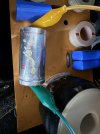
I am replacing C1, the 100uF axial, in each of my L710's and assumed they'd be non-polarized, but they are in fact marked + and - and the schematic shows polarized as well. I ordered like for like from Mouser, but found it odd. Also the crossover schematic shows only 4 caps, and notes them all as polarized whereas I have 5 caps, 4 of them film caps which are of course non-polarized. My L710's are a 4-digit serial number of the first series, circa 1975. Not a "problem" per se, just wondered what gives :)
 

Attachments

  • Screenshot 2025-04-01 at 5.13.29 PM.png
    Screenshot 2025-04-01 at 5.13.29 PM.png
    494.2 KB · Views: 84
  • IMG_0568.jpeg
    IMG_0568.jpeg
    106.9 KB · Views: 86
Register to hide this ad
I would guess someone who didn't know what they were doing replaced NP caps with polarized ones and that's what you are looking at. You really should use nonpolarized caps there.
 
That is a standard capacitor symbol and some web sources say non-polar, showing a + on the straight side of the symbol.
 
Seems untouched or not, they should be NP caps. You can make an NP cap from two polarized caps by connecting them in series, - to -. Two 100 uF caps connected that way gives 50 uF NP.

As for standard cap symbols, that's a hand drawn schematic. I wouldn't count on whoever drew it strictly adhering to standards.
 
Standard is curved line neg.
Yes, but there is also the group that use that symbol to indicate a capacitor without regard to polarity. In that case a + is used on the polar caps in those diagrams. We do not know the convention of the ads diagrams. Since it is normal to use non-polar caps in speakers, the use of this particular symbol probably means a non-polar cap.
 
It doesn’t look that way, seems untouched.
"ROE" /Roederstein caps should be considered original to ADS/Braun. Agree that switching to NP is the way to go. Whenever you're in doubt, always go with NP. It's always the safest choice and can't be installed incorrectly, causing problems.
 
I went ahead and ordered a couple of 100/100 MPT Film Caps. Expensive, but I remembered that's what I used in my KLH Six with excellent results. I found a pic of an old Braun L710 crossover with Roederstein polar caps also (2x50uF).
 
Maybe Mr. So knows of Gary and can vouch for him.
Who's Mr So? The plot thickens!

2a453c3b-0d00-4aaf-acaa-9200a3fd4d36.gif
 
From Google Heaven... :)

Always use non-polarized capacitors for the AC signals in speaker crossover networks because AC continuously reverses polarity.

If you use a polarized electrolytic in a crossover network, you probably won’t be able to hear the difference. However, measurements will show the difference (human hearing is a terrible measuring instrument).

After an uncertain amount of time, the electrolytic capacitor values start drifting, making the circuit operate even further away from the intended point. Again, you may or may not hear the problem, but it will be measurable.
 
Gary does not say whether the caps are polarized or not. Those viewing his work are deciding what he meant with the cap symbol he used
Gary used the industry standard notation for a polarized electrolytic cap (one side curved, as pointed out above) so no other notation should be required.

There is a schematic for the Braun 710 ( in German) out there on the interwebs that does not show polarized capacitors in the crossover but the Braun version may be very different than the ADS one. The only electrolytics I’ve seen in loudspeakers are BP/NP.

The OP could contact Richard So and ask, surely he would know.
 
Last edited:
Gary used the industry standard notation for a polarized electrolytic cap (one side curved, as pointed out above) so no other notation should be required.
There are web descriptions of the curved and straight caps as being nonpolar. Not saying it is always nonpolar and I knew it as polar but if it was taught as nonpolar to Gary, he may have meant it to mean nonpolar. Or maybe Gary didn’t see the difference if he was looking into these products as some caps are film caps and others are ’lytics.
Just saying we do not know the meaning of the symbol but we know to use nonpolar caps in speaker crossovers.
 
Back
Top Bottom