• The move to the new server is done. There are some software and database maintenance updates in process. This has us passing the hat around to help out. We appreciate any donations. Seriously, even a dollar helps. The payment page may be found here - https://www.audiokarma.org/support.html

Ported LaScala (Tribute to the late DJK)

THD+N

Portus
Subscriber
This is a continuation of some posts about a ported LaScala in the "Input sought re: tri-amping La Scalas and going with active (DSP) networks" thread.

If you have an older LaScala with open back and your plan is to remove the "dog house" cover inside the open top and then use the additional air volume and make a rear panel that is ported, you will have approximately 4.5cuft to work with as far as box tuning. Two 4" (diameter) x 7" long will tune a 4.5cuft enclosure to 30Hz.

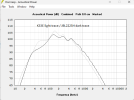
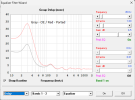
Here is the TF1525 simulated in WinISD using the 1525 pdf specs and some PEQ to optimize the response:
PEQ - 35Hz, Q=1.4, Gain=6.5dB
PEQ - 80Hz, Q=1.4, Gain=-2dB

1689183859712.png


I'll try and post the Horn Response simulation once I determine it is accurate. I'm much more versed at bass reflex using WinISD than Horn Response.
 
Register to hide this ad
Additional info:

 
Below Horn Response sims are corrected and based on the "ported model" of the LaScala:

Compared to the GRS K33 which is currently in my ported LaScala, the TF1525 sounds (from listening test) like it needs a slightly different PEQ to be optimized on the bottom end.

K33E vs Celestion TF1525

1689282511253.png

K33E vs JBL2225H

1689251720440.png

JBL 2225H w/30Hz high pass filter & 45Hz PEQ

1689251805461.png

1689253190573.png

Xmax could be a limiting factor in these simulations especially with PEQ/EQ not to mention operating the speaker at or near max power handling if high SPL's are desired, which is not really the case here, but something to be cognizant of. According to published data, the K33 (and its variants) have an Xmax of 8~8.5mm. When I recone my K33P's soon, I'll have the opportunity to actually measure the Xmax and confirm.

At low(er) to mid power levels a lot of these woofers should perform well in the ported LaScala model.
 

Attachments

  • 1689251023725.png
    1689251023725.png
    15.5 KB · Views: 46
Last edited:
Just read a lot of the "Help" file in Horn Response, very useful, but you have to be patient and READ it, then apply it.
 
Yep, the 4 db increase at 400 is even better with the Eminence with 3" Aluminum VC Kappa Pro 15a. Try that one in comparison to the Celestion but don't forget to use 2.83 volts with the same loading (1 Pi?).
 
Last edited:
That JBL doesn't look too bad, reduced X-MAX not withstanding; it seems to simulate a little flatter than the K33 and the lower sensitivity won't be an issue with bi-amping. Is that with a port, or just the standard enclosure? I don't play above 85dB, so I doubt the X-MAX will be an issue.
 
K33 (and its variants) have an Xmax of 8~8.5mm. When I recone my K33P's soon, I'll have the opportunity to actually measure the Xmax and confirm.
The Xmax on a 15C is only 2.5 mm, it won't work well in a Cornwall, BUT I had them in my Quarter Pies and Edgarhorn Titan II's (3 ft. Hypex, straight axis horns). PWK measured a 1.5 mm excursion in a Khorn at full 120 output with a laser in the Plexiglas Khorn built for that purpose.

JBL Xmax specs are pretty conservative AND the Bass Reflex portion of the LaScala produces the lowest excursion possible when tuned right. I don't see an issue. The 2225 is one RUGGED pro woofer (ever seen one?) which will not be taxed at all. No worries. The curve you did shows it to be the flattest and broadest, so Gigantic should definitely use them.
 
That JBL doesn't look too bad, reduced X-MAX not withstanding; it seems to simulate a little flatter than the K33 and the lower sensitivity won't be an issue with bi-amping. Is that with a port, or just the standard enclosure? I don't play above 85dB, so I doubt the X-MAX will be an issue.
It will NEVER be an issue for you. JBL is a Great driver and it's response is more than "a little flatter." LOL. It knocks down the nasty 140 Hz. peak, extends the bass below 40 hz. by quite a bit and the midrange above 400 Hz.. Use them with confidence and a thanks to THD+N. I'm just "seconding" the motion. Literally and figuratively!

Plus if you use a 1 Pi loading for the ports firing to the back wall, you well get a "free lunch" with a 6 or greater db output coupled to the Room below 100 Hz. that you will Hear and FEEL. Measuring with REW will also verify it's all good!
 
Last edited:
I tend towards understatement on that...

I imagine that I could make it board flat with PEQ pretty easily..
 
It will NEVER be an issue for you. JBL is a Great driver and it's response is more than "a little flatter." LOL. It knocks down the nasty 140 Hz. peak, extends the bass below 40 hz. by quite a bit and the midrange above 400 Hz.. Use them with confidence and a thanks to THD+N. I'm just "seconding" the motion. Literally and figuratively!
I had to interpolate some of the input parameter data because it was not on any published JBL spec sheets. Hopefully it (the data) is close so the simulation is accurate.
 
It will NEVER be an issue for you. JBL is a Great driver and it's response is more than "a little flatter." LOL. It knocks down the nasty 140 Hz. peak, extends the bass below 40 hz. by quite a bit and the midrange above 400 Hz.. Use them with confidence and a thanks to THD+N. I'm just "seconding" the motion. Literally and figuratively!

Plus if you use a 1 Pi loading for the ports firing to the back wall, you well get a "free lunch" with a 6 or greater db output coupled to the Room below 100 Hz. that you will Hear and FEEL. Measuring with REW will also verify it's all good!
The ports firing to the back wall make a HUGE difference (at least in my room / corners). You can use less EQ/PEQ which will help IM & Group Delay. Only use what you need (EQ/PEQ) instead of too much.
 
The ports firing to the back wall make a HUGE difference (at least in my room / corners). You can use less EQ/PEQ which will help IM & Group Delay. Only use what you need (EQ/PEQ) instead of too much.
Fortunately the group delay is directly propotional to the wavelength, to which, we are not prone to hearing. Like Subwoofers below 40-80 Hz. (mine cross at 40 in HT and 80 for music with a straight axis horn the same length as a folded FH-1, similar to a LaScala.
 
That JBL doesn't look too bad, reduced X-MAX not withstanding; it seems to simulate a little flatter than the K33 and the lower sensitivity won't be an issue with bi-amping. Is that with a port, or just the standard enclosure? I don't play above 85dB, so I doubt the X-MAX will be an issue.
The 22225H with its X-max of 5mm will not be an issue or problem in the ported LaScala.
 
Back
Top Bottom