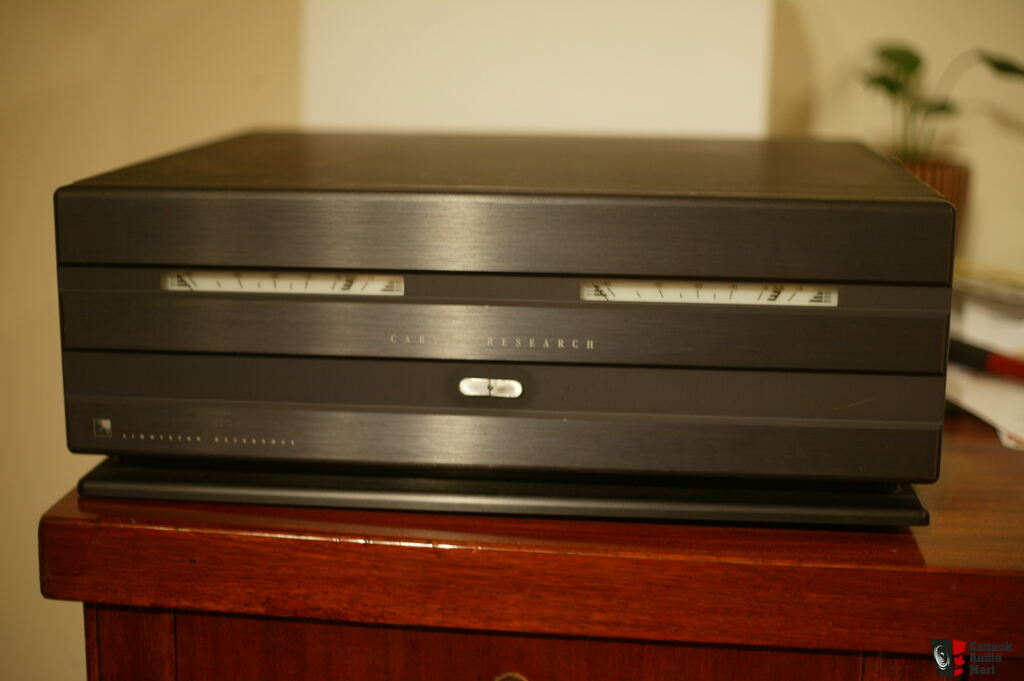
cinepro 3k6se II
425 WPC/8 ohms (typ. 500 W)
700 WPC/4 ohms (typ. 770 W)
1000 WPC/2 ohms (typ. 1200 W)
1200 Watts Mono 8 ohms x 3
1400 Watts Mono 4 ohms x 3 Dynamic Headroom: over 3.5 dB (more than double the power for short bursts)
MFR: 3 Hz - 185 kHz ± 3 dB
THD: 0.15% at Full Output
Input Impedance: 30 k Ohms; Balanced XLR and Unbalanced RCA Input Jacks
Size: 8" H x 19" W x 16" D
Weight: 86 Pounds
MSRP: $7,500 USA
A close-up of the power supply board (below) shows the star grounding system (red arrow), which helps give the Cinepro its incredibly low noise floor. Instead of having ground wires from various circuits go to the nearest ground buss, or to the chassis, all ground wires lead back to the same point. This means no difference in ground potential from circuit to circuit, and thus, lower noise. The power supply capacitors are underneath this board. The yellow color of the boards is due to gold-plating, on top of nickel, on top of the 4 ounce copper traces (4 ounce means that the circuit board has 4 ounces of copper plate before the circuits are etched into it). This eliminates any oxidation of the traces. Wiring is solid silver. Absolutely nothing has been spared in quality here.
The Cinepro 3k6 SE Gold is a six-channel, 425 watt per channel (into 8 Ohms), power amplifier that just begs to be in your home theater. Their multi-channel amps have been very popular with professional installers for some time, hence the name Cinepro, which does have the ring of the pro market. At 425 watts per channel, the 3k6 is probably the most powerful multi-channel amplifier in the world. And, these 425 watts have the power supply to back them up. A huge 4.2 kW toroidal power transformer delivers ± 95 volts to six 25,000 µF capacitors, for 677 joules of energy storage. That is one big power supply! There are three voltage gain stages, and the output stage of each channel has fourteen 250 watt bipolar transistors. LEDs on the front panel light up for each channel when there is a signal, and there is an additional LED for each channel in the situation where you overdrive the amplifier. I never encountered such a situation, even with electrostatic speakers, so I think the only purpose they would serve is to make you feel more secure when cranking a Stallone movie.





 this one was the trickiest to solder but sounds incredible...cheers