• The move to the new server is done. There are some software and database maintenance updates in process. This has us passing the hat around to help out. We appreciate any donations. Seriously, even a dollar helps. The payment page may be found here - https://www.audiokarma.org/support.html

Problem with a DIY Dynaco ST-35 clone

currituckco

Super Member
Hi all,

I'm building a Dyna SCA-35/ST-35 hybrid clone and having some trouble. I have the thing built right now as an ST-35, without the phono board built out (an SCA-35 is basically an ST-35 plus a phono stage and selector switch/volume/tone controls, plus a higher gain, worse sounding driver for the output stage to account for the signal loss in the tone controls. I'm building with no controls and lower gain, better sounding ST-35 amp boards.)

I built the power supply like the SDS power supply boards for the SCA-35, with 5 filter stages of 220uf. I'm using an Edcor 330-0-330 power transformer, exact same voltage/current specs as the Dyna PT-774 used in both SCA and ST-35s.

When I fire it up, I'm getting a wild oscillation, which I'm pretty sure is coming from the driver stage. The voltages all around are ridiculously high, and I can't figure out why.

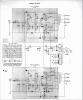
The voltage on the first cap is supposed to be 385vdc and I'm seeing like 475v. Then after R12 (51ohm/5w dropping resistor) it should be 380v and I get 472v. I experimented, just to see what happened, with putting more resistance there, but my readings basically didn't change.

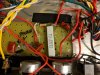
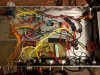
I'm stumped and I wondered if any of you guys had any suggestions of what to look at. Pictures attached. Note - right now one side of R12 is desoldered from it's wire from the diodes (actually from a thermisor between the diodes and the first cap) and its cap because I was testing other resistances there. The phono board is empty, though I have the cap that will eventually supply its B+ in there.
 

Attachments

  • IMG_20180424_144900.jpg
    IMG_20180424_144900.jpg
    137.6 KB · Views: 88
  • IMG_20180424_144919.jpg
    IMG_20180424_144919.jpg
    110.6 KB · Views: 81
  • Screen Shot 2018-04-24 at 10.11.48 PM.png
    Screen Shot 2018-04-24 at 10.11.48 PM.png
    252.3 KB · Views: 75
Register to hide this ad
Make sure you haven't reversed the OT sides (to the power tube anodes), or the feedback side on the secondary.

That' happened to me and it took me a long time to figure out what was wrong. In fact I was adding feedback: I made a beautiful generator instead :)

Disconnect the feedback to see if it still oscillates.
 
The OT sides aren't switched. The feedback side on the secondary, is that how the 16ohm tap is connected to C7/R10 on the board? I wasn't sure how to connect that - I'm using the 8ohm taps only. I experimented with connecting the 16 ohm taps of the OTs directly to the boards, also with disconnecting the 16ohm taps and connecting the feedback to the 8ohm taps. Neither of those stabilized the amp.

I just disconnected the 16ohm OT taps from the boards and fired it up - I didn't hear that oscillation, but the power tubes red-plated like crazy!
 
As Brice said, if the plate leads are reversed, then the unit becomes an oscillator. BUT, even if the plate leads aren't reversed but the screen grid leads are, it will still be come an oscillator. You say the leads are not reversed. To prove that, with the unit turned off and discharged, connect on lead of your Ohmmeter to pin 7 of one output tube. Then connect the other lead to:

1. Pin 9 of the same tube,

2. Then the CT B+ connection,

3. Then, pin 9 of the other tube,

4. Then, pin 7 of the other tube.

As you step through this process, the Ohmmeter reading should increase with each step, giving the highest reading in step 4. If that is not the case at each step, then one or more of the primary leads in fact are not connected correctly. If the resistance does grow with each step, it is still possible that the entire primary winding is reversed as well.

If you are certain that all is well, then pull the driver tubes out and operate the amplifier. If all or some of the output tubes still red plate, then either:

1. You have a short connecting Pin 3 of the output tube directly to ground, or

2. There is no DC resistance from Pin 2 to ground (should be 470K), or

3. One or more of the output tubes is not drawing any current at all, or once again

3. Your OPT primary leads are connected incorrectly.

Check the voltage coming off the Edcor transformer when operating. If delivering 330 volts AC each side, that should produce a B+ of about 412 vdc under load if the output stages are biased correctly.

Even if you only use the 8Ω tap, the NFB lead should be connected to the 16Ω tap.

I hope this helps!

Dave
 
I followed your instructions, Dave - my findings were that the resistance increased as it should from point to point. I got:

Right Left
1. 121.5 121.6
2. 191.2 191.3
3. 263.3 263.5
4. 356.4 356.7

Then I observed no red-plating when I operated with the driver tubes pulled. The Edcor was putting out about 424vdc.

I had previously pulled the driver tubes and seen the problem disappear, so that's why I thought the problem might be somehow in the driver stage. But I'm not sure how to diagnose beyond that. Any suggestions very much appreciated!
 
I'm not totally familiar with your stuff but I have some thoughts .
The sds boards have no natural grounds.
What I mean is the negative of the board has to be tied to chassis otherwise you get weird readings.
Also IIRC there was some weird ground issue that went missing (I think at input or speaker leads. I don't remember).
I've seen it pop up in other theads..(maybe stock the the terminal physically tied to chassis where in New builds the jack is insulated from the chassis.
One other thought. I remember leaving (I think feedback or ground off in mk3 rebuilt and it was motorboating.
I may not be comparing apples to apples here but worth a look.
I'll see if i can find the connection I left out on the mark 3
 
I had that problem once when I was rebuilding an SCA-35. I kept popping fuses and burning up resistors and couldn't figure it out, but it was exactly that problem. In this case, I have a ground buss from the jacks, through the speaker commons, to the power supply ground, to the chassis/PT CT/AC ground.
 
Make sure too that your coupling caps are not reversed between the output tubes. That is, the coupling cap from the plate of the inverter section of the driver tube must connect to the output tube with the Blu-Wht transformer lead connected to pin 7, and the Grn-Wht lead connected to pin 9. If the OPT leads are connected correctly, but the coupling caps are reversed between the output tubes, then the effect will be the same as having the transformer leads reversed as well........

Dave
 
You might also consider decoupling these two problems so you can focus on them independently. For example disconnecting the driver stage from the output stage so you can debug the output stage independent from the rest of the amp and without influence from the driver stage. Once you get it biased correctly and not red plating, but before you reconnect the driver stage, also check the quiescent conditions of the first two stages just to eliminate any potential problems there. Then reconnect the driver stage and focus on the oscillation problem.

One other possibility for the oscillation is too much feedback is applied (as in your feedback resistor is smaller in value than you think it is.
 
Also worth a look, is the secondary of the output transformer grounded where it should be? No ground connection makes them go really stupid.
 
Welp, I found the error, and it was one of my dumber mistakes. I had switch the signal and ground from the input jacks to the boards. Interestingly it still played music somehow. :dunno:

Unfortunately, I also roasted one of my output tubes when I redplated them with the feedback disconnected, so one side squeals. And very unfortunately, it was a vintage mullard, which I shouldn't have been using during testing, but I didn't have anything else.

Thanks all for the help and suggestions.
 
I keep cheap new or used tubes for first fire up. I started doing this after roasting one myself. And if you don't kill them your good for the next build. :thumbsup: At leased you figured it out.
 
Back
Top Bottom