• The move to the new server is done. There are some software and database maintenance updates in process. This has us passing the hat around to help out. We appreciate any donations. Seriously, even a dollar helps. The payment page may be found here - https://www.audiokarma.org/support.html

PRV D2200 Continued.

Mike, have you considered putting an 8-ohm resistor in series with the driver and bypassing it with a 10 µF capacitor? That should give you roughly 6 dB of attenuation below the shelf, with the capacitor creating a first-order transition centered around 2,000 Hz and gradually bypassing the resistor above that point. It may get you in the ball park.
I tried that, and dozens of other tricks, with no success so far :confused:
 
Reflection or mouth area? Care to experiment? Raise the Fc to 325, but keep the same mouth on it, if possible.
Or, heck, that's +/- ~2dB, not bad to get as low as its getting.
You bring up a good point! The 270hz horn has a 60-degree exit angle. The tool I'm using allows up to 88 degrees. :idea:
 
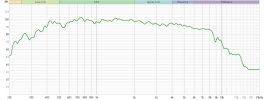
Dug this out of my old measurements, labeled midrange with no EQ.
PRV2200ph on WG45-50.
Since this was when I was working on the whole system(LS) I believe I had the mic at 1meter, aligned between the tweeter and midrange, so slightly off center from the midrange for this measurement.

Limits set the same as Mike's measurements above showing the his fc270 horn and wg45-50.
PRV-D2200PH on WG45-50v2.jpg


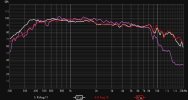
for comparisons sake, scaled and overlaid in photoshop, my measurement in purple.

invid-in-purple.jpg
 
I don’t really see the response around 2 kHz as a problem. With a 270 Hz horn, you have a lot of acoustic authority from roughly 300 Hz through 1 kHz, and that lower-frequency loading is raising the output in that region. So what looks like a 5–6 dB dip around 2 kHz may really be the response returning closer to the driver’s normal level after the horn has given you that extra efficiency lower down.

That’s also why the same driver can look much flatter on a 600 Hz horn. The higher-frequency horn simply isn’t providing the same amount of loading and output down in the 300–800 Hz region. Personally, I’m pretty impressed to see a 270 Hz horn working that well that low, especially with a driver intended to cross around 600 Hz.
 
Back from the Western Slope! Too much great food and wine, if that's possible.

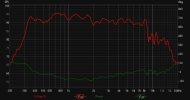
Thought I would do a simple on axis comparison of the D2200ph, WG45-50 (red) vs Dave's FT402 (white).

Dave's horn definitely loads the driver better, resulting in a very flat response from 400hz to 8500hz.

D2200ph WG45-50 vs FT404.jpg

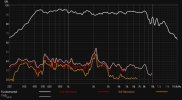
@Deang finally convinced me to start focusing on distortion as well. I admit I don't fully understand how REW measures distortion, but here's a plot. I decided to display only Fundamental, 2nd, 3rd order just to keep it cleaner. THD of all harmonics as well. D2200ph on the FT402.

D2200ph FT402 Distortion.jpg

Spikes at 530hz and 2250hz seem a little excessive???
 
Thanks, Mike, for taking the time to do the work and helping us understand what we're looking at here. I'm still learning how to interpret the distortion measurements myself.

In simple terms, through most of the usable range the distortion appears to be roughly **0.1–0.5%**, with much of it around **0.2–0.3%**. The highest point is around **2,000 Hz**, where it briefly reaches approximately **1.5%**. That localized peak could be coming from the driver itself or the interaction between the driver and horn.

For some perspective, these are very low distortion figures and would generally be expected to be considerably lower than the distortion from the 15-inch woofer in a folded-horn bass bin**, particularly toward the upper end of the woofer's operating range.

Overall, I consider these very good results, and I'm very happy with how the D2200PH and FT402 performed in this test.
 
I always wondered how one knows how well the diaphragm is being loaded unless they do a distortion test. You can see the response climb and begin to level off, and the assumption is that it’s a safe place to transition - but that’s not the whole story.
 
Frequency, and especially impedance loaded - vs - unloaded can give you a lot of info, right?
Distortion climbs as diaphragm motion goes up, too.

Then again, there's always the clanking noises...
 
I always wondered how one knows how well the diaphragm is being loaded unless they do a distortion test. You can see the response climb and begin to level off, and the assumption is that it’s a safe place to transition - but that’s not the whole story.
Phase response is also a tell. IIRC, mine lost directivity below 450Hz with the WG4550 horns, which I, along with others much smarter than me, attributed to losing horn loading. When I pull the mic out again, I'll also pull out one of @mboxler's prototype elliptical tractrix horns and see how they perform. I made an adapter that lets me swap them with the PRV WG4550, so I can get raw and in baffle responses. I have some new drivers set to arrive on Saturday, so that will give me the impetus to start testing again.
 
This one should load pretty well down to 350 Hz.

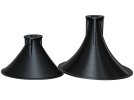
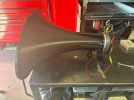
This is a new experimental Elliptrac design sitting next to the Elliptrac 400 for comparison. The finished outside dimensions are 22" × 12", with a calculated acoustic mouth of 20.6" × 10.6". The design target is a 350 Hz crossover with a 0.4-octave loading margin, which puts the calculated parent cutoff at approximately 265 Hz.

I built this specifically for a customer, but he was disappointed in it so here it sits.

Codex Image Sep 18, 2026, 06_23_24 PM.pngEliptrac 350.jpg
 
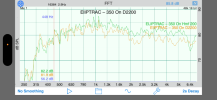
The response using the D-2200 is near identical to what @mboxler found using this driver on a large format horn.

Definately a great driver, just better suited for a smaller horn.
IMG_5592.PNG
 

Attachments

  • IMG_5593.jpeg
    IMG_5593.jpeg
    19.6 KB · Views: 7
  • IMG_5594.jpeg
    IMG_5594.jpeg
    17.8 KB · Views: 7
Dug this out of my old measurements, labeled midrange with no EQ.
PRV2200ph on WG45-50.
Since this was when I was working on the whole system(LS) I believe I had the mic at 1meter, aligned between the tweeter and midrange, so slightly off center from the midrange for this measurement.

Limits set the same as Mike's measurements above showing the his fc270 horn and wg45-50.
View attachment 3821182


for comparisons sake, scaled and overlaid in photoshop, my measurement in purple.

View attachment 3821185

can we see SPL + Phase?
 
Back
Top Bottom