• The move to the new server is done. There are some software and database maintenance updates in process. This has us passing the hat around to help out. We appreciate any donations. Seriously, even a dollar helps. The payment page may be found here - https://www.audiokarma.org/support.html

Question about replacing relays

Sergimm

Active Member
I am trying to find out why a Denon PMA 560 has very low volume on both channels. Looking around on the web I've seen that a common problem in this amp is that relays often fail or misbehave, so I went ahead and ordered new relays on Ebay that are supposed to be compatible with this model.

The new relays are a different, modern model.

Current:
Manufacturer: DEC
24VDC
Type: DH2TU
3A 120VAC
Number of pins: 6​

New:
Manufacturer: OMRON
24VDC
Type: G2R-2
5A 120VAC
Number of pins: 8​

Main differences are current (3A vs. 5A), and number of pins (6 vs. 8). I attach photos of each.

My question is basically if they are *really* compatible, and how would I go about cutting the pins of the new Relay, which seems necessary in order to fit it in. Also, I'm definitely not certain that the relays are at fault, but it seems wise to replace them given that they are prone to fail. Good idea?
IMG_8485.jpg
IMG_8483.jpg
IMG_8486.jpg
 
Register to hide this ad
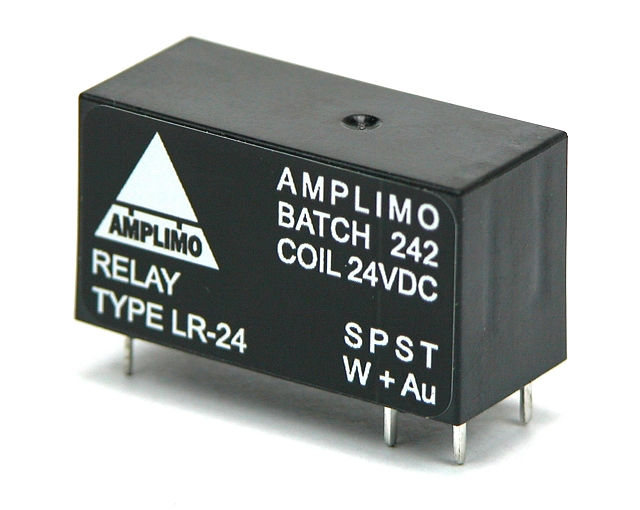
Have a look at the Amplimo relay and at its parameters. It's designed for speakers protection, see the description:
(no affiliation)
Miniature relay, specially developed for switching loudspeakers. Equipped with a tungsten pre-contact that can switch as much as 100A (at 50V) loudspeaker peak current.
After closing this lead contact, this is bridged by a silver contact, so that the transition resistance is also minimal with small currents (mA).

LR_RELAIS.JPG
1. https://www.hod-electronics.nl/nl/relais/luidspreker-relais/AMP LR-24V
2. https://www.toroidal-transformer.co...-relay/566/loudspeaker-relay-24v----lrz-.html
 
Last edited:
Problem with general purpose relays is that they don't last long. Contacts are not good for audio signal, they oxidize and have poor conductivity, especially at low volume.
That Amplimo relay looks good, it is designed for audio, for speakers.
 
Are you sure that original relay is bad? Typically when relay is bad, there is problems in low volume, one channel, L or R don't have contact, and when you turn volume up than sounds better.
Audio (speakers) relays have bifurcated contact (like that Amplimo), best have gold contacts, like famous Omron G2Z-222P-US, used in many Japanese amplifiers through 80's. That Omron works for 30 years, but is unobtainable now.
Today DEC is one of the better choice for relays, Luxman use them in their high-end amps.
 
General purpose relays are designed to work with one voltage, usually 110V or 220V, and they do it good.
Audio (speaker) relays must work with 0.001V and 28V at the same time, and problems are always with that low voltage.

28v is example, if amp is 100W
 
General purpose relays are designed to work with one voltage, usually 110V or 220V, and they do it good.
Audio (speaker) relays must work with 0.001V and 28V at the same time, and problems are always with that low voltage.

28v is example, if amp is 100W

That's really helpful, thanks. Knowing that, I'll look for better relays.

I am not sure it's the relay...it probably isn't the problem in fact, given that it's happening on both channels. I don't know much about relays, how much can the parameters of a relay change? What makes them compatible?
 
Contacts of relays changing parameters, rising resistance as they become oxidized or wornout.
Compatible relay should have all parameters same as original, or close as possible. That means switching voltage and amperage, coil resistance and coil voltage.
And must be designed for speakers. They never have 8 pins, just 6.
 
It's not the relay. If the speaker protection circuit was kicking in or there was excessive DC offset, it would be intermittent or cut out altogether. If it's low volume on both channels, I would be looking at the power supply.

Did this just happen?
 
It's not the relay. If the speaker protection circuit was kicking in or there was excessive DC offset, it would be intermittent or cut out altogether. If it's low volume on both channels, I would be looking at the power supply.

Did this just happen?
Yeah it just happened. Unopened amp that has been unused for many years. Tested it carefully when I received it, only issues were heavy scratching and sometimes a channel failing. Took off the cover to check, but nothing else. Next thing I know, the volume is super low.

At least I can be sure it’s not anything in the tone control, because it has a tone defeat button, and The low volume persists when it’s activated.
 
I would first deoxit all switches and those two big slider switches (input selector?), potentiometers.
That would be the absolute first thing to do on all vintage amps or receivers before any other testing or repair. If you also end up having the dirty/oxidized relay problem: I restored dozens of them and as far as I know all are still fine, some after +10 years. The only one which was hopeless (melted contact surfaces) was a funky and ultra-unobtainium Fujitsu relay in 1974 Accuphase E-202.
 
I am trying to find out why a Denon PMA 560 has very low volume on both channels. Looking around on the web I've seen that a common problem in this amp is that relays often fail or misbehave, so I went ahead and ordered new relays on Ebay that are supposed to be compatible with this model.

The new relays are a different, modern model.

Current:
Manufacturer: DEC
24VDC
Type: DH2TU
3A 120VAC
Number of pins: 6​

New:
Manufacturer: OMRON
24VDC
Type: G2R-2
5A 120VAC
Number of pins: 8​

Main differences are current (3A vs. 5A), and number of pins (6 vs. 8). I attach photos of each.

My question is basically if they are *really* compatible, and how would I go about cutting the pins of the new Relay, which seems necessary in order to fit it in. Also, I'm definitely not certain that the relays are at fault, but it seems wise to replace them given that they are prone to fail. Good idea?

View attachment 1921325
View attachment 1921326
View attachment 1921327
I use the Omron relays all the time. Just snip off the 2 unneeded pins and away you go. The only other thing to be mindful of is the coil resistance. The Omron datasheet will tell you that if it is in question.
 
That Omron is general purpose relay, it will not last long.
They are ALL "general purpose" relays and the Omron last longer than the Energizer bunny. :p Hell, a LOT of "original" relays in audio equipment are Omron "General Purpose" still working after 50 years.
 
Agree, Omron G2Z-222P-US was a great speaker relay, worked great over 30 years, but is unobtainable long time ago.
GP Omron will work very good for 6 months.
 
Agree, Omron G2Z-222P-US was a great speaker relay, worked great over 30 years, but is unobtainable long time ago.
GP Omron will work very good for 6 months.
Well, I still have them working flawlessly for years. The silver plating on the points will last for years and years and silver is the best for conducting signal. Check the datasheet and you'll see the points are ag...
 
People seem to be taking about two different relay requirements and getting confused as a result, one kind for speaker connection use, and another kind for low level signal switching. The low level signal relays DO need to be designed for the purpose with special contacts, because of the very low currents involved.

You might be able to buy 'boutique' speaker relays :rolleyes: - but who wants to switch 100A at 50V in a piece of vintage gear? I can only think that these relays must be for live switching of PA system speakers by the sound of it?

In my experience it is very rare to use anything but 'ordinary' relays for speaker protection/switching relays used in vintage gear. So unless you chose an under-rated relay - or buy cheap knock-off or counterfeit relays, you won't have any problems with them.

To the OP
I would check carefully before cutting off two of the pins on the replacement relays you have. Although the 'footprint' is similar to the old ones, the contact assignments may be different - so you might just be cutting off contacts and ruining the relay as a result. Another look at the replacement relay you have reveals that pins 2 & 7 are the 'NC' contacts for that particular relay. You should check the contact assignment on the old relays.
 
Last edited:
Back
Top Bottom