• The move to the new server is done. There are some software and database maintenance updates in process. This has us passing the hat around to help out. We appreciate any donations. Seriously, even a dollar helps. The payment page may be found here - https://www.audiokarma.org/support.html

Question about speaker enclosures

PJP122954

Member
I'm considering purchasing an older pair of Klipsch Forte's and the cabinets need to be replaced due to moisture damage. Can you tell me why they use MDF and veneer rather than solid wood. Is it a cost consideration or does it affect the sonic quality? I will have the old cabs and can use them for a pattern. Question is should I use solid 3/4' walnut or 1" MDF. Thanks in advance.
 
Register to hide this ad
I'm considering purchasing an older pair of Klipsch Forte's and the cabinets need to be replaced due to moisture damage. Can you tell me why they use MDF and veneer rather than solid wood. Is it a cost consideration or does it affect the sonic quality? I will have the old cabs and can use them for a pattern. Question is should I use solid 3/4' walnut or 1" MDF. Thanks in advance.
PS....the speaker boards are still solid and useable.
 
MDF is actually a better material for speakers than solid wood. It is heavier, more consistent, and results in a less resonant and more acoustically dead cabinet.

If you make plywood cabinets, you may find that you actually hear the cabinet more. Not a good thing for speakers. This is kind of the same reason why an MDF acoustic guitar would sound terrible - it's supposed to make sound!

In addition to the above, it is also cheaper, making it a win-win-win. Not so good with water though. If you reproduce your cabs, I strongly suggest to use a similar density of MDF as Klipsch originally used if you want them to sound the same.
 
MDF is used for speaker cabinets for sonic reasons. MDF is very dense and has a consistent composition. Natural wood has a variable density and consistency, and is subject to unwanted resonances. Plywood is somewhere in the middle, depending upon the quality of the plywood, including the lack of internal voids. No reputable speaker builder would use solid wood for a speaker enclosure if the desired outcome is good sound.

I suggest using MDF. And the cabinet dimensions that matter are the inside, volumetric dimensions.
 
Solid wood construction is tricky. Warpage and the various wood densities can create issues. Warpage due to uneven moisture content before and during construction can destroy an enclosure. The strength of solid wood's tendency to move is very real. The varying densities can screw with the driver response and cabinet wall damping. MDF core panels are consistent with regard to movement and density. There are veneer core panels as well but they can exhibit similar damping problems to solids unless the inner plys are completely void free. From a cost standpoint, MDF cores are best bang for the buck.

Alternatively, you could build a substructure and clad that with solids but you still need to respect the woods tendency to move. The construction techniques will dictate how successful you are. It can be done but your skill level has to be up to the task. In other words, crack a book or two. Tage Frid, etc.
 
Hi,the Forte are they made from veneer presswood ,like all the old speaker. Moisture and water damage, you can still use the same technic or plywood veneer. Walnut veneer is more expensive than birch veneer sheet,more commun.In cabinetery long time they don't use hardwood because with time it crack. MDF is a product more stable and inert that is why manufacture speaker use it.Me if I was you I will use the same as the original. Best regards,Yvan.
 
One other thought which occurred to me, is a lot of the value in Klipsch speakers is the cabinets. Most of them seem to make do with middle quality drivers in great cabinets, and getting a great result. I am not entirely sure I'd be interested in a pile of Klipsch components sans cabinet.
 
Last edited:
One other thought which occurred to me, is a lot of the value in Klipsch speakers is the cabinets. Most of them seem to make due with middle quality drivers in great cabinets, and getting a great result. I am not entirely sure I'd be interested in a pile of Klipsch components sans cabinet.

Good point. If OP is going to rebuild the speakers for his own use, a replacement cabinet would be fine. But if those speakers are to be sold, they would not bring much on the market. Without the original cabinets, they are no longer Fortes. I would not pay much for speakers with home-made cabinets, even if the cabinets were made by a master cabinet maker with lots of speaker building experience.
 
Seems to me if they were executed exactly like the originals in form and function, there might be a bit of a discount for unoriginal cabinets, but they'd sound just like Fortes. The market is a weird thing though.
 
Seems to me if they were executed exactly like the originals in form and function, there might be a bit of a discount for unoriginal cabinets, but they'd sound just like Fortes. The market is a weird thing though.

Short of pulling the drivers out and closely inspecting the cabinets and comparing to the original specs, a typical buyer will be able to tell how good of a job the cabinet builder did. I do not trust DIY types. There are too many who lack the skill to do a good job. A case in point is shown by the OP asking about MDF. If he knows so little about speaker cabinet building, it is likely that the resulting cabinets will be subpar. Those that care enough to want to buy a good speaker will not pay anywhere near the price of original speakers for a DIY rebuild. In my market, Fortes go for between $500 and $900, depending on version and condition. As a discerning buyer, I would not pay $150 for a speaker with a homemade cabinet. But as you say, the market can be weird.

An example of shoddy work by a DIY'r is how I spent this last weekend. I bought a pair of KLH Model Seventeen that appeared to be close to original shape. The cloth surrounds appeared to be original when I applied the first coat of the proper butyl compound. When I pulled the drivers to recap, I noticed that every screw was loose because the holes had been worn beyond their ability to grip the threads. Then there were the crossovers. Someone decided to replace the factory crossovers with a new design. They used a simple series crossover with a very good air cored inductor, but they used the original Temple caps. :dunno:

The original parts were left in one speaker, so I could easily rebuild that crossover per the original design. In the other speaker, two of the resistors were missing and I could not completely rebuild. I need to order resistors to complete the restoration and fix the driver mounting holes. I work on speakers one at a time so I can A/B test them. There was no comparison between the one restored speaker to the modified speaker. Part of the difference is attributable to the bad Temple cap, but the series crossover changed the speaker's sonic signature. What should have been a simple recap took several hours. smh /rant

See, also, https://audiokarma.org/forums/index...able-upgrades-post-your-findings-here.835402/
 
Just a meandering comment...

When I first went to visit the Klipsch factory, I really hadn't thought about anything to know what to expect. After I got there and saw the various assembly lines, the engineering section, listening room blah blah blah.... it finally dawned on me that really, at it's core..... it's a huge woodworking shop to make the cabinets and the rest is essentially stuffing said cabinets with the ingredients that the engineering department came up with.
 
I prefer properly braced baltc birch plywood over MDF. I just hate the MFD dust...give me real saw dust. With walnut veneer, of course.

I used well braced baltic birch plywood when I built speakers; in this I was influenced by PWK and his base model unfinished speakers. And baltic birch could take a pretty nice finish itself. (I had the Altec 825s built by a fella, I can't take credit for them.)

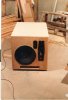
6591D9D6-F388-4ABB-AADC-014B9DF9434D.jpeg 1B38E17D-BBF3-4FFE-A472-DB3607151278.jpeg DF437DED-A4B5-43A9-BC16-E3E24F563C52.jpeg
 
You probably know this, but use a good respirator mask working with mdf, it's very irritating (toxic).

So is walnut wood dust.
 
To be honest Uncle Fester people should wear a mask when working with anything that will create dust. There are the fibers but some of the fungus in the fibers can lay you up.
 
I had a set of Snell E II's redone by my brother in law. He made the cabinets exactly to the originals, with the exception of using Baltic Birch. I then upgraded the drivers to Audio Note drivers, that they use in their AK-E speakers. Basically an upgraded Snell E II. I would put them up against anything in the 4-5000 dollar range. Just mentioning this to allow you the chance to think outside of the so called box in what you do. I wish you well.
 
Back
Top Bottom