• The move to the new server is done. There are some software and database maintenance updates in process. This has us passing the hat around to help out. We appreciate any donations. Seriously, even a dollar helps. The payment page may be found here - https://www.audiokarma.org/support.html

Rare EMI score

Jayrosc

Super Member
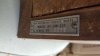
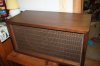
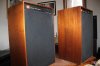
I found these in a barn underneath an upside down wheel barrow today. Had no idea what they were but they felt like real quality so I got them. Glad I did. Turns out they are some rare form of British speaker from the 60's called EMI 319's. There's an oval shaped woofer inside with a tweeter in the center of it, like a coaxial speaker. These are on par with my pair of Allison Four's. Very similar sound with plenty of dispersion. Bit stronger bass coming out of the EMI's though. Hard finding info on them, but there are some on the bay with pretty crazy pricing. Like from $150.00 a pair to $1500.00 a pair. EMI seems to have a great reputation though and appears to have been involved with B&W back then. I can't figure out if they are 4 or 8 ohms though, anyone know? I also don't know if they are meant to sit horizontal or vertical. Binding posts suggest one way but the position of the ID badge suggests the other.
 

Attachments
  • EMI 319.jpg
    EMI 319.jpg
    78.8 KB · Views: 529
  • 20160723_124131.jpg
    20160723_124131.jpg
    51.4 KB · Views: 508
  • 20160723_142614-2.jpg
    20160723_142614-2.jpg
    55.1 KB · Views: 528
Last edited:
Register to hide this ad
The elliptical woofer offers better dispersion than a big round woofer (perpendicularly to the long axis) and deeper bass than a smaller woofer with good dispersion. The cone is made of a combo of aluminum foil inner and pulp outer, which helps with high frequencies. They are kind of nice, but don't go for disco volume.
 
Hi,

They work fine horizontally or vertically. For sure they are worth much
more to a collector than the sound quality they offer, like most old stuff.

rgds, sreten.
 
Hi,

They work fine horizontally or vertically. For sure they are worth much
more to a collector than the sound quality they offer, like most old stuff.

rgds, sreten.

Yeah, If someone wanted to give me upwards of a thousand bucks I wouldn't say no, but I'm not selling these until I get my fill of them. I think they sound super with music from the era they were produced. Listening to the Rat Pack Live at the Sands right now and these have that great, high sensitivity clarity: Voices right out front until that horn section comes up from behind them and punches me in the face. No deep bass here, but I don't always want that, especially with stuff like I've got on now.

Very cool indeed! Is that a wooden cap holder? Those crazy Brits...
I'm still scratching my head about it. I've read that its actually an inductor, which means no re cap! I was hoping it was just insulation similar to those old caps in some of the JBL L series speakers.

The elliptical woofer offers better dispersion than a big round woofer (perpendicularly to the long axis) and deeper bass than a smaller woofer with good dispersion. The cone is made of a combo of aluminum foil inner and pulp outer, which helps with high frequencies. They are kind of nice, but don't go for disco volume.

So far they sound better in the room they are in sitting on their sides about three feet off the floor and against the wall, like in the pic. I had them set standing up and they sound like they had a little less imaging, but not by much. As for volume, they put it out big time without any effort and with not much power, but I don't think I'd play too much Hip Hop through these at high volume. Bottom line is I think these are premium speakers from a time lone gone and I'm glad to hear them.
 
Hey, great to see a fellow owner of these. I did a thread back in the winter about turning a "not-quite-a-pair" into a pair. I'm pretty sure, though, that the single crossover component is in fact a cap. In the course of my refurb, I wound up with a spare driver (er, set of drivers... whatever) that supposedly had a bad woofer. I desoldered the mystery piece and tested its capacitance; it came out at something in the 6uF range, if I remember correctly. I don't think a coil would read anything sensible like that. And to the other poster who asked, it's not wood, it's like a wax impregnated cloth. And it's not a cover or an outer shell or anything like that, it is the body of the cap. If you cut it open, you see bare wires. The caps were originally orange, although this one seems to have faded quite a bit. I would love to see something "official" listing the original cap value as I have no way of knowing if the one I pulled had drifted, so I can't use it as a guide for replacement. Enjoy! Keep us posted.
 
I set up a pair of these as side fill in a custom setup a few years ago. Suprizingly decent sound but I would advise not over driving thrm.
 
I'm still scratching my head about it. I've read that its actually an inductor, which means no re cap!
I was hoping it was just insulation similar to those old caps in some of the JBL L series speakers.
.

Hi,

Its strange but it is actually a bipolar capacitor, fitted with a wooden
sleeve and an inductor then wound around the wooden sleeve.

Why I don't know.

rgds, sreten.
 
Hi,

Its strange but it is actually a bipolar capacitor, fitted with a wooden
sleeve and an inductor then wound around the wooden sleeve.

Why I don't know.

rgds, sreten.
In other words, I can't just remove it and put a new capacitor in its place.
 
Oh well. Win some, lose some. I just turned my system on at a barely audible, early morning volume so as not to wake anyone in the house and noticed that the sound in one of these speakers has begun breaking up. Checked the connections and all is well. Guess I'm screwed unless I change that cap after all. If it fails, well, another 8 bucks down the drain.:dunno: Only kidding about the money thing, isn't that the cost of a beer in a tavern nowadays? In truth these are superior speakers that deserve saving and it really bums me out that, after exactly one week, they may have become firewood on my watch. Too bad the manufacturer has made it so hard to repair them. Only good news is that I put my JBL 4312's in their place because they were the closest pair available that I could reach without much effort, and they HAVE been restored with new caps and pots. Have not heard them in months. Sound great.
Fall down, get back up. And on it goes.
 

Attachments

  • IMG_1780.jpg
    IMG_1780.jpg
    60.8 KB · Views: 103
Sreten is right,of course.If someone draws a simple sketch how the wires go,I'm sure we can solve the mystery of the strange crossover filter.
 
Sreten is right,of course.If someone draws a simple sketch how the wires go,I'm sure we can solve the mystery of the strange crossover filter.
Do you mean that I should make such a sketch and post it here? I think my next step will be to remove the driver for a better view and take some pics. I've seen photo's of other EMI drivers that are similar, not exact, and they have a capacitor hidden between the back of the cone and the basket that is in addition to the strange crossover filter. BUT, before that, I'm going to reconnect them and make sure that a strand of wire wasn't touching where it should not. The attached pic is of the binding post assembly. Don't know if one can tell from the pic, but the posts are very close together. Plus, the backing plate for these posts is metal. Could a stray strand touching the plate wreak havoc?
 

Attachments

  • 20160730_093116_001.jpg
    20160730_093116_001.jpg
    53.3 KB · Views: 114
Yeah, those closely-spaced screw terminals often make me a bit uneasy, but a decent pair of spade connectors usually ensures a secure connection. And yes, if you remove the driver and post some good pics of the wire connections, that may begin to describe the circuit better. Perhaps you will eventually need to remove that inductor-cap thingy and measure the values. Definitely not firewood yet.
 
Hi,

I understand in another thread, not knowing what effect the capacitor had on
the inductor, it was left in place but disconnected and a new cap wired in.

However IMO if the old cap shows no reaction to a magnet, its not steel cased,
then fit a foil cap in its place. Modern elcaps of its value will be too small, but
you could always sleeve them into the wooden ring.

The only question is what the two components do ? Three options :

1) 2nd order highpass on the tweeter
2) 1st order parallel on both drivers
3) 1st order series on both drivers

If 1) or 3) best left as is. If 2) then 3) is worth trying.

rgds, sreten.
 
Hi,

I understand in another thread, not knowing what effect the capacitor had on
the inductor, it was left in place but disconnected and a new cap wired in.

However IMO if the old cap shows no reaction to a magnet, its not steel cased,
then fit a foil cap in its place. Modern elcaps of its value will be too small, but
you could always sleeve them into the wooden ring.

The only question is what the two components do ? Three options :

1) 2nd order highpass on the tweeter
2) 1st order parallel on both drivers
3) 1st order series on both drivers

If 1) or 3) best left as is. If 2) then 3) is worth trying.

rgds, sreten.

This is all over my head, but I'll work on it. Can't take the speaker apart today. Will do tomorrow and post some pics.
 
Hi,

Its strange but it is actually a bipolar capacitor, fitted with a wooden
sleeve and an inductor then wound around the wooden sleeve.

Why I don't know.

rgds, sreten.

That is fascinating! I've never paid attention to the guts of a capacitor (only seen the inside one or two of those black and red Mexican jobs post-explosion), but what I saw when I sliced through the cloth jacket on my spare certainly looked like a coil. As I said, I tested the capacitance, but not the inductance, and since it gave a reasonable reading I assumed it was just a cap. A first order high pass on the tweeter made sense, so that's what I assumed. Now that I think of it, the wiring did seem more complex than a simple cap. You don't by any chance know the values?
 
Hi,

An electrolytic capacitor is just two parallel planes separated by a dielectric rolled up into a coil.
As the the two planes are separated they don't act like coils at all, the currents in the two planes
are always opposite and cancel. Unlike an inductor where all the currents add together.

rgds, sreten.
 
Hi,

I understand in another thread, not knowing what effect the capacitor had on
the inductor, it was left in place but disconnected and a new cap wired in.

However IMO if the old cap shows no reaction to a magnet, its not steel cased,
then fit a foil cap in its place. Modern elcaps of its value will be too small, but
you could always sleeve them into the wooden ring.

The only question is what the two components do ? Three options :

1) 2nd order highpass on the tweeter
2) 1st order parallel on both drivers
3) 1st order series on both drivers

If 1) or 3) best left as is. If 2) then 3) is worth trying.

rgds, sreten.

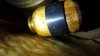
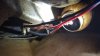
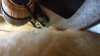
I took the back off but decided against taking the driver out. Got my camera in there pretty good though, and I hope the pics I took reveal something that those in the know here can see. First, there is no other capacitor hidden anywhere. The cloth wrapped thing is actually the ONLY thing on these speakers. Two wires come off the capacitor and two more wires come from out of the wrap around stuff. The black plastic thing that holds the capacitor in place has the word "insuloid" on it. There are two connection posts that are easily seen (for the woofer) but the connection for the tweeter is somewhere on the front of the speaker (one wire goes right through a hole drilled in the basket) If these pics don't give enough info I'll pull the driver out, though the attachment is odd and I fear having trouble putting back in.
I have no idea what this thing is. Never seen anything like it. That said, its looking like the only thing to do is to try and slide the capacitor out and replace it.
 

Attachments

  • insuloid 1.jpg
    insuloid 1.jpg
    65.5 KB · Views: 159
  • insuloid 2.jpg
    insuloid 2.jpg
    56 KB · Views: 155
  • insuloid 3.jpg
    insuloid 3.jpg
    44.5 KB · Views: 147
  • insuloid 4.jpg
    insuloid 4.jpg
    42.5 KB · Views: 143
  • insuloid 6.jpg
    insuloid 6.jpg
    35.9 KB · Views: 153
They look to be in pretty good condition.Love those period speakers.If thats your preference I would keep these.I believe EMI was a recording studio in London at that time.
 
Ok, as I recall, the damping is a single sheet of fiberglass wrapped around the four sides of the cabinet, not attached in any way. You can just pull out by rolling it up and put it in a bag. May want to wear gloves if you're apt to get itchy. There are studs through the front baffle which go through holes in the four corners of the driver(s), and are secured by nuts. Remove the nuts and the driver should slide out easily over the studs. There's no adhesive gasket, just cork.
 
Back
Top Bottom