• The move to the new server is done. There are some software and database maintenance updates in process. This has us passing the hat around to help out. We appreciate any donations. Seriously, even a dollar helps. The payment page may be found here - https://www.audiokarma.org/support.html

Realistic STA-111 acting strange under load

Corktowner

Active Member
Hey everyone, I’ve got a strange problem and I am not even sure how to properly search for it. It’s a Realistic unit I’m working on which I bought a few years ago off of eBay that had a weak right channel. I did a recap on this one because I had second that was working well which I ordered the caps for and did. So that’s the background.

What I am seeing on the problem right channel is the signal looks good when there is no load (I.e. speaker selector off), but as soon as I turn the speakers on (with my 8 ohm dummy resistors hooked up) the signal immediately goes wacky. The pictures attached are the before and after. The left channel is perfectly fine.

So I am trying to think of what may be causing this but I am at a loss. With the load connected I can imagine that the path to ground is being completed, so perhaps there is a bad resistor somewhere is is allowing too much current? The protection circuit isn’t tripping, so I don’t think the issue is DC. Voltages measured just fine on the STK unit.

Any hints you may have I’ll be happy to investigate.
 

Attachments

  • D8358D18-12DB-4133-B4E1-F47C5A9402B9.jpeg
    D8358D18-12DB-4133-B4E1-F47C5A9402B9.jpeg
    87.7 KB · Views: 13
  • BC629D91-0307-4DD2-96BB-7469515AA858.jpeg
    BC629D91-0307-4DD2-96BB-7469515AA858.jpeg
    81.9 KB · Views: 13
  • AD80E11E-7BF0-4578-987F-F0D428E5DBB8.jpeg
    AD80E11E-7BF0-4578-987F-F0D428E5DBB8.jpeg
    149.7 KB · Views: 16
Register to hide this ad
I think the most likely explanation is that an internal transistor in the STK has failed with something like an open collector, so it can still track its input voltage with an unloaded output, but not if it needs to deliver appreciable current to a load. If you want to make really sure of that and don't mind some extra work, you could check by swapping STKs between channels.

With the load connected I can imagine that the path to ground is being completed, so perhaps there is a bad resistor somewhere is is allowing too much current?

With respect, and with the acknowledgement that I might not be picking up your thinking, this reasoning doesn't scan for me. First let me say that it is true that an additional path to ground is being completed when you turn on the speaker switch. So far, so good. But, the symptoms sure look to me like something is limiting current (at the amplifier output) rather than allowing too much. A very good rule of thumb is that a failed resistor (by itself) will not lead to too much current through that same resistor; failed resistors almost always have excessively high resistance and will pass too little current.

HTH,

chazix
 
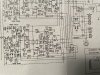
Usually when you have a good signal without a load it means everything up to and including the drivers is OK and if the signal goes bad with a load the problem is in the output stage. R619b and R621b are the output emitter resistors, are they OK? TR608b is the current limiter for the negative side is it OK? TR608b can be removed for troubleshooting purposes.

Craig
 
Last edited:
OK, I checked the R619b and R621b resistors (they are in a single, 3-legged body), and they checked out ok. I then removed both STKs and put the one from the good channel (R) on the bad channel. The strange distortion went away, so that was good. There was a little instability in the signal on the scope, but I will assume for now that it was because I didn’t have the right channel STK installed.

I’ll get an STK ordered up and then I’ll let everyone know the results. Thanks again for your help, as always.
 
EDITED: Did you try the "bad" stk on the good channel?
I did not. Logically if the STK was good and the circuit was bad on the right channel, then the known good STK would have still shown the problem. Also, if the known good STK didn’t show a problem, then the signal would test good. So algabraicly it works out.

Two unknowns and two equations make the problem solveable.
 
It could be some cold soldering solved when installing the stk again. Just an idea.
That’s a risk, but for these joints I think it is very low. I’ll get some pictures to show what I am judging on - the amount of solder on these is massive.
 
Back
Top Bottom