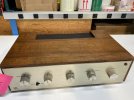
I've not written on this thread for years. My AR amplifier is still sitting in a basket. A rebuild kit remains stashed somewhere. It's on my list of projects. It's an interesting, classic piece that IMHO reflects some construction methods belonging to the tube era. It's remarkably compact, simple and looks elegant. My salient remark here is sparked by some stories of disasters and failures of this amp model. I ran my AR amplifier on nearly a daily basis for 15 years — hours and hours listening to CBC FM as I studied and did my chores. It ran very hot (correctable with some advised revisions). And years later, it entertained friends who owned much richer, contemporary equipment. They respected this amp that gave a musical performance. By then, the1980's, it was already a rather rare relic of the past.
Around about 2000, just before I was to pack the AR away and lug it to Japan to where I had emmigrated, my best friend and I did a shoot out against his recent NAD model. WHAM! We ran the **** outa these two units on some very good speakers and some profoundly decent source. Then we had coffee and reviewed what we had heard. The result was rather surprising, especially since the AR had sat unused for years, and all the capacitors must have been boiled for over a decade of running hot.
We concluded that the two were rather similar, but the AR exhibited more "grain". That's the best word we could put on it. We were both rather surprised. But I should mention that we were playing my friend's favored catalog — rock and loud stuff. Not harpsichord, chamber music, or symphony orchestra. I like to hear the violas discernible from the violins, and the bassoons heard amid the French horns. Only a restoration and the approved alterations will give me a real estimation of just how good, or flawed this amp really is. In the early 1970's, it was an affordable introduction to decent, solid state. And it was a good way to drive AR speakers, as I was able to witness at the time.
I am reminded of a retrospective I read some years ago in a well-known audio journal — the AR being given some reflection of a bygone era. The final words were, to the best of my recollection: "The AR is a NAD with balls."