
• The move to the new server is done. There are some software and database maintenance updates in process. This has us passing the hat around to help out. We appreciate any donations. Seriously, even a dollar helps. The payment page may be found here - https://www.audiokarma.org/support.html

Recap Questions

IgniFerroque

The Count of Connotation
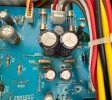
I recently bought a Niles SI-275 which I ended up getting for free after the shipper packaged it inadequately and it was damaged during shipping. It works fine, but while poking around to find what it would take to repair the structural damage I also found some leaking capacitors on the board:
File (2).jpg

It looks like those big capacitors are leaking. I think the goo on C32 is glue? I've read that this area of the board is an area that others have seen problems in before for this model and someone here recommended higher voltage capacitors.

I have never replaced capacitors before so I thought I would ask a few things. Is it a good idea to get higher rated caps? I imagine that it might be a problem to fit them in the space space. What kind of capacitors do I need to buy, these appear to be 25V 2200µF Aluminium Electrolytic Capacitors maybe? Would I want the same thing, but maybe slightly higher rated? Thanks in advance.
 
Register to hide this ad
Are those actually leaky caps or just old adhesive? Not sure I've ever seen thick brown goo from capacitors, but I'm no expert in the era of solid state capacitor board construction...

Edit: oh, but the white one to the left might be leaking. Thought that was just a shadow at first. Might be glue--is it hard and brittle when you scratch it?

I would stick with the spec'd capacitance, but yes, it's wise to go with caps with a higher voltage rating, however. They will probably be even smaller than those, actually. Nichicon and Rubycon are the trusted brands, purchased from a reputable online supplier like Mouser, but again, other actual techs will chime in with good recommendations—
 
Last edited:
I would have expected to see the aluminium casing bulging if they had leaked to that extent. I wouldn't worry about the caps not fitting, modern caps are much smaller, you should be fine going up to the next voltage rating, so the 25v caps, would go up to 35v etc.
 
Are those actually leaky caps or just old adhesive? Not sure I've ever seen thick brown goo from capacitors, but I'm no expert in the era of solid state capacitor board construction...

Edit: oh, but the white one to the left might be leaking. Thought that was just a shadow at first. Might be glue--is it hard and brittle when you scratch it?

I would stick with the spec'd capacitance, but yes, it's wise to go with caps with a higher voltage rating, however. They will probably be even smaller than those, actually. Nichicon and Rubycon are the trusted brands, purchased from a reputable online supplier like Mouser, but again, other actual techs will chime in with good recommendations—
That looks like electrolytic fluid leaking from the caps. Not silicone sealer or glue gun adhesive.

I'd replace all the 'lytic caps, leaky or not—use the same mfd and voltage ratings. :thumbsup:
 
Agreed that if they were leaking that bad they would usually have some sign of bulging, but could be a defect on the seal allowing the fluid to leak out. Electrolytic fluid is usually dark brown but would be soft & mushy compared to hard like old glue.

Many solid state components from this era with large caps used a glue to hold them in place during shipping, many brands used glue that when heated or over time became dark & hardened, when it does that it can also become corrosive & damage near by parts it touches, luckily yours doesnt seem to have that problem as parts are psaced out pretty good. Whether its leaky caps or hard glue its best to remove it & clean it up with some acetone after removing the caps.

Also no reason to change what the engineers selected for caps unless they are known to have a problem, like very low voltage caps can go out of spec sooner than larger voltage caps in some cases, so unless you want to "mod" the original design or use film caps for certain lower values i the signal path, its best & easiest to keep them all as the original design, IMO.

The popular caps to use are nichicon and most will be available at digikey, they had a much better selection than mouser for the 50+ caps I just bought to recap a 1970's sansui. Use UKL for signal path & UPW for power supply. They will be smalller than teh originals so should be easy to place on the board, just pay attention to the lead spacing so they are the same or close to originals, if they are a little smaller on new ones, you can bend/widen the leads some to fit in the holes. Make a list of the caps in there & search digikey for them, should be able to find them all. & just an FYI, most these caps should be a 20% tolerance, which means if you cant find the exact value, it will be OK to use one thats within the tolerance range, but as close to original is best... & the same if you cant find the exact voltage, its ok to go one step higher, 25v to 35v wont be an issue.
 
That's what old Japanese glue looks like. It can be corrosive, so a recap isn't out of order, cleaning everything up in the process. Those caps are designed to blow out from the top, making it even less likely that there's a leak from the bottom.
 
That's what old Japanese glue looks like. It can be corrosive, so a recap isn't out of order, cleaning everything up in the process. Those caps are designed to blow out from the top, making it even less likely that there's a leak from the bottom.
Sometimes, they leak from the bottom. Maybe excessive gravity at the user's house?

Okay! I just threw that one into the mix. ;)
 
I mentioned what I think is glue on the other capacitors but the stuff here looks nasty and gross. I do wonder if it is a heat issue. Is this where the power comes in?

With more light:
File (3).jpg

The board:
File (4).jpg

We're looking at the upper left corner here. The AC goes into the big white thing and then there are two bundles of red/yellow/black that go to the middle of the board and one bundle of red/white/brown that looks like it goes to this part.

In any case, I guess it sounds like UPW Nichicons are in my future. :thumbsup:

EDIT: Gravity feels fine here. No complaints.
 
I'd ventured that those big 10,000 mfd/63VDC caps are the main power supply filter caps. I'd replace them.

How old is this unit?

Good luck with the fix! :thumbsup:
 
I'd ventured that those big 10,000 mfd/63VDC caps are the main power supply filter caps. I'd replace them.

How old is this unit?

Good luck with the fix! :thumbsup:
Ahh, I wonder what this corner of the board is then? Unfortunately Niles doesn't release schematics from what I hear. I certainly haven't been able to find one and probably couldn't read it if I could find one.

The manual has a copyright date of 2005 which seems about right to me. It's not too old.
 
I was thinking those caps might've fallen victim to the conductive adhesive issue in some circuit board construction. Here's a link from @restorer-john over at another forum about 5 years ago. Not sure if that's what it is but it probably makes sense to rule it out.

https://www.audiosciencereview.com/forum/index.php?threads/bond-glue-issues-and-pictures.10329/

If the Niles is only from 2005, there shouldn't really be a pressing need to recap due to age, unless there's a genuine leaking electrolyte issue, or if you want to clean all that old adhesive off (if that's in fact what it is). That stuff *will* cause corrosion at some point. But I'm mostly a tube guy, so all those circuit boards make me nervous ;-)

Example of the brown adhesive goo:

IMG_0358 (Small).jpeg
 
I was thinking those caps might've fallen victim to the conductive adhesive issue in some circuit board construction. Here's a link from @restorer-john over at another forum about 5 years ago. Not sure if that's what it is but it probably makes sense to rule it out.

https://www.audiosciencereview.com/forum/index.php?threads/bond-glue-issues-and-pictures.10329/

If the Niles is only from 2005, there shouldn't really be a pressing need to recap due to age, unless there's a genuine leaking electrolyte issue, or if you want to clean all that old adhesive off (if that's in fact what it is). That stuff *will* cause corrosion at some point. But I'm mostly a tube guy, so all those circuit boards make me nervous ;-)

Example of the brown adhesive goo:

IMG_0358 (Small).jpeg
Man, I'd change those. I mean, why do some caps have this "adhesive" and some don't? :idea:
 
Do you know what adhesive that is? It doesn't look like high-temp silicone sealer, which is what I use to support big caps.
i do not know. probably the same as what others call "sonybond"

it turns corrosive and judging by the color in the pic above, that glue has turned.
 
Surprising, since if you look at the caps, they are a current series from Chemicon (KMG).
 
I recently bought a Niles SI-275 which I ended up getting for free after the shipper packaged it inadequately and it was damaged during shipping. It works fine, but while poking around to find what it would take to repair the structural damage I also found some leaking capacitors on the board:

View attachment 3168005

It looks like those big capacitors are leaking. I think the goo on C32 is glue? I've read that this area of the board is an area that others have seen problems in before for this model and someone here recommended higher voltage capacitors.

I have never replaced capacitors before so I thought I would ask a few things. Is it a good idea to get higher rated caps? I imagine that it might be a problem to fit them in the space space. What kind of capacitors do I need to buy, these appear to be 25V 2200µF Aluminium Electrolytic Capacitors maybe? Would I want the same thing, but maybe slightly higher rated? Thanks in advance.
Look at the cap on the right. The sleeve is split indicating it has been run hot. And that could have pushed electrolyte past the rubber cork at the leads. The fact that the glue has turned dark is an indication of heat, and/or electrolyte attacking it. I would definitely replace them, and try to find smaller diameter ones so they aren't hugging each other which will allow for air to circulate around them. That area is a lower voltage secondary power supply.
 
Man, I'd change those. I mean, why do some caps have this "adhesive" and some don't? :idea:
I cant speak for newer components, but the glue used in vintage stuff like 70s & 80s was used mostly to protect from shipping damage. These units were shipped by boat from asia and often had rough handling that could dislodge larger caps, its not the newer clear silicone stuff some use or that I see in all powered subwoofer or speaker plate amps to control vibrations. Sansui was notorious for using it, called "sansui glue" it is originally clear but after heat or excessive voltage exposure or just age like 40 years it turns hard & dark and becomes corrosive sometimes even conductive. Needs to be scraped off when hard but acetone helps soften it up and makes removal much easier.

The caps in this unit from 2005 are probably still ok but with such easy access I would definitely remove that glue before it becomes an issue and replace the caps with it or whatever that stuff is on the 2 bigger caps. the large filter caps are probably fine being under 20 years of age and larger caps usually last a lot longer than smaller values/voltage, out of over 50 capacitors I just replaced on a 40 year old sansui, they were all within spec except for the very small 1-10uf caps & 2 47uf but very low 6.3 voltage, the 1500uf filter caps tested good along with all the other 35-100+uf caps.
 
Last edited:
Look at the cap on the right. The sleeve is split indicating it has been run hot. And that could have pushed electrolyte past the rubber cork at the leads. The fact that the glue has turned dark is an indication of heat, and/or electrolyte attacking it. I would definitely replace them, and try to find smaller diameter ones so they aren't hugging each other which will allow for air to circulate around them. That area is a lower voltage secondary power supply.
I think this is right answer, the board is discolored here, looking a little baked. I think smaller capacitors and more air is certainly a good idea but is there anything else anyone could recommend?

I measured those resistors right there and one is dead on, but the other is out of spec so I'm thinking of replacing those. Do I just buy some metal film resistors? .5W? 1W, I have no idea.

Replacing the zener diodes seems beyond me and I hear they are pretty hardy so maybe I'll leave them alone and I have no idea what the component on the other side is I'll assume that's good too :)
 
I think this is right answer, the board is discolored here, looking a little baked. I think smaller capacitors and more air is certainly a good idea but is there anything else anyone could recommend?

I measured those resistors right there and one is dead on, but the other is out of spec so I'm thinking of replacing those. Do I just buy some metal film resistors? .5W? 1W, I have no idea.

Replacing the zener diodes seems beyond me and I hear they are pretty hardy so maybe I'll leave them alone and I have no idea what the component on the other side is I'll assume that's good too :)
Which resistors? R113/114? I can't really tell, but those two look to be at least 1 Watt from here. Without the service manual, it's just guesswork. I would replace them with Metal Oxide and leave them standing up off the board a bit for air to circulate around them. Metal Oxide will withstand more heat than carbon film of the same value.
 
Back
Top Bottom