

You are using an out of date browser. It may not display this or other websites correctly.
You should upgrade or use an alternative browser.
You should upgrade or use an alternative browser.
Recommend a good bench-top isolation transformer
- Thread starter EdBacon
- Start date

Register to hide this ad

If you can find one of these buy it, reconditioned is best, rebuilt. I used one on a high end repair bench and it was excellent. Old but absolutely worth it if you can find a rebuilt or well kept example. Might have helped to include a link with picture. No affiliation. https://reverb.com/item/5605842-eico-1078-variable-power-supply-variac-in-excellent-conditionHey all. I'm interested in getting myself a nice isolation transformer for my workspace. Most of what I see when I search online is just flooded with rebadged Chinese stuff. What would be some good names and models to look into?
Last edited:

I use one of these BK Precision 4 Port Isolation Transformer TR-110. Used it with a Japanese market Luxman 100v amp. Very reliable and built like a tank. The output voltages are dead on. They can be had for reasonable money at that big auction site. The Eico mentioned above is a variac not an isolation transformer.

Last edited:

Try to find medical- grade units via surplus electronics sources. I have a couple from my days working in clinical medical/ hospital facilities. These things are damn heavy for their size & will likely never fail.
specific caution about these, confirm they are in fact wired as an isolation trafo. I know at least one person on here posted his, and I know someone else who has one that was not. Internally it is a true iso trafo, but as-built the neutral on the output side was wired to the neutral on the input side, which defeats the isolation. Easy enough to modify, just break the connection from input to output, but its something you want to confirm before assuming things are safe. Ohm check from input to output will tell the tale, it should read open circuit. If it does not, something is connected internally.
and a general warning from my own experience, don't go with one that is grossly over-capacity. These things tend to bump the output voltage some to account for load. At full rated load they are 1:1, otherwise its usually 1:1.something. My big 20 amp iso trafo takes my incoming 122 volts and will give me about 127 volts out. Not an issue if paired with a variac and a voltmeter, but just something to be aware of.


Example?If you can find one of these buy it, reconditioned is best, rebuilt. I used one on a high end repair bench and it was excellent. Old but absolutely worth it if you can find a rebuilt or well kept example.
appreciate that, it's the first time I've heard about the common neutral. Will check mine in due time.specific caution about these, confirm they are in fact wired as an isolation trafo. I know at least one person on here posted his, and I know someone else who has one that was not. Internally it is a true iso trafo, but as-built the neutral on the output side was wired to the neutral on the input side, which defeats the isolation. Easy enough to modify, just break the connection from input to output, but its something you want to confirm before assuming things are safe. Ohm check from input to output will tell the tale, it should read open circuit. If it does not, something is connected internally.
and a general warning from my own experience, don't go with one that is grossly over-capacity. These things tend to bump the output voltage some to account for load. At full rated load they are 1:1, otherwise its usually 1:1.something. My big 20 amp iso trafo takes my incoming 122 volts and will give me about 127 volts out. Not an issue if paired with a variac and a voltmeter, but just something to be aware of.

David_NC
Super Member
I have two hospital grade Tripp-Lite isolation transformers. One looks like this:
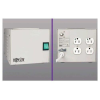
And the other is a smaller model but looks similar. As @gadget73 said, confirm the wiring. This is easy to do with a multi-meter. I had to remove a ground to neutral connection on both of them. Now, they behave as true isolation transformers. The output on mine is a couple volts lower than input, which is handy for vintage tube equipment. These seem reasonably priced (I paid $80 for the 500 watt unit and $50 for the 250 watt) even with having to remove that wire.
Edit: I just looked these up on eBay. Prices are easily 2-3 times what I paid in late 2020. Still, if one can keep an eye out for them, they do appear for a decent price time to time.
And the other is a smaller model but looks similar. As @gadget73 said, confirm the wiring. This is easy to do with a multi-meter. I had to remove a ground to neutral connection on both of them. Now, they behave as true isolation transformers. The output on mine is a couple volts lower than input, which is handy for vintage tube equipment. These seem reasonably priced (I paid $80 for the 500 watt unit and $50 for the 250 watt) even with having to remove that wire.
Edit: I just looked these up on eBay. Prices are easily 2-3 times what I paid in late 2020. Still, if one can keep an eye out for them, they do appear for a decent price time to time.
Last edited:

maxhifi
Addicted Member
I have a Hammond, older version of this:
Am completely happy with it, it's perfect for working on gear which is not isolated properly from the AC line, including but not limited to AC/DC radios, TVs, subwoofer plate amps with a switch mode power supply... anything else with a switch mode power supply, etc.
Am completely happy with it, it's perfect for working on gear which is not isolated properly from the AC line, including but not limited to AC/DC radios, TVs, subwoofer plate amps with a switch mode power supply... anything else with a switch mode power supply, etc.

arts
Addicted Member
As gadget73 has mentioned, it is very important to ensure that the wiring is configured in such a way as to actually provide complete isolation.
One aspect that very few people are aware of is that in North America (well, Canada and the US at least) the Neutral Line and the Ground Line are at the same electrical potential.
Why is this? Quite simple; we use the great big ball we're all spinning around on as one of the AC power line conductors. Saves the cost of another transmission line...
Then, why do we use a separate Ground Line? Just to ensure that, regardless of what happens with plugs and receptacles (and there are LOTS of polarity screw-ups happening) the Ground Line is always at Ground potential. This is also why you are expressly forbidden to circulate current in the Ground Line.
All that said, what all this means is that, in the end, in order to have complete isolation, you must ensure that there is no connection whatsoever between the primary and secondary windings of the isolation transformer, and you must not use the ground terminal for the device under test.
One aspect that very few people are aware of is that in North America (well, Canada and the US at least) the Neutral Line and the Ground Line are at the same electrical potential.
Why is this? Quite simple; we use the great big ball we're all spinning around on as one of the AC power line conductors. Saves the cost of another transmission line...
Then, why do we use a separate Ground Line? Just to ensure that, regardless of what happens with plugs and receptacles (and there are LOTS of polarity screw-ups happening) the Ground Line is always at Ground potential. This is also why you are expressly forbidden to circulate current in the Ground Line.
All that said, what all this means is that, in the end, in order to have complete isolation, you must ensure that there is no connection whatsoever between the primary and secondary windings of the isolation transformer, and you must not use the ground terminal for the device under test.

I have two hospital grade Tripp-Lite isolation transformers. One looks like this:
View attachment 2949110
And the other is a smaller model but looks similar. As @gadget73 said, confirm the wiring. This is easy to do with a multi-meter. I had to remove a ground to neutral connection on both of them. Now, they behave as true isolation transformers. The output on mine is a couple volts lower than input, which is handy for vintage tube equipment. These seem reasonably priced (I paid $80 for the 500 watt unit and $50 for the 250 watt) even with having to remove that wire.
Edit: I just looked these up on eBay. Prices are easily 2-3 times what I paid in late 2020. Still, if one can keep an eye out for them, they do appear for a decent price time to time.
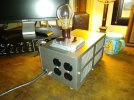
I picked up a similar model from eBay a few years ago (and also had to remove a ground to neutral.) I want to say I paid about fifty bucks for it. The TrippLites are very well made - heavy metal with quality transformers. I cut a hole in the top of mine and added a separate DBT circuit.
This is correct. I have a medical grade IT and the neutral was already floating, but I disconnected the ground on the output outlets. The chassis of the isolation transformer is still grounded. I only use it to power DUT’s. Mine has 6 outlet plugs in 2 groups of 3. I’m thinking about reattaching the ground for 3 of them to take advantage of the extra plugs for regular gear.As gadget73 has mentioned, it is very important to ensure that the wiring is configured in such a way as to actually provide complete isolation.
One aspect that very few people are aware of is that in North America (well, Canada and the US at least) the Neutral Line and the Ground Line are at the same electrical potential.
Why is this? Quite simple; we use the great big ball we're all spinning around on as one of the AC power line conductors. Saves the cost of another transmission line...
Then, why do we use a separate Ground Line? Just to ensure that, regardless of what happens with plugs and receptacles (and there are LOTS of polarity screw-ups happening) the Ground Line is always at Ground potential. This is also why you are expressly forbidden to circulate current in the Ground Line.
All that said, what all this means is that, in the end, in order to have complete isolation, you must ensure that there is no connection whatsoever between the primary and secondary windings of the isolation transformer, and you must not use the ground terminal for the device under test.

Puddintane
Super Member
I've been trying to understand the iso transformer thing, and I saw this YT video (link) where he discusses this issue (at least I think so). He explains it at the 10:40 mark. Is he talking about the same thing being cautioned about here in this thread?As gadget73 has mentioned, it is very important to ensure that the wiring is configured in such a way as to actually provide complete isolation.
One aspect that very few people are aware of is that in North America (well, Canada and the US at least) the Neutral Line and the Ground Line are at the same electrical potential.
Why is this? Quite simple; we use the great big ball we're all spinning around on as one of the AC power line conductors. Saves the cost of another transmission line...
Then, why do we use a separate Ground Line? Just to ensure that, regardless of what happens with plugs and receptacles (and there are LOTS of polarity screw-ups happening) the Ground Line is always at Ground potential. This is also why you are expressly forbidden to circulate current in the Ground Line.
All that said, what all this means is that, in the end, in order to have complete isolation, you must ensure that there is no connection whatsoever between the primary and secondary windings of the isolation transformer, and you must not use the ground terminal for the device under test.

Bill Ferris
Lunatic Member
I use one of each of the white med rated 1000 watt versions on my 2 repair benches, in conjunction with Tripp-Lite 20 amp AVRs, that provide surge/spike protection to boot.I have two hospital grade Tripp-Lite isolation transformers. One looks like this:
View attachment 2949110
And the other is a smaller model but looks similar. As @gadget73 said, confirm the wiring. This is easy to do with a multi-meter. I had to remove a ground to neutral connection on both of them. Now, they behave as true isolation transformers. The output on mine is a couple volts lower than input, which is handy for vintage tube equipment. These seem reasonably priced (I paid $80 for the 500 watt unit and $50 for the 250 watt) even with having to remove that wire.
Edit: I just looked these up on eBay. Prices are easily 2-3 times what I paid in late 2020. Still, if one can keep an eye out for them, they do appear for a decent price time to time.
I prefer to purchase these type power products brand new.
Yup. Some have a connection from input neutral to output neutral which makes it not actually isolate. Pull that connection and you're good to go.I've been trying to understand the iso transformer thing, and I saw this YT video (link) where he discusses this issue (at least I think so). He explains it at the 10:40 mark. Is he talking about the same thing being cautioned about here in this thread?

I'm not sure what the purpose of an isolation transformer is. Can anyone enlighten me?
As far as I an tell, in the USA you get 120V AC coming from the mains (230V AC here in UK), and you get exactly the same coming from the isolation transformer. So what's the benefit?
As far as I an tell, in the USA you get 120V AC coming from the mains (230V AC here in UK), and you get exactly the same coming from the isolation transformer. So what's the benefit?

One reason would be to work on hot-chassis transformerless radios, which were popular in the 40s-50s-60s. Another might be to isolate the ground from a scope etc from the chassis or other circuit element of the device under test. There are better ways to do the latter (ie pseudo-differential mode on the scope) however.

I use the Tripp-Lite, too.I have two hospital grade Tripp-Lite isolation transformers. One looks like this:
View attachment 2949110
And the other is a smaller model but looks similar. As @gadget73 said, confirm the wiring. This is easy to do with a multi-meter. I had to remove a ground to neutral connection on both of them. Now, they behave as true isolation transformers. The output on mine is a couple volts lower than input, which is handy for vintage tube equipment. These seem reasonably priced (I paid $80 for the 500 watt unit and $50 for the 250 watt) even with having to remove that wire.
Edit: I just looked these up on eBay. Prices are easily 2-3 times what I paid in late 2020. Still, if one can keep an eye out for them, they do appear for a decent price time to time.
Super steady voltage and excellent isolation. It works well for phono and regular pre-amps power sources, too!