

You are using an out of date browser. It may not display this or other websites correctly.
You should upgrade or use an alternative browser.
You should upgrade or use an alternative browser.
Recommend a good bench-top isolation transformer
- Thread starter EdBacon
- Start date

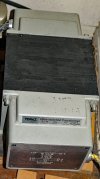
On my computers.

Yours has a wider lamination stack than mine has; otherwise they look the same.

Puddintane
Super Member
I’ve never used one of these, but it seems as though for random use (testing or working on different things) having the output receptacles on the back would be sort of inconvenient. You’d have to turn it around or dig it out of the stack on your bench every time you wanted to plug-in or unplug something. I suppose that if you were keeping something plugged into it all the time, as almost some kind of protection device, it wouldn’t matter that much. Yes?I use the Tripp-Lite, too.
Super steady voltage and excellent isolation. It works well for phono and regular pre-amps power sources, too!

Bill Ferris
Lunatic Member
Beefy stack amount of lams on that stout looking iso, Booch !
What`s the VA/wattage/current ratting ?
Dave Jones has a good example here of why. Basically to prevent a short to ground when probing a circuit since the scope probe “grnd” is at ground potential.I'm not sure what the purpose of an isolation transformer is. Can anyone enlighten me?
As far as I an tell, in the USA you get 120V AC coming from the mains (230V AC here in UK), and you get exactly the same coming from the isolation transformer. So what's the benefit?
Heavier than sin, too!Yours has a wider lamination stack than mine has; otherwise they look the same.
At least it won't fly away in a hurricane.


arts
Addicted Member
My entire bench runs off an isolation transformer, but I couldn't remember what make mine was, so I had to go crawling underneath and behind the main bench with a flashlight. Felt like I was in the movie Alien; it was dark, creepy, dusty and I was expecting some horrible creature to pop out and attack me...Boy, do I need a spring cleaning!
Toroid Corporation of Maryland, ISB-100W. 1000VA, 9 receptacles. Weighs a ton, 24lbs.
For equipment isolation 500VA and under I have a few old Hammond 171 series with the built-in line cord on one side and the receptacle on the other.
Toroid Corporation of Maryland, ISB-100W. 1000VA, 9 receptacles. Weighs a ton, 24lbs.
For equipment isolation 500VA and under I have a few old Hammond 171 series with the built-in line cord on one side and the receptacle on the other.

Bodhi1
Super Member
Richard Gray power transformers/purifiers have a good reputation and are often in use at audio shows. And all their products are made in their factory in Norridge, Illinois.

There are number of transformers out there. Many of them can be wired for a 1:1 voltage.
Transformers are really heavy and shipping is expensive. I would suggest getting a "Variac". It is a variable output single winding transformer and gives good isolation.
Transformers are really heavy and shipping is expensive. I would suggest getting a "Variac". It is a variable output single winding transformer and gives good isolation.
Bill Ferris
Lunatic Member
Unless, it has a not commonly integrally installed isolation transformer, it ain`t isolated directly from the AC line to the DUT (Device Under Test) !There are number of transformers out there. Many of them can be wired for a 1:1 voltage.
Transformers are really heavy and shipping is expensive. I would suggest getting a "Variac". It is a variable output single winding transformer and gives good isolation.
I know this for a fact, as I have a $$$ Viz brand 10 amp isolated variac on one bench, and another Stancore brand on my second bench, a 10 amp variac on the other, but purchased a Tripp-Lite brand 15 rated amp isolated transformer that is used that is installed post the variac for power line isolation from the incoming AC.
Common reostat wired variacs provide zero isolation from the direct connection from the AC mains !
I preferred Stanton Moving Iron to all others, and the 681 EEE or 681A my favorite. I also really like the best Shures and Ortofon OM family.
Unless, it has a not commonly integrally installed isolation transformer, it ain`t isolated directly from the AC line to the DUT (Device Under Test) !
I know this for a fact, as I have a $$$ Viz brand 10 amp isolated variac on one bench, and another Stancore brand on my second bench, a 10 amp variac on the other, but purchased a Tripp-Lite brand 15 rated amp isolated transformer that is used that is installed post the variac for power line isolation from the incoming AC.
Common reostat wired variacs provide zero isolation from the direct connection from the AC mains !
True. I had my video system on a 5kVA isolation transformer. It worked well and I couldn't tell the difference from the AC line feed. There is a distribution transformer on my property. It serves 4 houses. I have my stereo on a PS Audio P-300, My system is all SET. Look at my Face Book Page.
Bill Ferris
Lunatic Member
Ok, I`m also on a shared with 2 other neighbors 400 amp drop "power pole pig" transformer.True. I had my video system on a 5kVA isolation transformer. It worked well and I couldn't tell the difference from the AC line feed. There is a distribution transformer on my property. It serves 4 houses. I have my stereo on a PS Audio P-300, My system is all SET. Look at my Face Book Page.
All of my house`s 7 rooms A/V systems have quality surge spike/conditioners and in some rooms 15 or 20 amp AVRs feeding them as well.
No isolation transformers used on any of these room`s A/V systems, outside of my workshops 2 benches.
I looked on your profile and didn`t find a Face Book page link to check out your SET system.
And since I`ve never desired to join FB, a link, if possible, provided by you will be required, if you wish me to check it out.
Nice video!Xraytonyb has a new vid on this subject. I like his videos. His explanation is suited to audio repair bench and very easy to follow his descriptions.
This is why reversing the power cord plug on old-school units to reduce hum is not the safest idea --- especially on units that have metal cases or exposed metal screws.
Plus, defeating a polarized two-prong plug is also not the safest idea.
I like iso-transformers on the bench, just because some old units have the funkiest wiring. Those old table-top radios can be the worst offenders.Unless, it has a not commonly integrally installed isolation transformer, it ain`t isolated directly from the AC line to the DUT (Device Under Test) !
I know this for a fact, as I have a $$$ Viz brand 10 amp isolated variac on one bench, and another Stancore brand on my second bench, a 10 amp variac on the other, but purchased a Tripp-Lite brand 15 rated amp isolated transformer that is used that is installed post the variac for power line isolation from the incoming AC.
Common reostat wired variacs provide zero isolation from the direct connection from the AC mains !

His video is what got me searching and now I’m here go figure! His setup is so damn cool.Xraytonyb has a new vid on this subject. I like his videos. His explanation is suited to audio repair bench and very easy to follow his descriptions.