Follow along with the video below to see how to install our site as a web app on your home screen.
Note: This feature may not be available in some browsers.
The move to the new server is done. There are some software and database maintenance updates in process. This has us passing the hat around to help out. We appreciate any donations. Seriously, even a dollar helps. The payment page may be found here - https://www.audiokarma.org/support.html
I have a shorted JBL LE5-6 & LE25-2 (mid and high) from Decade L36 set. Is the LE5 kit at Simply Speaker and LE25 kit at Speaker Exchange a good aftermarket solution?
Looks like the LE5 recone kit is for the LE5-9 or the LE5-2 not for the LE5-6 and it’s siblings LE5-10, LE5-8 or LE5-12. You might be better off finding good working ones for either one on eBay. The LE25 recone kit page says that it is a very difficult project to recone since the Voice coil leads are very fine. There is a pair of LE5-10s up for bid on the bay. Search for JBL L110.
The only difference between the LE5-6 and the LE5-10 is that the LE 5-6 still has the cast marks on the face whereas the LE5-10 has the brushed face.
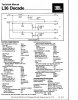
I received LE25-2 from eBay and it measures 4.0 ohm. The tweeter pulled from speaker is marked LE25-4 8 ohm. This tech manual shows LE25-2 8 ohm
Were there later revisions vs the manual i posted below or do I have the correct replacement and its not the exact impedance?
I received LE25-2 from eBay and it measures 4.0 ohm. The tweeter pulled from speaker is marked LE25-4 8 ohm. This tech manual shows LE25-2 8 ohm
Were there later revisions vs the manual i posted below or do I have the correct replacement and its not the exact impedance?
How are you "measuring" the tweeter? Using a multimeter? If so, what you are measuring is the DC resistance, not the impedance. Impedance is an AC measurement, and it changes based on frequency. That is why you see impedance described as "Nominal Impedance" because it's basically an average. You can't measure impedance with a multimeter, again, because it changes depending on frequency. You CAN measure DC resistance with a multimeter, because the current only flows in one direction, there is no frequency component (you could describe it as 0Hz (Zero Hz)).
But DC resistance can still be a useful measurement. It can help determine if there is voice coil damage. You can measure the tweeter from each speaker and compare - if there is a significant difference then that could indicate a problem.
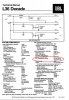
Looking at the tech manual, it shows the acceptable DC resistance range for the tweeter - 3.6-4.4 ohms. That would put 4-ohms right in the middle of that. So it sounds like your tweeter is fine.
I am looking at this LE25-2 on ebay from L36 decade and he lists and measures it at 4 ohm. I guess there were two versions. LE25-2 dont look the exactly same from front anyways, I am going to suck it up and order the LE25-4.
Acceptable DC resistance range for a LE25-4 is 3.7-4.2 Ohms, so if you are measuring 6-ohms it's possible/probable that your "working" tweeter is damaged somehow.
Acceptable DC resistance range for a LE25-4 is 3.7-4.2 Ohms, so if you are measuring 6-ohms it's possible/probable that your "working" tweeter is damaged somehow.
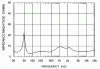
I typed up an entire post earlier in this thread explaining why Impedance and DC Resistance are two different things. You simply cannot measure Impedance with a handheld meter like you are doing. Impedance can only be measured while the cone & voice coil are in motion, and impedance varies depending on the frequency of that motion. When you measure using a handheld meter like you are doing, what you are measuring is DC Resistance, NOT Impedance. This is what Impedance looks like (not your speaker, just an example):
That is why it's always called "Nominal impedance", because the impedance you see listed is basically an average. In contrast, DC Resistance is a single figure that can be easily measured.