• The move to the new server is done. There are some software and database maintenance updates in process. This has us passing the hat around to help out. We appreciate any donations. Seriously, even a dollar helps. The payment page may be found here - https://www.audiokarma.org/support.html

Record Cleaning - Soap and Water - test results

I've been following this thread all day. Wouldn't ya know that I read the post about the dent pullers as soon as I got back from Home Depot with the outlet covers and a couple of knobs. Oh well. I've now washed five records. Playing the first. Very good. I've been a proponent of glue, the paintbrush and paint pad seem to do about as well. I will say though that the washing process is still not as fast and easy as I'd like. Glueing is actually faster and less messy (as long as you don't screw up). The downside is the wait time for each side.
 
I would like to add an alternative to the paint brush which I tried at first.
Thinking about how LPs are pretty resilient and that a firm but soft brush would do the trick, I went to my car-cleaning kit and retrieved this:

Soft_alloy_wheel_brush_z.jpg

A brush for cleaning alloy wheels.
The thing about brushing alloy wheels is that you don't want to scratch them. Same with records. A brush with short bristles is also easier to use.
I have had two washing sessions using this brush ($6 here in Aus.) and find a definite improvement over the paintbrush. I simply brush the records around the grooves in soapy filtered water, rinse and then wipe the soap and water off with a good quality micro-fibre cloth as a secondry cleaning action and allow to air dry in a rack.
So far, so good.
Please someone, don't tell me I am ruining my records using this brush. It certainly doesn't sound like it when they play.

Cheers
wolster
 
Last edited:
Well... I made an US$8.42 label saver from metal 4" round outdoor junction box plates with the foam gaskets, but I'm calling it an abject failure:
Too much gorilla glue (which foams up as it cures in the presence of humidity) combined with too little clamping force wrinkled the gaskets terribly.
Thicker gasket material (which can compress more) may alleviate this potential problem for the next guy, as will using the bare minimum glue (or better, contact cement) and lots of clamping force.

For myself, I opted for the $10 way out: Two 3M/Bondo brand model # 956 suction cup dent pullers from Autozone (as previously documented here) look like the hot setup. $4.99 each.
Here's an online source: http://www.drillspot.com/products/415634/Bondo_956_Suction_Cup_Dent_Puller
Clamping force is very consistent as long as both cups are reasonably well centered.
I have yet to use one productively, but it clamped the bejeesus out of my test record. :banana:
 
Firstly, hats off to Mark for starting this thread, oh so long ago.

I went the Bondo dent puller route myself, mostly because I wanted to try this method right away without having to assemble anything. The principle is the same and so are the results - cleaner, quieter records. My LPs are much quieter than before, some having seen no more cleaning than a cursory wipe with a little audio-technica brush in 20-plus years. I'll refine my routine in the coming weeks and would like to introduce a wet/dry vacuum into the process to get that last bit of gunk out of the grooves. My new turntable is so much more revealing than the old one - a mixed blessing for sure. The delta between noise and music is huge but I am hearing elements of both that I never noticed before. Gotta take the good with the bad, eh?
 
I used the dent-pullers today....18 LPs are shiny and clean! I ran across one LP (John Lennon - Plastic Ono Band) where on side two there was BARELY enough room between deadwax/dent-puller and the last track (My Mummy's Dead). Other than that LP, the rest didn't really matter whether the pullers were lined up or not.

I also "modded" my wet/dry vac for use as well. Just a portion of an old tee-shirt, tightly rubber-banded around the nozzle was perfect in that it didn't scratch the vinyl AND it allowed water to suck through.

I opted for a three step* approach:
1) wood glue
2) sporocidin (anti-mold, protein dissolver) bath
3) distilled water/isopropyl/dish detergent

*I did a distilled water spray/rinse between steps 2 and 3 as well as a vacuum.
 
4164JT99K0L._SL500_AA280_PIbundle-10,TopRight,0,0_AA280_SH20_.jpg

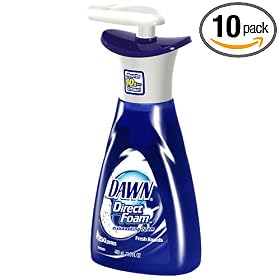
Just got this from the grocery store. When you hit the pump, foam comes out. It eliminates the need to form a lather out of goo.

How did this stuff work out for you?
 
I've been trying this, and there seems to be no difference in sound before and after. I'm using a Mobile Fidelity record brush for "scrubbing", Dawn soap, rinse with distilled water and drying with old t-shirt. Any ideas?
 
I've lately been using a cheap paint pad refill that I got at the hardware store. It seemed to have the thinnest and fairly stiff bristles. I've been using it by running it against it's nap around the grooves with VERY light pressure. My reasoning is that I want the bristles to penetrate the grooves and if I press hard they will lay down instead of sticking into the grooves. With light pressure I can feel the brush tracking the grooves and I let the grooves guide the brush around the record. I do this in both directions, maybe 10 or 15 revolutions. I use hot water from the tap with the sprayer thing to wet the record first. I hold the record at an angle where I can feel that there's a lot of force from the spray on the vinyl. Then I spray it with my soap/water/IPA mix from a spray bottle, use the brush as described and then rinse with the hot water jet from the sink again. Then I use the brush once again (it's got plenty of soap accumulated in it, no need to spray again) and give it another few passes around. I rinse again under the tap, then I spray from a second spray bottle with distilled water and maybe 5% IPA to displace the tap water before it evaporates. I dry with a microfiber towel, then put in a dishrack to air dry the rest of the way. Seems to work pretty well, and even though I'm a big fan of wood glue, the glue doesn't seem to improve upon the results of this technique in most cases.
 
My current system is (full process one side at a time):

1. run tap water over all

2. a solution of distilled water, alcohol and dishwashing soap applied with a sponge

3. wipe with microfiber towel

4. small wet/dry vacuum ($30 at Sears) with the nozzle wrapped in velvet.


Good results so far.

:music:
 
My current system is (full process one side at a time):

1. run tap water over all

2. a solution of distilled water, alcohol and dishwashing soap applied with a sponge

3. wipe with microfiber towel

4. small wet/dry vacuum ($30 at Sears) with the nozzle wrapped in velvet.


Good results so far.

:music:

#4 is the key. I don't think it matters much what solutions/glue/etc. you run before/while cleaning, but vacuuming up the gunk is the key (same with an RCM or DIY). I use a Sears shop-vac as well, cone-nozzle wrapped in velvet with a slit down the middle. Suction+
 
#4 is the key. I don't think it matters much what solutions/glue/etc. you run before/while cleaning, but vacuuming up the gunk is the key (same with an RCM or DIY). I use a Sears shop-vac as well, cone-nozzle wrapped in velvet with a slit down the middle. Suction+

I haven't tried a vacuum method yet, though I'd like to. I don't understand why it should be superior to a forceful rinse from the tap before a final rinse with distilled water, but I have an open mind.
 
I was looking for something simple and cheap.

After researching on AK I tried this method:

- Groovmaster label saver - to protect the label (cost about $50 and sold by William Sargent, email: wmsar@cox.net)

- Dawn kitchen soap ($1.65) and warm water in empty plastic margarine bowl

- 2 1/2" paintbrush (found one in the garage)

- Microfiber towels (8 for $8.24 at Target)

- Sink in our laundry room and warm tap water to rinse (almost free)​

So far I am very happy with the results. My thrift store records are now very quiet, except for the music.

....

it's great information.
thanks
 
Home depot sells plastic round outdoor electrical outlet covers that are exactly the right size. Buy two. Go to the hardware section and pick out two nice cabinet knobs and get a length of the correct size threaded rod. Drill a hole in the center of each cover and you are in business for around six bucks.
 
My Dad has been trying to get me to use Rain-X on my vinyl. I'll have to give it a go.

Rain X has wax or something in it to repel water, if I'm not mistaken, even the windshield cleaner fluid, may not be the best thing to use.
 
Back
Top Bottom