• The move to the new server is done. There are some software and database maintenance updates in process. This has us passing the hat around to help out. We appreciate any donations. Seriously, even a dollar helps. The payment page may be found here - https://www.audiokarma.org/support.html

Replace parallel resistors with a single resistor?

z-adamson

Addicted Member
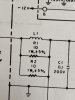
So we have a pair of 10 ohm, 1 watt resistors in parallel, in a point to point arrangement.

9573509C-F30E-4489-96AB-891EC27F0EF3.jpeg

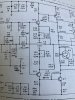
See schematic…

4C4F00B4-7FA2-4E3C-A69A-40BA728DC58F.jpeg

This is r1 and r2.

Question:

Is there any reason I shouldn’t use a 5 ohm resistor with a power rating of at least 2 watts as a replacement for the parallel 10 ohm, 1 watt resistors?
 
Register to hide this ad
You might want to be careful with what you replace those carbon comp resistors with. Because they're in parallel with an inductor I'm assuming this is some type of amplifier output. Carbon comps generally have different characteristics at high freq than other types of resistors. The use of carbon comps may help to keep the output stable in this application, switching to say a 5 ohm 3W metal oxide resistor may not have the same effect. I would definitely put it on a scope if you use a different type of resistor to make sure its not doing something unsavory.
 
You might want to be careful with what you replace those carbon comp resistors with. Because they're in parallel with an inductor I'm assuming this is some type of amplifier output. Carbon comps generally have different characteristics at high freq than other types of resistors. The use of carbon comps may help to keep the output stable in this application, switching to say a 5 ohm 3W metal oxide resistor may not have the same effect. I would definitely put it on a scope if you use a different type of resistor to make sure its not doing something unsavory.
So, where would you shop for carbon comp resistors for this application? 10ohm, 1watt or 5ohm, 2watt.

Mouser has nothing.
 
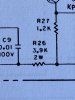
R26 looks like a dropping resistor, so the type isn't critical.

IIRC, metal film resistors were "OK" for audio things. It's when you get up into RF that their inductance can cause issues.
 
I agree with drjim, R26 is just dropping the voltage on the opposite side creating a 10V zener regulated supply. Only the wattage is important on this one.
 
So, where would you shop for carbon comp resistors for this application? 10ohm, 1watt or 5ohm, 2watt.

Mouser has nothing.

Have these resistors shifted appreciably in value? They do not really appear to have changed in color in the picture so minimal heating. Is there really any reason to replace them? The inductor should handle the bulk of any current through this part of the circuit so the resistors should've had an easy life.
 
Have these resistors shifted appreciably in value? They do not really appear to have changed in color in the picture so minimal heating. Is there really any reason to replace them? The inductor should handle the bulk of any current through this part of the circuit so the resistors should've had an easy life.

Good point about them shunting the inductor. That's usually done to "damp" the inductor a bit, broadening the "Q" of the circuit it's in. Hard to tell, though, without seeing the rest of the circuit.
 
Have these resistors shifted appreciably in value? They do not really appear to have changed in color in the picture so minimal heating. Is there really any reason to replace them? The inductor should handle the bulk of any current through this part of the circuit so the resistors should've had an easy life.
Nothing like that.

They had to come out to access something else. At this point I have very short leads to work with and rather than solder on some extensions, I would rather be working with new components and fresh leads.
 
Increased power handling in a smaller package. Moving up to a 2W 5ohm resistor may have made it too long to fit in the space they wanted to use on the terminal strip.
+1 Yep its size. Replacing with a good high wattage shielded film (and make it fit or mod the placement) is what I would do and not worry about any RF problems.. Carbon comp is crap except like in a speaker crossover, you want cement covered or better resistors near any inductor.
 
+1 Yep its size. Replacing with a good high wattage shielded film (and make it fit or mod the placement) is what I would do and not worry about any RF problems.. Carbon comp is crap except like in a speaker crossover, you want cement covered or better resistors near any inductor.


Is this what you would use?

4BF2F63D-864C-44AA-BA73-203D7A86EC25.png
 
So, I have the following in my possession..,

10 ohm, 1 watt, Allen Bradley, carbon comp resistors. Purchased on eBay.

image.jpg

Also in my possession 5.1ohm, 3 watt, Vishay, metal film resistors. Purchased on Mouser.

image.jpg

Not sure which to use…..the metal film or the carbon comps.

Which would you use and why?
 
The carbon comps came from eBay, the metal films came from Mouser. Mouser is more reliable and trustworthy….advantage metal film.

The metal film give 3 watts of power handling, the pair of carbon comps gives 2 watts….advantage metal film.

Carbon comps are true to the original design and some say are better for audio and sound better….advantage carbon comp.

The metal film is smaller than the 2 carbon comps in parallel, so a more tidy install….advantage metal film.
 
Test the carbon comps before using. Even if they are new old stock, they can drift. They are susceptible to moisture. As for using them for audio, I rip most if not all carbon comps from old equipment. I've just found too many out of spec.
I've had zero problems using metal films to replace them as have many others.
There are a few instances where carbon comps are a better choice, but just a few. Mostly when it comes to tube gear. I use precision metal films in all my builds. Tube, SS and crossovers. There are zero carbon comp resistors in any of my amplifier or preamp builds. Including kits.
 
Back
Top Bottom