
• Please note that Audiokarma will be offline briefly for updates early on Monday morning, September 28th.

Replacement suspension washers (foam? rubber?) for old turntables...?

Danzilla

Active Member
I've picked up a number of old turntables here and there over the years. Fixed up a couple that were already in decent condition (cleaned, lubed, replaced stylus, etc), but a few more are missing pieces and was wondering if there are some generics replacements that are recommended. Specifically I'm looking for spacers / washers for the platter motor suspension that go bad after a few decades (or more).

A couple specific examples.. A JVC SRP-471E, needing a few damping 'washers' that were rubber (I think). It was a bit of a mess inside when I got it. Someone apparently used something like Silicone sealant around the screws for the platter motor suspension, retained with electrical tape wrapped around them. (pic attached)

Another, an Onkyo CP-1057F with similar issue, but I believe they were foam of some sort. Where I believe the damping foam goes, it appears to have turned to dust. So the platter section hits hard after rebounding from any movements.

So is there any one or two recommended parts or materials that can be used in place of exact parts that are often hard or impossible to find?
 

Attachments
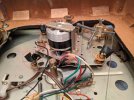
  • PXL_20220212_000221847.jpg
    PXL_20220212_000221847.jpg
    125.7 KB · Views: 55
Last edited:
Register to hide this ad
Melamine sponges (a.k.a. Magic eraser) works well as a replacement for the deteriorated foam.
For bushings and rubber spacers, I keep an assortment of rubber washers in different sizes and thicknesses.
 
Melamine sponges (a.k.a. Magic eraser) works well as a replacement for the deteriorated foam.
For bushings and rubber spacers, I keep an assortment of rubber washers in different sizes and thicknesses.
Any specific rubber type? I was thinking typical rubber washers, often meant more for sealing, would be too stiff.
PS. Thanks, never would have considered a melamine sponge. Have a bunch of cheap ones around I might try out.
 
Last edited:
Any specific rubber type? I was thinking typical rubber washers, often meant more for sealing, would be too stiff.
PS. Thanks, never would have considered a melamine sponge. Have a bunch of cheap ones around I might try out.
Not sure of the rubber type on the washers. I picked them up during a couple of trips to local hardware stores.
 
Hmmm, didn't find what I was looking for when searching for 'suspension', but checking again for 'motor mounts', brought up a few more useful threads. One in particular has a decent bit of info on fixing up the JVC SRP-471E ...
 
It's hard to beat Sorbothane for audio / vibration isolation. Oracle uses it in their turntables and I used it to great effect with my VPI HW-19 mk IV. I tested the sorbothane washers I made out of a flat square on the VPI with a stethoscope and the isolation works remarkably well.
 
It's hard to beat Sorbothane for audio / vibration isolation. Oracle uses it in their turntables and I used it to great effect with my VPI HW-19 mk IV. I tested the sorbothane washers I made out of a flat square on the VPI with a stethoscope and the isolation works remarkably well.
Might get to there, but hoping to find regular washers, mounts, or whatnot that will fit for now. Not looking for the best solution, just a good solution that will get things working decently.
 
Take a look at Vibrapods. I changed out the rotted feet on a JVC QL Y5F with them a month or so ago, worked like a charm.
 
Specifically I'm looking for spacers / washers for the platter motor suspension that go bad after a few decades (or more).
This is a difficult subject. Motor mounts… There are quite a few different ways for isolating platter drive motors. It’s not a one-size-fits-all subject. I’ve found it best to mold my own using butyl rubber. I use the best one of the originals and make either a wax or silicone rubber mold. Then fill it with butyl rubber by using a large syringe to inject the liquid butyl into the mold under pressure. Most rubber grommets are too hard. Butyl is soft, absorbs vibration, and damps really well. Plus, it’s very stable for decades of use.
 
There is Swedish fellow who makes excellent (according to the feedback I have seen) replacement motor mounts in silicone rubber.
I will try to find a link.
For the internal damping of suspension springs I use surplus urethane foam rubber from my Welpur pillow.
The damping pads on my JVC JL-A1 have nearly perished, so I’m looking for a good replacement for those. I have some self sticking foam feet that may be ok, but I will see. The do ok on turntable lids.
 
Since this is the OP’s question, why are people bringing up feet, dust covers, and chassis suspension damping?
Probably I wasn't all that clear. Maybe just because I'm not completely sure of the terms myself. The JVC parts I was interested in turn out to likely called motor mounts instead... though they still seem like suspension to me. Keeping motor vibrations from the rest of the chassis.
The Onkyo parts I thought had broken down, I've been told never existed in the first place and the platter section only rests on springs. No foam dampers like I'd assumed (based on something I'd read elsewhere and some previous experience.)
Just received a replacement gear for the Onkyo, so I'll get back into that one soon and see how that goes...
 
I understood what you were referring to, re: motor mounts. I think some folks enjoy going off on tangents in here, or not carefully reading the description of the issue.
 
Okay.... moving past the motor mounts for the moment and concentrating on the Onkyo CP-1057F table. I've looked at it again and see better what the issue that I was concerned about previously really was. The 'floating base' assembly has three springs with height adjustment screws around the platter, holding the base in place. However there's a 4th spot, under / next to the tonearm base that doesn't seem to have any support (spring? cushion?). So with the platter removed, when anything pushes down even a little on the floating base near the platter, the tonearm side raises up, but once the pressure is released, the springs under the platter effectively push the tonearm side back down, causing it to hit hard against the rest of the base.
In reality, now that I'm really thinking about it and have experimented with it some more, I realize it's not an issue at all. Once the platter and mat is in place weighing it down (and without certain people intentionally pressing down on the floating base to 'test' it), the tonearm side would be balanced out and effectively 'float', so it might never happen that the tonearm section bottoms out even without any additional rubber or foam support (like what I thought was missing.)

At any rate, I've reinstalled a replacement for the damage worm gear, but still can get the cueing working. With the gear removed everything seems to turn smootly, but when installed, the motor keeps seeming to hang and make a buzzing noise. Or it will work for a few seconds and then hand and buzz. When I try and manually turn the motor gear to drive the cueing, I can definitely feel additional resistance in places that would explain the motor struggling, but I can't find any cause for it and when I remove the little worm gear that I just replaced, the individual pieces (including the motor), all work smoothly. :(
So not sure ATM if the motor is just weak / damaged or if there is something else in the gears and other parts that's causing the problem.
 
Last edited:
Okay.... moving past the motor mounts for the moment and concentrating on the Onkyo CP-1057F table. I've looked at it again and see better what the issue that I was concerned about previously really was. The 'floating base' assembly has three springs with height adjustment screws around the platter, holding the base in place. However there's a 4th spot, under / next to the tonearm base that doesn't seem to have any support (spring? cushion?). So with the platter removed, when anything pushes down even a little on the floating base near the platter, the tonearm side raises up, but once the pressure is released, the springs under the platter effectively push the tonearm side back down, causing it to hit hard against the rest of the base.
In reality, now that I'm really thinking about it and have experimented with it some more, I realize it's not an issue at all. Once the platter and mat is in place weighing it down (and without certain people intentionally pressing down on the floating base to 'test' it), the tonearm side would be balanced out and effectively 'float', so it might never happen that the tonearm section bottoms out even without any additional rubber or foam support (like what I thought was missing.)

At any rate, I've reinstalled a replacement for the damage worm gear, but still can get the cueing working. With the gear removed everything seems to turn smootly, but when installed, the motor keeps seeming to hang and make a buzzing noise. Or it will work for a few seconds and then hand and buzz. When I try and manually turn the motor gear to drive the cueing, I can definitely feel additional resistance in places that would explain the motor struggling, but I can't find any cause for it and when I remove the little worm gear that I just replaced, the individual pieces (including the motor), all work smoothly. :(
So not sure ATM if the motor is just weak / damaged or if there is something else in the gears and other parts that's causing the problem.
I picked up a 1057 from a flipper.....$60. Beautiful condition, dustcover ugly. But he had done the New Gear.
I ran it thru its paces....perfect from what I could tell. Iusually always buy a new Stylus, here to 'cept this soud very good, looks good under high magnification!
That suspended top assembly felt loose, worn out. I started researching, people also talked about overly sensitive.
Iopened it up....I mistook the shipping screws for suspension screws.
I eventually found the Cups with Springs and Dampening foam. The foam was in very good condition. I put some discs of closed cell foam in the springs to help.
Did a "little" help.

@Danzilla , I know its 3 years ago, hoped you sorted it out.
Mine dosen't sit levell. What you said about the weight of the Platter, and not pushing on it made sense.
However, that corner, underthe tonearm/gimble -as you say- has nothing there. no support or dampening.
My platter shows a slight GAP on the Left side (platter to plinth), sloping down towards the tonearm. The GAP eventually goes away (the platter is tilted to the right)
I can add some dampening over there---under the tonearm, its just somethng must be wrong, out of adjustment.
There is no adjustment there, only the 3 under the platter. adjusting them didn't help.

Maybe somebody has seen this also
 
Back
Top Bottom