• The move to the new server is done. There are some software and database maintenance updates in process. This has us passing the hat around to help out. We appreciate any donations. Seriously, even a dollar helps. The payment page may be found here - https://www.audiokarma.org/support.html

Replacing Dahlquist DQ-10's 80uf electrolytic cap

-reverb-

Buying, selling... mainly buying
I was a little bored yesterday; it was raining so I couldn't do anything outside. I mentally went through my audio projects in search of something small.

My Dahlquist DQ-10's has all poly caps expect for the 1 80uf electrolytic. That's a pretty small project!

I shuffle through my box of caps trying to find a couple of 80's or something that can be ganged together to total 80. Nothing. Nada.

I then remember a huge box of 10uf polys I bought from Madisound for like 40 cents each. I could gang 8 of those together to get the 80uf I need. It may be overkill - not sure if it's even in the signal path, but they are just sitting in a drawer and 80uf is 80uf regardless if it's poly or lytic, right?

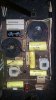
I cobbled together an off-board sub-crossover with flying leads to replace the 80uf on the Dahlquist crossover. No way 80uf's worth of poly will fit in the original location. All the caps are soldered and hot-glued together to form a nice, solid block. Measuring with my meter I get 78.9uf for each one. Not too shabby.

I plan to either mount it to the Dahlquist cabinet with 4 small screws, or more likely use an industrial strength hook & loop fastener (Velcro). Here's a peek - shown beside a standard-size BIC lighter for scale.

View media item 6731
View media item 6729
Thoughts and/or suggestions?
 
Register to hide this ad
Interesting. It's really not necessary for the midbass cutoff. A good quality electrolytic will serve the purpose just fine. And you may not fit that stack under the cage. But, why the hell not!? Go for it.
 
I've thought of buying a boat-load of those Madisound caps, for a recap on my AR90's. While I need to build up an 80uf too, I didn't know they'd be that big! :yikes: So, I'm really curious as to how these will work out for you? Plus, please be sure to post any differences in sound that you hear after the change. :)
 
I have a stack of those same caps too and they measure well. Chinese caps are almost always within the -10% range of the +/- 10% spec. Just FYI. You'll almost never get a 10 uF cap that measures above 10 uF, but they will measure between 9 and 10.
 
If you get one of the three metalized polypropylene caps at 82µF from PE, you are looking at these dimensions:

61 mm Dia. x 62 mm L
52 mm Dia. x 62 mm L.
53 mm Dia. x 63 mm L.

Now a 12-ounce can is 54 mm in diameter and 122 mm tall. These caps all all about half a coke can tall and just as big or bigger around. Some strap these caps to the adjacent leg of the superstructure support system holding the drivers.

That group of 8 doesn't look any bigger and it is a nice rectangular item, ready to be mounted behind the boards that do not have the crossover in the way, plenty of space.
 
you really don't need poly caps for that part of the circuit. And to Doug's point, adding a bunch of components to get the desired value will cause the potential for the tolerances to swing wildly.

Mundorf E-cap is a very very good electrolytic. Intertechnik/Audyn "rough foil" ERA caps would be another excellent option. Both are available in 82uF sizes which is essentially about as good as it gets with a decent cap.
 
you really don't need poly caps for that part of the circuit. And to Doug's point, adding a bunch of components to get the desired value will cause the potential for the tolerances to swing wildly.

I'm always ready to learn baco. I assume you mean that ganging 8 caps together increases my potential for tolerance swing, yes?

If indeed that is the case, given the inherent stability of poly caps, and a measurement of 78.9uf on each gang, wouldn't these be as good a substitute for a single electrolytic like the one you mention (discounting any size penalties of course)?

Keep in mind, the main reason for going this route was it would be no worse than a good electrolytic and most importantly, these were unused parts that needed to find a purpose. I understand that the caps you mentioned themselves are relatively cheap, but factoring in shipping for just those couple of caps and the dollars-per-part rises significantly.

Thanks for any illumination. :thumbsup:
 
reverb,
I have a very early set of DQ 10's, and I replaced C1 with an axion polypropeleen 75 along with all of the other old paper caps. When I was done I had a completely different speaker. What I thought was bad on the top end was the drivers, not the caps. boy was I wrong! I don't know what you use to drive the DQ 10's, but if you could find a 60 watt Nakamichi SR4a, or any Stassis circuit amp you will be blown away. Nothing I have ever owned drives them any better through the whole range. I have had many fine amps on them. I had to rebuild my whole system after I installed the Nak. The phono and MC section is dead quiet. If you have any interest on more detail PM me. My Nak cost $75 + some resistors, It blows me out of a 14' x 24' room at 12 o'clock on the volume.
 
I'm always ready to learn baco. I assume you mean that ganging 8 caps together increases my potential for tolerance swing, yes?

If indeed that is the case, given the inherent stability of poly caps, and a measurement of 78.9uf on each gang, wouldn't these be as good a substitute for a single electrolytic like the one you mention (discounting any size penalties of course)?

Keep in mind, the main reason for going this route was it would be no worse than a good electrolytic and most importantly, these were unused parts that needed to find a purpose. I understand that the caps you mentioned themselves are relatively cheap, but factoring in shipping for just those couple of caps and the dollars-per-part rises significantly.

Thanks for any illumination. :thumbsup:


If you already have everything ready, then go for it and report the results!
 
If you already have everything ready, then go for it and report the results!

Well, not if it's a bad idea. Maybe I am missing a nuance of caps in parallel that I should understand better. My understanding was once you reach the desired uf, it doesn't matter how you get there i.e. a single 80uf, 2-40uf's in parallel, 4-20uf's in parallel etc. Once the uf is achieved, the crossover knows no different. Also with poly or mylar caps, the uf reading will be very stable - much more so than electrolytics as they age.

I am concerned about the potential tolerance swing you and Doug refer to. DC, please chime in here if you would.

I don't want to do something stupid. I am not opposed to replacing with a nice Mundorf, just had the polys on-hand.

I'm in no hurry and I see this as an opportunity to learn from you, Doug and others. Maybe those playing along will learn something too!
 
Unless you can find new versions of the original stock capacitors, it's not really going to matter too much what's used, as anything used is going to be a change from stock. And since I don't think paralleling caps can hurt anything, why not give the 80 bundle a try? Even buyers that bought the 10uf Madisound caps, and left review comments, have mentioned using multiples to build up values, and liking what they heard afterwards. Also, NPE are so cheap, why not experiment and try it both ways, and see if you can hear any difference?

One other thing, in refurbishing speakers over the years, I've pulled and rebuilt a lot of crossovers. Most used a single cap for each needed value. But, I've looked at crossovers from expensive 'high end' speakers, and they had multiple capacitors built up for each value. These used bypass caps too. So, that's why I felt that you can't hurt anything to try a bundled cap. Good luck.
 
Maybe a question for the Capacitor Abyss.

Do capacitors rated at 10µF ±10% when paralleled to get 80µF is the result something that will vary way outside say 80±10%?

I don't know but it seems to me that the spec is the capacitance of each capacitor and when the caps are added there isn't going to be an equal addition of the variance, ±80%. I believe, and could easily be educated otherwise, that you have a 78.9µF cap with a variance that is well within what is needed for that speaker, not something that might vary from 15 to 142 (±80%, 10% per cap added).
 
I love those caps, I bought 500 and they're in a big bin at my electronic work station. I'll rarely use them in a tweeter circuit, I'll usually go for an Audyn Q4 or better there. So anywhere else in the circuit if there is a cap from 10uf to 60uf I'll gang these guys together. Over 60uf I'll usually go electrolytic. I bought so many as I rebuild a lot of speakers and don't want to have to order again. I've used them in many speakers and think they sound great. Even though they're spec'd at 10% tolerance I don't think I've ever measured one below 9.7 which is which is within 3% spec, pretty darn good. And I've measured many.

Dan

image.jpg
 
If all the 10uf at 10% tolerance were all at the high end, they would be 10uf + 10% = 11uf. 8 of these paralleled would be additive so the total would be 88uf, which would be the 80uf + 10%. Similarly, if they were all -10%, then each would be 9uf. Then x8 = 72uf, which is the desired 80uf -10%. So paralled caps of the same % accuracy will be within the same % tolerance.

Given a sufficient number of caps, and a random assortment of them, you'll likely have a wash of + and - tolerances, and possibly get within 3-5%. Since modern manufacturing of film caps can give pretty tight tolerances already, it might even be less than the printed tolerance, as noted above.

KEF was one of the first (along with Falcon Acoustics whose founder worked with KEF specifically on crossovers) to manually and then computer checked incoming caps to 1% tolerance and then selected them into batches so that when building crossovers, they could match components and build crossovers which along with similarly matched drivers, could yield speakers matched to 0.1-0.5db.

Best thing to do is get a decently accurate cap meter and then test and note true capacitance on each cap. I do that with my recaps. I like the B&K cap meters, they are old school but accurate.
 
Last edited:
Very lucky the OP had oval shaped caps, they nest better. If they were cylindrical, the set would be even bigger.

A great use of the parts box, and of course, cost effective. Personally would use 4x20 or 2x 40, but there's a certain expense to it. Or a 60-70uf electrolytic plus the remaining in a film cap.
 
Whether the cap is plus or minus 10 percent is easily measured with a capacitance meter. The same holds true for a single caps or 8 caps in parallel. What will be changed, and is probably of little consequence, is the ESR (being very very low with all those pseudo resistors in parallel) and power handling, which is ridiculously high.

My own feeling is that very large caps like this can be NP electrolytics, if that was speced originally, since I'm sure Jon Dahlquist accounted for the ESR of each cap. Having spent some time rebuilding this crossover, it's clear to me he was EXTREMELY detail oriented about his crossovers...

Also, I think the benefits of film caps (which manifest themselves in the higher frequencies) don't really come into play when used to block the lower end for the midrange, as used here, I think at 500 Hz or so.
 
Back
Top Bottom