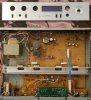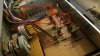
I've come across a Pioneer SA-510 that was kept in the garage as an amplifier. It started "acting weird" so it was given to me. I respect the vintage tech, and want to bring this thing back to life for normal use in a cared for environment. It's got 2 problems.
- It is oxidized inside. Rusted on wrapped terminals. (Red square)
- Two wires are broken. (Red circle, only one shown)
Owner said that it had been working last time he turned it on but was acting weird. This was almost 6-8 months ago.
As for the oxidation, when I open it up, it smells acidic. Like a bag of gummy worms. It was not close to the ocean, but it is very humid and hot in our area. There appears to be no batteries or leakage. The wire wraps are oxidized to green and there are two wires that are broken. You can see the oxidized wraps and one broken wire in the close up picture. Here's my plan, and correct me if I am wrong.
I plan to clean the boards with 90% or 99% alcohol and detergent, then alcohol and baking soda (to stop the oxidation/acidic smell), then a final flush. Next step, I plan to resolder over the oxized wire wraps as stated in the following thread.
https://audiokarma.org/forums/index.php?threads/tutorial-deep-cleaning-an-amplifier.258899/
"Many Japanese amplifiers used a wire wrap connection system on the PCB(s) (consisting of a tinned pin, soldered onto the PCB and the wire conductor twisted around it in a tight fashion). This system usually oxides over the years and makes for intermitted or bad electrical connections. These connections can be “reestablished” by simply flowing a bit of solder over the wire and pin."
This doesn't seem like a correct fix. A full removal and resolder of nonoxidized wire, if there is any, would seem to be the best. Does solder restore oxidized terminals?
Then I plan to solder on a whole new small loop wire for the broken two in the pictures. I don't know why they aren't a simple conductive track like the others on the board. Maybe they needed a higher voltage. Here are my concerns.
- Is the above a good attack plan?
- If the broken two wires are oxidized at the break point, is ever other wire oxidized under the sheathing? Will this change the resistance? Should I replace every wire?
- In the pic, there are multiple PCBs and a Flouroscope display. Do I separate all this for cleaning? This will be very time intensive. What if It doesn't work currently? Can I turn it on or will the broken wires risk damage?
- There is the transformer and multiple wire wrapped choke inductors. Will 90% alcohol ruin these, trapping distilled water?
- Should I apply new thermal grease to the heat sink and MOSFETs?
- It doesn't appear too dirty in the picture, but it definitely feels a little oily, or waxy and this combined with the citric acid smell worries me. Should I just skip the alcohol/detergent/baking soda clean and do only resolder oxidation and wire repair?