• The move to the new server is done. There are some software and database maintenance updates in process. This has us passing the hat around to help out. We appreciate any donations. Seriously, even a dollar helps. The payment page may be found here - https://www.audiokarma.org/support.html

RM9 - Same socket killing tube?

Crang

Well-Known Member
Have an RM9 that got rebuilt 2 years ago. All new power switch, electrolytics, bias pots and LEDs. Resistors and diodes all tested good and are original. Wondercap output coupling caps are original and untested. Gain & inverter tube sockets got reflowed as they are direct mounted to PCB and are known to crack with heat/age. The main EL34 sockets are untouched. Its a PPP design for reference which can be run with either 2 or 4 tubes per channel.

Anyway so had gotten a new tube set at time of rebuild. After maybe 400-500 hours use running the full 8 output tubes one of the EL34s started flashing. Assumed was just a bad tube. Pulled it and just ran the amp with a half set of output tubes no problems. Was a pain to get a matching EL34 RAM tube that matched that sides quad but eventually managed to. Ran fine with the new tube for another 400-500 hours then tube in the same socket as the last one went bad. Started blowing fuses intermittently. Tested the tubes and the one in the same socket as last time failed the short and grid leakage tests.

So what are the odds a tube in the same socket went bad 2x in a row at about 500 hours? I assume its an amp issue but no idea what to even check at this point. I retested all the resistors on the bottom side of the PCB and across socket pins that I could get to without it being full surgery and they tested fine, although there are many more on the flip side of the PCB. Ideas before I replace the tube again?
 
Register to hide this ad
Did you measure the resistance of the grid resistor? That resistance going up too much could explain the tube 'running away'.
 
Did you measure the resistance of the grid resistor? That resistance going up too much could explain the tube 'running away'.

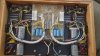
Im honestly unsure which ones those are. I only know enough to be dangerous. I can test with a multimeter and solder but thats as far as my knowledge goes- how the circuits work are still beyond me. Attached is a picture (pre recap) as well as the schematic. I tested the resistors across the socket pins and the couple on this side of the PCB. I did not test the large ceramic ones nor did I test the majority of them on the other side of the PCB since I didnt want to desolder it if unnecessary. Thanks for the help.
 

Attachments

The only per-socket resistors are the 1K grid stops. Easy enough to check all 4. Typically these are mounted right on the socket. I can't quite tell, but it does appear there is a resistor between 2 pins on each socket, if one end goes to pin 5, thats the one. Often they will sit between pins 5 and 6. 6 is not connected internally so it makes a good junction spot between the resistor and the rest of the circuit.

The caps would be shared between 2 tubes, same with the grid to bias supply resistor so those would affect a pair of tubes, not just one. The other likely possibility is a loose or crusty contact in the socket itself. Might be worth giving them all a good cleaning, and maybe re-tensioning the contacts on the sockets, especially the one that is giving you trouble.
 
The only per-socket resistors are the 1K grid stops. Easy enough to check all 4. Typically these are mounted right on the socket. I can't quite tell, but it does appear there is a resistor between 2 pins on each socket, if one end goes to pin 5, thats the one. Often they will sit between pins 5 and 6. 6 is not connected internally so it makes a good junction spot between the resistor and the rest of the circuit.

The caps would be shared between 2 tubes, same with the grid to bias supply resistor so those would affect a pair of tubes, not just one. The other likely possibility is a loose or crusty contact in the socket itself. Might be worth giving them all a good cleaning, and maybe re-tensioning the contacts on the sockets, especially the one that is giving you trouble.

Thanks- I did test all the resistors that were across the socket pins- every socket has one. They were all perfectly in spec. I did clean the sockets quite well with deoxit and tiny scrub brushes when the amp was first acquired but its been awhile. I'll certainly do it again. Just apprehensive sticking a new matched tube in there until Im sure of what went wrong. Its difficult to get a single matched tube from RAM these days and they had a hard time finding one the last time this happened.
 
Another possibility is that there is some internal leakage between the socket pins. I've had this happen a couple of times and replaced the socket only as a last ditch effort.

The last time it happened the sockets were even NOS. Luckily, I had 5 of them.
 
Another possibility is that there is some internal leakage between the socket pins. I've had this happen a couple of times and replaced the socket only as a last ditch effort.

The last time it happened the sockets were even NOS. Luckily, I had 5 of them.

I dont suppose thats something I can test for with a continuity test?
 
usually they only leak with a few hundred volts applied. Maybe if you have one of those old style wind-up insulation testers (a Megger) but not with a standard ohm meter.
 
I dont suppose thats something I can test for with a continuity test?
No but I was getting some puzzling voltage readings with the amp powered up. I don't recall the details, though. If everything else checks out OK I'd just replace it. Sockets are much cheaper than tubes and if that's not the problem you're only out a few bucks.
 
yeah, looks like they mount with screws, so no drilling required. Just a bunch of wires.

Yeah. I guess Ill try a new or NOS socket. Any preferred ones to use and look for? I guess there is no way to know if it fixed it except get another tube and wait 500 hours.
 
I like Amphenol or Cinch sockets in NOS. There is another one that I'm drawing a blank on right this moment thats good too.

For new, the Belton are pretty good, though I don't know if I've used one of their octal sockets. They are a sort of grey color though. Not sure about you, but having one odd-color socket would bug me.
 
I like Amphenol or Cinch sockets in NOS. There is another one that I'm drawing a blank on right this moment thats good too.

For new, the Belton are pretty good, though I don't know if I've used one of their octal sockets. They are a sort of grey color though. Not sure about you, but having one odd-color socket would bug me.
I would never replace only one socket, unless the unit was a year old and one of them failed due to a fluke. I have a pretty good working stash of NOS, but I agree about Belton. Jim Mcshane recommends them too, and that's worth a lot in my book. :)

Jack
 
It may be that there is either bad wiring or the screen stopper is too far away from the socket resulting in ultrasonic oscillation.
 
It may be that there is either bad wiring or the screen stopper is too far away from the socket resulting in ultrasonic oscillation.
If it was a screen stopper too far would that have shown up erlier as its never moved in the life of the amp?

Any chance a leaky output coupling capacitor could do it? The only caps that didnt get changed out at rebuild were the 4 Wondercaps it uses for the output coupling. Even though they arent electrolytic, they have been in use in there since 1986......
 
Yes, you should probably replace all the coupling caps. Based on the symptom, I would recommend that even if they weren't 37 years old. I also recommend good quality commercial-grade film caps for this, not boutique components.

Jack
 
If it was a screen stopper too far would that have shown up erlier as its never moved in the life of the amp?

Any chance a leaky output coupling capacitor could do it? The only caps that didnt get changed out at rebuild were the 4 Wondercaps it uses for the output coupling. Even though they arent electrolytic, they have been in use in there since 1986......
Depends on the tube, sometimes one tube is stable and another is not.
 
Yes, you should probably replace all the coupling caps. Based on the symptom, I would recommend that even if they weren't 37 years old. I also recommend good quality commercial-grade film caps for this, not boutique components.

Jack

Its been on my to do list for some time to replace them. The original Wondercaps are quite small for what they are rated for and its a very hot location. When I tried to find suitable 'audio' grade components small enough to fit a rather cramped spot and could handle the heat I came up with VCap ODAMs which always get rave reviews but are quite pricey....so I just never get around to it.
 
Its been on my to do list for some time to replace them. The original Wondercaps are quite small for what they are rated for and its a very hot location.
Have you checked the voltage on the grid of the following tubes? If the caps are good you should not have any significant amount of DC voltage there.

If they are (electrically) leaky I would expect that the voltage would not only be higher than normal but that it would also be consistently present. At least, I've never found a cap that was leaky one moment and then later measured fine.

On the other hand, if there's some internal flaw in the socket it's entirely possible that voltage measurements may not be quite that consistent.
 
Back
Top Bottom