• The move to the new server is done. There are some software and database maintenance updates in process. This has us passing the hat around to help out. We appreciate any donations. Seriously, even a dollar helps. The payment page may be found here - https://www.audiokarma.org/support.html

Running Four Mixed Ohm Surround Speakers on Two Terminals?

VonDrake

It began with FantaSound
A few months ago I added 2 extra surround speakers to my 5.1 surround sound setup.

2 small bookshelf speakers each connected in parallel to the left and right surround on my Yamaha RX-V663 (95 watts per channel). 4 surround speakers total on a 5.1 setup.

I was inspired by cinema theater design, which usually has an array of surround speakers mounted on the walls.

To me it has improved the surround quite a bit. I am very happy with the volume of the speakers and the surround effect. All the speakers blend together well.

My question is, will this setup stress and/or blow up my Yamaha AVR at some point? The speakers are not matched in Ohms - one is 4 and one is 6 ohms running on the same terminal. Main speakers are 8 ohms.

The receiver is not heating up, there has been no problem for months running the system this way. Just curious if any of you here think there might be a problem down the line or not? Thanks.

P.S. If you're wondering why I'm running 5.1 on a 7.1 AVR, it's because I'm only streaming these days (Netflix, Disney+) as opposed to watching Blu-rays. Streaming only works in 5.1, so the back surround speakers are laying dormant for the time being.
 
Last edited:
Register to hide this ad
4 and 6 in parallel is 2.4 ohms. That's pretty low for a receiver.

That said, the average duty cycle for the surround channels is fairly low. Given the receiver isn't getting hot or going into protect suggests to me the receiver tolerates it in your use case. But, is there a perpetual guarantee? No, not really a guarantee about anything.

About only 5.1 from streaming, you could change the surround mode to engage, for example, Dolby Prologic IIx (DPLIIx) on the Dolby Digital (DD) signal and that would create the two back channels giving you 7.1. Engaging DPLIIx on top of DD does not change the underlying DD 5.1 content, it just creates the back two channels from it.

If the topic of the parallel speakers is an ongoing concern perhaps you want to try going back to 7.1 layout and giving it a go with DD+DPLIIx instead.
 
Thanks Whoaru99 (Alice in Wonderland reference?)
Judging from your avatar image you're exactly the right person to answer this question - Thanks!

I will probably leave the speaker setup as is for now. I usually have the Yamaha RX-V663 set to PLIIx surround mode (Dolby Pro Logic II),
but never checked whether audio was coming out of the back speakers. The AVR might be set to Straight, so I will fiddle with it and report back.

By the way, you said "4 and 6 in parallel is 2.4 ohms. That's pretty low for a receiver."
Does that mean if I added yet another speaker in parallel (3 on one terminal),
the Ohm number would then be higher than 2.4, and thus easier for the receiver? Just curious, as I don't actually intend to do this, but your answer might help others.
 
By the way, you said "4 and 6 in parallel is 2.4 ohms. That's pretty low for a receiver."
Does that mean if I added yet another speaker in parallel (3 on one terminal),
the Ohm number would then be higher than 2.4, and thus easier for the receiver? Just curious, as I don't actually intend to do this, but your answer might help others.

The more speakers you put in parallel the lower it will be. For example, 4, 6, and 8 ohms in parallel would be 1.85 ohms.

If the additional parallel resistance is high enough, say like 1000 ohms or more, it won't drop it by any appreciable amount. For example, 4, 6, and 1000 in parallel is 2.39 ohms, not much different than 2.4 ohms of just the 4 and 6 in parallel.

When you combine resistance in parallel, no matter how many it is, the resulting parallel resistance will always be lower than the lowest individual resistance.

There are parallel resistance calculators on the internet. Else, the formula is -

Rt = 1 / ((1/R1) + (1/R2) + (1/R3) ...)

Try it with 4, 6, and 8 as R1, R2, and R3. See if you get the same result as said above.
 
Thanks again Whoaru99 for the info.
I am still fiddling with my Yamaha RX-V663, trying to figure out how to get 7.1 audio out of a 5.1 signal.
Whenever the Yamaha detects a 5.1 signal, it only plays in Straight mode, with no way to deactivate or switch to PLIIx surround mode.
 
Quick question: Would connecting two 6 Ohm speakers in parallel be easier on the AVR than two 4 and 6 Ohm speakers on the same terminal?
 
Thanks again Whoaru99 for the info.
I am still fiddling with my Yamaha RX-V663, trying to figure out how to get 7.1 audio out of a 5.1 signal.
Whenever the Yamaha detects a 5.1 signal, it only plays in Straight mode, with no way to deactivate or switch to PLIIx surround mode.

I suggest you'd need to turn off Straight mode to allow other sound modes to be used. How to do all that should be in the manual.
 
UPDATE & NEW QUESTION >> All seems to continue to run smoothly with my 4 surround speakers on 2 terminals, but now I've got two related questions.

1>> The mixed OHM speakers do not output at the same volume. The (Infinity RS-125) sounds approximately 1/3 or 1/2 louder than the speaker.
I switched the for another speaker, with more or less the same result. The Infinity is still a bit louder.
I am curious whether the difference in output has to do with OHMs, or simply that different model speakers will sound louder or softer, given the same amplification?
Then again, it may have to do with the way I've wired the speakers, which leads me to my second question.

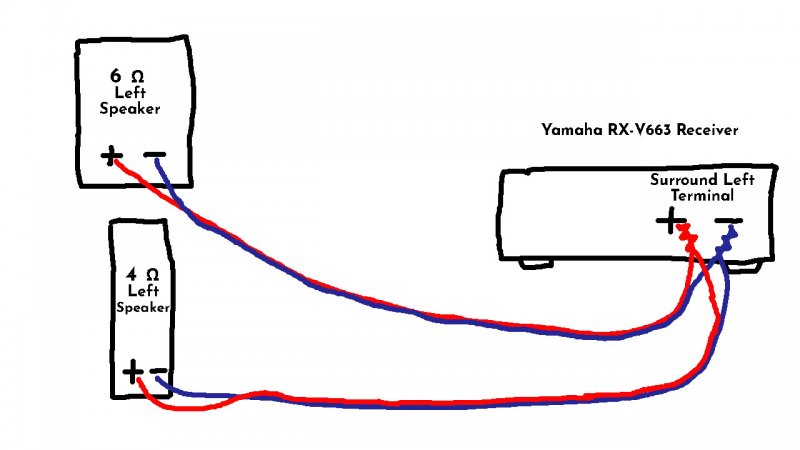
2>> I connected each speaker as usual (+ & - cable wired into the speaker cabinet), twisted the 4 positive and negative ends to blend them into 2 positive and negative wires,
then connected in-phase into their respective binding post terminals. I believe this is considered parallel wiring, but maybe I'm wrong about this.
Is this the best way to connect this type of multiple speaker setup, or is there a better way? Again, all is working fine, except for the difference in mismatched speaker volume.

Attached is a schematic of the wiring I am asking about >>

 
some speakers will naturally sound louder than others with the same amount of power. .

The different impedances may have a little to do with that but even different speakers with the same rated impedance will have different volume levels. That's the nature of the beast.

Yes, that is parallel wiring.
 
some speakers sound louder than others with the same amount of power. That means that some will sound louder than others.

The different impedances may have a little to do with that but even different speakers with the same rated impedance will have different volume levels.

Its all about sensitivity. ;)

Although, to your point, impedance does have some influence on power distribution between the two speakers.
 
It might be worth trying the speakers connected in series, rather than in parallel. The combined impedance would then be 6 + 4 = 10 ohms. Ten ohms would be an easy load for your amplifier, which is rated at 8 ohms, to drive. The surround sound would be very likely still be loud enough, and you'd have no worries about overloading the amplifier. To connect them in series, just connect the - terminal of one speaker to the + terminal of the other. Then connect the remaining - terminal to the corresponding terminal on the amp, and the final + terminal to the amp's + terminal. You will now have just one wire to each amp terminal, and not two. You may or may not like it as well as your present setup--it may be better, it may be not as good--but, as with many things in audio, the best way to find out is to try it!
 
Last edited:
Back
Top Bottom