• The move to the new server is done. There are some software and database maintenance updates in process. This has us passing the hat around to help out. We appreciate any donations. Seriously, even a dollar helps. The payment page may be found here - https://www.audiokarma.org/support.html

Sabotage of KA-7100?

hitjazz

Member
With the help of a friend, I am beginning a project to revive my KA-7100 diagnosed with a protection circuit issue. As we move forward, I may look to this forum for advice. However, for now, we are stymied at the outset by what appears to be a short.

Background: I checked all 4 fuses before bringing it into a repair shop for an estimate. The fuses all were good. I paid the shop $60 for a diagnosis and estimate and was quoted $470. As you might imagine, I decided not to have the shop fix it.

Plugged it in today to begin troubleshooting. The power LED came on and then shut down almost immediately. That surprised me. Prior to brining it in for an estimate, it would light up and stay lit (but the relay wouldn't click). Opened it up and found that all 4 fuses were blown. Can't help but wonder if the tech made some change during the diagnostic check that caused the fuses to blow when I powered it up. If so, I'd like to think it wasn't sabotaged because I didn't leave the amp at the shop for repair.

We have new fuses. Tomorrow will try to proceed with troubleshooting the protection circuit. Hope the fuses don't blow out again on power up.

If you have any suggestions how to diagnose the short circuit, I'd be very grateful.
 
Register to hide this ad
Did you power it up before taking it to the "repair shop"? The fuses might have been alright because it hadn't been powered on for forever.

Blowing fuses is symptomatic of shorted output transistors.
 
First of all make yourself a dim-bulb tester. Search this forum for advice on that. It will save a lot of frustration and fuses. Then acquire a schematic and learn how to read it and make the connection between the drawing and the actual circuits.
This will allow you to isolate the circuits in the amp; power, pre-amp, main amp.
Frankly, all four fuses blown is a bit suspicious. I don't want to fuel any conspiracy theories but the purpose of the fuses is to protect the above amp sections. So to have all four of them blown is unusual at best.
Hang in there, maybe some others much more knowledgeable than I will soon chime in.
 
Did you power it up before taking it to the "repair shop"? The fuses might have been alright because it hadn't been powered on for forever.

Blowing fuses is symptomatic of shorted output transistors.

Last time I powered it up was a few years ago. Consider that, if the short existed prior to bringing it in to the shop, the tech would have had to fix it in order to diagnose the protection circuit issue and to list for me the capacitors, resistors, and transistors he intended to replace. And he would also have included the short circuit in the diagnosis (which he did not do).

We'll certainly try to check the output transistors. I'll search for a post or two about doing that on AK.
 
First of all make yourself a dim-bulb tester. Search this forum for advice on that. It will save a lot of frustration and fuses. Then acquire a schematic and learn how to read it and make the connection between the drawing and the actual circuits.
This will allow you to isolate the circuits in the amp; power, pre-amp, main amp.
Frankly, all four fuses blown is a bit suspicious. I don't want to fuel any conspiracy theories but the purpose of the fuses is to protect the above amp sections. So to have all four of them blown is unusual at best.
Hang in there, maybe some others much more knowledgeable than I will soon chime in.

Yeah. Fashioning a DBT.

Found a link to a schematic here on AK.
 
You might want to read the links in the resto sticky. there is a lot of great info on the KA-7100. I used them to fix mine.
 
Welcome aboard hitjazz

First thing I'd do is check Qe27 ,28,29 and 30 out of circuit.( output transistors ) If they check out OK. Then check rectifiers De19 thru De26 bridged rectifiers. On the rectifiers lift one leg of each one to diode test them. I wouldn't even bother powering it up again until you locate the short circuit.

Make sure your output transistors are insulated from the heatsink with a sheet of mica.


KEY!!

Missing mica would definitely blow all 4 fuses.

s-l400.jpg
1000-pcs-lot-TO-3-Transistor-Mica-Insulator-Insulation-sheet.jpg
 
Last edited:
Welcome aboard hitjazz

First thing I'd do is check Qe27 ,28,29 and 30 out of circuit.( output transistors ) If they check out OK. Then check rectifiers De19 thru De26 bridged rectifiers. On the rectifiers lift one leg of each one to diode test them. I wouldn't even bother powering it up again until you locate the short circuit.

Make sure your output transistors are insulated from the heatsink with a sheet of mica.


KEY!!

Missing mica would definitely blow all 4 fuses.

Thanks for the tips, Avionic!
 
You might want to read the links in the resto sticky. there is a lot of great info on the KA-7100. I used them to fix mine.

Yes, rickl. I've read through some of them. Will continue doing so. Frankly, it is because of reading so much on AK and recognizing that help is a few keystrokes away that I decided it is worth a shot to try to fix the old gal myself (with the help of a somewhat more skilled and knowledgeable friend).
 
Welcome aboard hitjazz

First thing I'd do is check Qe27 ,28,29 and 30 out of circuit.( output transistors ) If they check out OK. Then check rectifiers De19 thru De26 bridged rectifiers. On the rectifiers lift one leg of each one to diode test them. I wouldn't even bother powering it up again until you locate the short circuit.

Make sure your output transistors are insulated from the heatsink with a sheet of mica.


KEY!!

Missing mica would definitely blow all 4 fuses.

[
/QUOTE]

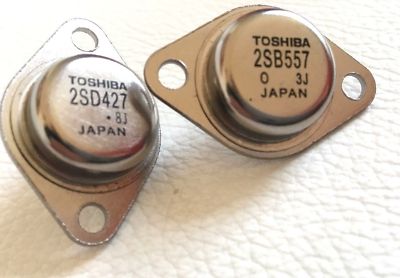
Mica insulators were intact. Tested output transistors and 3 of them are bad. Any point in checking the rectifiers as part of identifying the short circuit without working output transistors in place? We went ahead and tested 2 of them and got values of 0.50 and 0.53 - quite low, I believe. Do you recommend replacing all of them as part of the repair?

BTW, could the bad output transistors have been the cause of the blown fuses?
 
Welcome aboard hitjazz

First thing I'd do is check Qe27 ,28,29 and 30 out of circuit.( output transistors ) If they check out OK. Then check rectifiers De19 thru De26 bridged rectifiers. On the rectifiers lift one leg of each one to diode test them. I wouldn't even bother powering it up again until you locate the short circuit.

Make sure your output transistors are insulated from the heatsink with a sheet of mica.


KEY!!

Missing mica would definitely blow all 4 fuses.

In my last reply, I accidentally typed within the quotes. Wanted to be sure you noticed my questions:

Mica insulators were intact. Tested output transistors and 3 of them are bad. Any point in checking the rectifiers as part of identifying the short circuit without working output transistors in place? We went ahead and tested 2 of them and got values of 0.50 and 0.53 - quite low, I believe. Do you recommend replacing all of them as part of the repair?

BTW, could the bad output transistors have been the cause of the blown fuses?
 
Yes

MJ21193G and MJ21194G from Mouser or Digikey <---------- 2 of each

Thanks, avionic, I am preparing to order the output transistors.

But my question is whether you recommend replacing all the 8 rectifiers. As I stated, we checked two of them and they read 0.50 and 0.53. We thought those readings were on the low end of the 5.0 - 8.0 range for diodes and wonder if we're right about that and if they need replacing. For all we know, as long as the reading is between 5.0 and 8.0, the rectifier is in good shape. Thoughts?

I'm going to post a separate message showing parts I plan to order right off the bat. As of now, it does not include replacement rectifiers.
 
Repair Shop Parts slip.jpeg

Above are the replacement parts the repair shop listed for me. Since I will be replacing the output transistors and the 6800uF filter caps, I figure why not go ahead and order the rest of these parts. Problem is I can't seem to identify the part numbers of the two sets of resistors and the set of 100uF capacitors (4 of them) and their locations within the amp's PCBs.

Background: The reason I had brought the amp in for an estimate is that, although the power LED was lighting up the relay no longer was clicking and no signal was being delivered to speakers. The repair shop tech identified the issue as lying within the protection circuit but he also recommended replacing the 6800 uF capacitors and, apparently, the output transistors. I paid the shop $60 for the diagnosis and estimate and they were as vague as could be in describing what needed to be fixed when I decided not to have them repair the amp. So I don't feel bad about sharing the parts list with you as it was like pulling teeth to get even this barebones list from them.

Can you help me I.D. the parts?
 
Regulated power supply components

470µf --- Ce29 & 30
100µf --- Ce25,26,27 & 28
Do not use 1/2 watt these are considered fusible resistors.
100Ω @ 1/4 watt--- Re77 & 78 Flameproof
1 KΩ @ 1/4 watt --- Re75 & 76 Flameproof
 
Last edited:
Back
Top Bottom