• The move to the new server is done. There are some software and database maintenance updates in process. This has us passing the hat around to help out. We appreciate any donations. Seriously, even a dollar helps. The payment page may be found here - https://www.audiokarma.org/support.html

Safe touching of live circuitry inside amps

oldNslo

Active Member
As I gain perspective, knowledge and how-to's from repair videos on YT, I am continually amazed at what repair folks touch on live boards. Now, granted many (but not all) seem to be seasoned professionals where I see MM's hooked up with readings, scopes in play, and yet fingers, etc are touching circuits, using metal drive bit ends to adjust trim pots, and finger poking about on video boards, tapping caps with fingers, so I can only guess the mains are plugged in. Perhaps they know how many volts are going where, but I'm sure a long way away from that level of confidence.

It's not designed to be a rant, just trying to observe and learn.
 
Register to hide this ad
Take every "how-to-do-it" YouTube video with a grain of salt. Especially when safety may be involved.

If it looks potentially dangerous, it prolly is.

To follow your avatar — it's NOT "Monkey see, Monkey do."

a0b40bdc-087f-4d3e-872a-c0494700664b.gif
 
One absolutely hardfast rule of live amp testing, especially tube amps, and really most electronics, is one hand only. Tie the other arm behind your back if you must. Two hands and you're begging to become part of the circuit. You can still kill the amp with a single probe, but you're much less likely to hurt yourself. Clips exist for a reason. Use them.
 
Yes. With one hand on the chassis and the other touching voltage your heart can stop, even with the component powered off and unplugged if a cap is energized.
 
not to shrug off common sense electrical precautions, but a lot of this also depends what you are working with. Low voltage really doesn't require all of these precautions. Solid state amps often have plenty of stuff thats less than 50v, which is where even OSHA considers low voltage. There just isn't much risk at that level.


that said, you best know what you are about to stick your fingers into and be 1000% sure its safe to do that. If you are not sure whether its safe, assume it is not until you can prove that it is. If you aren't sure how to prove that its safe, then its not to be touched.
 
Personally I am far more concerned with accidentally creating a short between the point I am measuring and something else which should not be touched with the point that I am measuring. I hate potentially making a small problem a huge problem.
I’m not saying I like to be shocked, but it’s not my major concern when working on something. Back in the day I got shocked too often at work and at home, and I also welded a few screwdrivers to things, but I eventually learned my lessons.
 
Some machinists lightly touch their finger to a running surface grinder wheel, but that doesn't make it smart. I keep an 8" long plastic rod with a rounded end handy. Just under 1/4" diameter. It's readily at hand with my pens and pencils in a tin can on the bench. When I want to push, poke, prod, tap or just threaten a part, I use the rod.
 
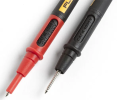
As for reducing the chances of inadvertent shorts while measuring stuff, sharp test probes that don't slip, and heat shrink or a shroud around the test probe tip behind the point helps with that. I've got this cool set of Fluke probes that have retractable shrouds for higher voltage work that I really like for this. Quarter turn and now its just the very end exposed. Twist it back and they plug into pin jacks or whatever that needs the whole thing accessible. I've also seen snap-on shrouds but that just seems like a part waiting to get lost to me.

1791305409967.png
 
+1 on the sharp tips. If I'm working in a skeery area (and it's mostly that way for me at this beginning stage), I reach for my vintage digital Simpson 467. I have an entry level Fluke, but those tips are far more rounded, and thus slip. I've de-dulled them a bit. Despite me ordering needle tip extensions, it seems they don't fit my model Fluke (too large of an opening). Do I make my own needle tips, or upgrade my Fluke?

Hmmmmmmm :rolleyes:
 
As for reducing the chances of inadvertent shorts while measuring stuff, sharp test probes that don't slip, and heat shrink or a shroud around the test probe tip behind the point helps with that. I've got this cool set of Fluke probes that have retractable shrouds for higher voltage work that I really like for this. Quarter turn and now its just the very end exposed. Twist it back and they plug into pin jacks or whatever that needs the whole thing accessible. I've also seen snap-on shrouds but that just seems like a part waiting to get lost to me.

View attachment 3851375
Thanks for the "tip". I'll defenetly add some shrink tubing to all my probe ends.
It never occurred to me to do that.
 
not to shrug off common sense electrical precautions, but a lot of this also depends what you are working with. Low voltage really doesn't require all of these precautions. Solid state amps often have plenty of stuff thats less than 50v, which is where even OSHA considers low voltage. There just isn't much risk at that level.


that said, you best know what you are about to stick your fingers into and be 1000% sure its safe to do that. If you are not sure whether its safe, assume it is not until you can prove that it is. If you aren't sure how to prove that its safe, then its not to be touched.
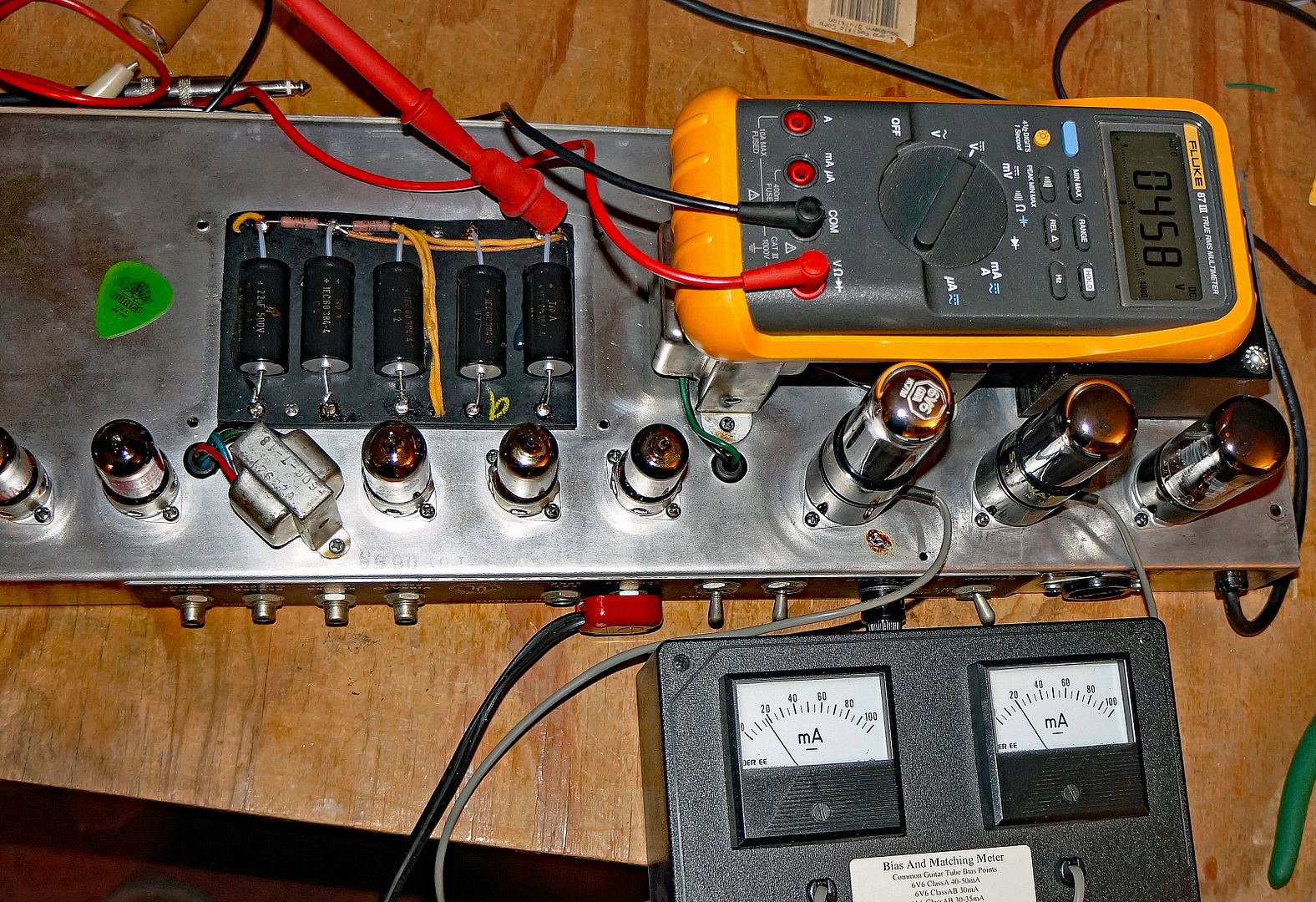
Poke around with a voltmeter to be sure that there are no dangerous voltages. I really don't like personally conducting electricity. It tickles my innards too much.
 
not to shrug off common sense electrical precautions, but a lot of this also depends what you are working with. Low voltage really doesn't require all of these precautions. Solid state amps often have plenty of stuff thats less than 50v, which is where even OSHA considers low voltage. There just isn't much risk at that level.
You still need to be careful, even with low voltages. Maybe not to protect you, but to protect those delicate solid-state devices on circuit boards. Of course, this depends on the specific application.

If you work with computers, you'll know what I mean. I use a grounding strap on my arm to help prevent static discharges. It may be overkill, but better overkill than buying new memory boards.

I guess what I'm trying to say is to be careful when dealing with electricity. Even the 12VDC in your car.

0c9dacbb-b62b-4ad2-86f2-6ec88d309816.jpg
 
Last edited:
I guess what I'm trying to say is to be careful when dealing with electricity. Even the 12VDC in your car.
I have a scar at the inside of the last joint on my middle finger from that. Changed a solenoid in the car, connected a ground wire to the hot instead of to the mounting bolt for the solenoid. Went to yank the heavy battery cable off and got the glowing red 10awg wire right on the inside of my knuckle instead. Not one of my more brilliant moments, and a 2nd degree burn on the inside of a finger joint is not exactly pleasant.
 
I have a scar at the inside of the last joint on my middle finger from that. Changed a solenoid in the car, connected a ground wire to the hot instead of to the mounting bolt for the solenoid. Went to yank the heavy battery cable off and got the glowing red 10awg wire right on the inside of my knuckle instead. Not one of my more brilliant moments, and a 2nd degree burn on the inside of a finger joint is not exactly pleasant.
I have a 13mm end wrench with a chunk taken out of it after I stupidly removed the (+) lead from the battery first and kissed the chassis. I have never made that mistake again. I still have that wrench (40 years old, from high school days).

"Beginner's Inadvertent Welding 101."

ab7a63a1-cdc1-4661-a076-48b0161ab824.gif
 
I have a 13mm end wrench with a chunk taken out of it after I stupidly removed the (+) lead from the battery first and kissed the chassis. I have never made that mistake again. I still have that wrench (40 years old, from high school days).

"Beginner's Inadvertent Welding 101."

ab7a63a1-cdc1-4661-a076-48b0161ab824.gif
I suspect that you were also pretty grateful that the battery chose not to explode during the unexpected short circuit welding practice event, at least in reflection !
 
Back
Top Bottom