• The move to the new server is done. There are some software and database maintenance updates in process. This has us passing the hat around to help out. We appreciate any donations. Seriously, even a dollar helps. The payment page may be found here - https://www.audiokarma.org/support.html

Sangean HDT-20

Bubo

Super Member
Picked one of these up the other day to try it out.
I believe it was a good to very good addition to my gear.....

Pros
Seems to pick up all of the same stations my SONY HD Radio does
Pulls in some of the FM stations better than the McIntosh MR 78 does.
User interface works well, full featured
Analog and Digital outputs
Audio Quality seems pretty good, haven't done AB comparison with other tuners yet.
Form factor is good for my 19in racks
Remote control is easy to use
Price $160 at Home Depot and Amazon
Tuning knob instead of buttons
They got almost everything right IMHO

Cons
Like the Sony, it auto switches to the HD station, not a show stopper but an HD off button would be nice.
20 Preset buttons could be a larger number like 40.

Brian Beasley sp, did nice evaluation of the previous Sangean HD radio, but no such tech evaluation of this model exists to date.

Audio Quality
If I had the tools it might be nice to run a frequency sweep through the FM tuner and HD decoder sections and compare the two sine waves to see how accurate the unit is.

I don't know if anyone has modified one or these yet for sound or tuning.........
 
Register to hide this ad
I've always been puzzled by the fact that while it's easy to tune in a HD broadcast in your car, doing so in a home system is a little more challenging. That's particularly frustrating as HD signals tend to sound better and often have early FM-like programming experimentation and commercial levels. So, when the little Sony receiver unit came out
(XDR-F1HD) I bought one. It was a really nice sounding tuner but unfortunately it had two problems: 1) it tended to run small-tube-amp like warm (odd and somewhat disconcerting for a little transistor unit) and 2) the controls were on the top (less than ideal in an equipment rack). Thus when my latest tuner died I decided to give HD another try. The HDT-20 is Sangean's second attempt at a component tuner. For not a lot of money (~$160) I'd say they got a lot right. First, it's regular component size so it fits in well with other kit. Second, it has a nice big tunning knob which I infinitely prefer to rocker switches. And third, even in my 60+ miles to the nearest large city location, it picks up over a dozen HD signals and a great many analog ones I never new existed. It also sounds rather nice, perhaps a bit on the warm side thru the RCA outputs which for FM is fine with me. Admittedly, I feed it a pretty good signal with the Dynalab ST-2 antenna up maybe 25' in the air but then again, I use that antenna with all my other tuners. It does have typically Sangean programming oddities like to get to preset 1 you don't just push preset 1, you have to press the preset button first, then press preset 1 because it defaults to the secondary use for that button if you do not. It's also a bit on the $99 CD player light side, likely because it's basically a big empty box. All that said you would have been hard pressed to find a tuner that brings in this many stations and sound this good for double the price not that long ago.
If you haven't given FM or HD FM a try recently you might want to pick one of these up while you still can. It's no Marantz 10b, then again it doesn't cost several grand & is capable of picking up HD transmissions.
 
I enjoy mine... It is not , spec wise , as good as the XDR-F1HD. But with most stations the differences between the two are splitting hairs - IMHO

I like feeding the digital out of the Sangean into a DAC
 
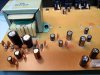
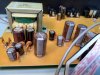
I've been very curious about modding the HDT-20 as well as it's the only component in my stack I haven't yet personally touched or upgraded. As you can see, there's not much going on under the hood, mostly empty space with some electrolytics and single layer ceramic disc capacitors as being the seeming potential upgrade candidates (at a glance). In my opinion, and with my cables and other associated gear it's hooked up to in my system at least, the sound is definitely weighted more towards the resolving upper frequencies where it generally gets it right and is sort of refreshing to hear with radio in a home component system. However, it's also lean and thin sounding and uses a small transformer with a weak bottom-end, lacking in body or fullness of sound. Part of this sound signature may possibly have more to do with the digital, HD broadcasts themselves, which may be bandwidth limited and are the only ones I listen to. I have come to appreciate the extra detail I am hearing from the Sangean and enjoy listening to HD radio and the extra stations and added content on the airwaves that it offers over analog, but am curious to know how/if better tone caps such as Silmic or Tonerex could possibly help round out the sound across the whole spectrum especially the midrange and bottom-end. This, in addition to using better capacitor materials to sub for the SLCCs, such as MLCCs, polystyrenes, polycarbonates or polypropylenes. It should be especially easy and straight forward to swap some components in and out (or revert back) to see if any of it will make a difference. I'll post any pics or updates If I pursue this as there is currently nothing else on the web (I could find) with regards to upgrading or modifying the HDT-20 for better sound. I don't have any issues with receptivity using a good FM antenna in my metropolitan area, so my focus would be on the sound itself, not necessarily increased receptivity.
 

Attachments

  • sangean.jpg
    sangean.jpg
    66 KB · Views: 171
it is quite possible that most of the components are on the back side of the pcb. if it is a dsp based tuner, i do not think changing a few comps will make any difference.
what is your definition of a SLCC?
It should be especially easy and straight forward to swap some components in and out (or revert back) to see if any of it will make a difference.
I do think it is as easy as you think, esp if you do not have a schematic or a service manual.
 
Yes. That online photo I found doesn't show the whole story. Like you say, there's got to be more to it on the other side. I'm thinking it is mainly reliant on IC's and other chips for the digital processing and its other features, so I'm not too hopeful swapping a few components around is likely to make That much difference, although I will still probably try it and may revert back if there is no change or it sounds worse. The fewer through-hole components it uses, the less likely upgrading any of them is likely to provide a benefit. There's doesn't appear to be many through-hole components.

I don't like messing with surface mount SMD components if I come across any of them- too tedious to deal with, and nowadays with the miniaturization of everything they are more and more common and non-serviceable unless you're an expert precision solderer with a magnifying glass.

I know there's another, long skinny pcb located behind the display. I wouldn't be surprised if it is mainly also populated with non-serviceable chips as well. SLCC is single-layer ceramic capacitor, they're the little orange discs you see inside everything and can be safely swapped out to the more stable and better performing COG/NP0 type, multi-layered ceramic capacitors (mlccs) or possibly even better performing capacitor materials entirely.

If the diodes I see on the photo are of the standard-recovery type, they could also be safely upgraded to the ultra-fast recovery "UF" type, although I don't think that would make much of a difference here, if any. I've performed dozens and dozens of successful recaps on much more complex pieces of equipment. This would be the easiest component I've ever worked on to replace through-hole components that I've ever seen.
 
Last edited:
HDT-20 user here. I appreciate the sound quality, but not the implementation of the interface. Like a lot of Sangean radios, and I've had a few, they don't get the ergo right IMHO.
 
It never made sense to me that it comes with the option for two alarms, the clock never stays set whether it's on automatic or manual, and that the power button is only illuminated when turned off, so you think it's always turned off when in reality it's turned on when listening to another input source and the display is blacked out.
 
I think you sort of hit the nail on the head: most FM signals are not nearly as good as the tuners that's can receive them. HD seems a little better but it's still going thru the same boards & processing that the main FM signal are going thru in many cases. To me, the advantage of HD is less sound quality (better but limited by source) but that it's more than a heart beat away, sort of like FM was back in the day. Some interesting stuff gets put up on those HD sub-channels, well worth the $160 cost of admission for this unit. As to Sangean, bless there little pointy heads,
every one of their pieces that I've owned (several) have had their WTF? programming oddities. It's sort of like the super-smart kid sitting next to you in the physics class: odd, yes but damned if he didn't come up with some amazing stuff now and again. That said, an alarm clock function on a component tuner is totally beyond me. 'Must have sourced the board from the last clock radio...
 
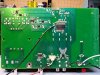
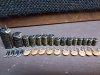
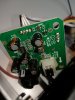
I swapped all through hole components on the main board, [including (4) 1N4002 diodes, upgraded to UF4002] considered the headphone board (but left it since I don't listen to the radio with headphones) and didn't mess with the display board because I think it just controls the UI and don't think it would have any impact on the sound. Here is what I found. Upgrading to better electrolytic tone caps did indeed help flesh out the bottom-end and midrange in the ways I had hoped.

However, I wouldn't recommend touching the ten orange 103/104Z 25V single layer ceramics. The "Z" rated ceramics are important here. While it's true they have terrible stability, ranging anywhere from +80% to -20% of their rated capacitance, they seem to function the best here compared to some other alternatives I tried.

Moral of the story? It was worth upgrading the cheap, Chinese "GD" branded electrolytics on the main board, but nothing more. If I didn't have the right ultra-fast diode equivalents, I wouldn't have swapped out the (4) 1N4002. It's possible my faster diode replacements could be a slight improvement in sound, but if so, I cannot really tell as easily as I had noticed the improvement in sound by using the Silmic and Tonerex electrolytics.

IMAG4623.jpg IMAG4625.jpg IMAG4631.jpg IMAG4626.jpg
 
Last edited:
Final look with the 10 factory ceramics re-installed. It has never sounded better and am still getting all 5 bars of signal strength on HD stations as before. The capacitance on all caps is the same, but most have an increased voltage rating and are much larger because it's what I had available. The larger Silmics sound more natural on the bottom-end and midrange and have more presence, especially bass which helps flesh out the sound as it was already pretty good in the upper frequency range.

IMAG4636.jpg
 
Last edited:
Just listening now for a few hours straight after the recap I have to say the sound is a lot more 'muscular' from top to bottom and fuller now, for lack of a better term and I'm really enjoying the music much more than before. It has more body and sounds more complete throughout the entire audible range and doesn't seem to run out of steam or lose definition on fast, more difficult or complex musical passages. Lots more oomph.

Because of this, I have to say I'm glad I upgraded the diodes as well to the (4) UF4002 and would recommend this in addition to using higher voltage, physically larger Tonerex and Silmic caps of the same capacitance as the originals. The increased voltage rating, along with increased physical size, allow for a much higher ripple current capability on both the low and high frequencies, which, along with the faster diodes, gives a sense of increased headroom, authority and ease with how the music is conveyed. Other than that, I used the clean-sounding 2,200uf KZH and 1,000uf UHE power cap(s) for the two larger electrolytics next to the transformer. I didn't have any tone caps for these larger values, and if I did, they probably wouldn't fit on the board next to each other anyway. See above photo on one of my previous posts for all the electrolytic cap values and voltages on the main board of the HDT-20. Of course, substitute your own choice of caps (if desired) This is just what I use and it seems to consistently give me a more natural, warmer, full-bodied sound signature I like to use for my recaps, especially when dealing with 'digital' which helps to subdue the harsh/ brash artificial digital sound somewhat.

A couple observations worth taking note if pursuing this recap. The solder pads for some of the smaller electrolytics are very close together, about 1mm apart, so it takes a little finesse, be careful not to accidentally bridge the gap with too much solder when re-soldering. Also, very little solder was originally used to secure them, which made it a little more difficult to liquefy it even at a high temp without adding some additional, fresh solder before removing it (at times)
 
Last edited:
@onanysunday thank you for your post about recapping and changing the diodes. Did you happen to try using a good DAC and then do an A/B? I have a few DAC's and just hooking up a DAC would be much easier for me than recapping and the like. But if the digital out is not so high quality, that would be good to know. I am thinking of purchasing one with the idea of hooking up to a DAC.
 
I didn't try using another DAC, it's likely a surface-mount type. What I can say is that (after the recap) it sounds much better through analog out versus digital out. I even had its digital signal processed through a Cambridge DACMagic Plus and it still sounds much better with regular analog RCA out.
 
Sorry for bumping a fairly old thread. I've been looking at the HDT-20. I need to know how deep this unit is. I see dimensions listed on Sangean's website:

Width (mm/inch) 430 / 16.93
Height (mm/inch) 75.5 / 2.97
Depth (mm/inch) 310 / 12.2

I need to know what the actual depth (from the tip of the knob up front to the tip of the FM antenna jack on the back) of the unit is. From the pictures I can find, the depth looks to be much shorter than 12.2 inches.

Thanks for any help guys.
 
Hey onanysunday, Thanks for all this cool information, I just picked one up myself. Can you list the Caps and values need to Recap, Also did you happen to notice what Op-Amp was being utilized for the RCA Outputs? Surface mounts are a pain but it can be done, need good magnification and technique, Lots of Video on YouTube showing how to change out an Op-Amp that size. I have done them myself. I received my tuner yesterday and just burning it in. I will perform the Cap and maybe exchange to faster diods.

Again Hope all is well with you and your family.

Mark
 
Last edited:
Hi Mark. See post # 10, pic # 3 for cap values. Reception was better by keeping the stock, single-layer ceramic disc capacitors in place. I don't remember which opamp it had. It's all back together again now so I can't say. If you open it up, I'm sure you'll find out and be able to swap it out with something else if you like. Best wishes on the project- it's a decent little HD Radio for home use and offers lots of content and many different stations if given a proper antenna.
 
Back
Top Bottom