• The move to the new server is done. There are some software and database maintenance updates in process. This has us passing the hat around to help out. We appreciate any donations. Seriously, even a dollar helps. The payment page may be found here - https://www.audiokarma.org/support.html

SANSUI 2000 - Dead Right Channel

JB8

Well-Known Member
Whelp, I finally snagged my first Sansui (it's about time) and I've got to say I'm already smitten! I really appreciate the way things are laid out and the general construction of the unit, but, I have a small problem, no right channel.

Before powering up the unit after it arrived I checked the three fuses on the rear of the unit, all were fine. I then powered it up through my DBT just in case, again, all was fine. Checked voltages at speaker terminals, minimal, all good. Left channel sounds fine, no issues, right channel is silent except for the faint sound of bacon frying - that "transistor is going bad or is already bad sound" I've heard on other units. After cleaning the pots and switches I tested the output transistors in-chassis, all seemed fine, case voltages were ~69V and ~36V DC as well.

Since the issue is limited to one channel I figured it's likely an issue with either the control, driver or EQ amps, and not the power supply. Started with the driver amps and swapped out TR801/802, low hanging fruit, no change. I then looked at the EQ amp and swapped out 602/604, again, no change. I then partially pulled the control amp and compared voltages on the transistors and didn't find anything alarming, so I pumped the brakes instead of just shotgunning the transistors. Notice I've said nothing about caps - my MO lately had been to just replace them all them all before identifying the actual issue, trying to slow down and be more thoughtful about my approach. I then went back to testing the output transistors, may as well double check them, and found that if I use the technique shown in the manual I got normal readings from TR-811/812 but a neg DC reading from 806 and a roughly 1.3 DC reading on TR805, so I pulled them for more testing. WOW, so easy with this rig! Pull the back grill and just pop em out! They all tested fine out of chassis.

There are only three 458's on the phono board so I'm not terribly concerned about those at the moment. I am, however, in a familiar position of feeling a bit lost specific to next steps. I know I can just keep changing out transistors and caps as well, but if I'm going to learn this specific troubleshooting sequence I'd rather pull off the road and actually look at a map instead of just hoping I'll see a sign that points me to the issue, which likely won't happen.

Apologies for bloviating, any advice on next steps would be fantastic and much appreciated. Excited to hear this thing sing, sounds like I should expect a nice warm result with a fat low end to match how badass this thing looks.
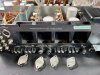
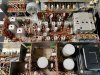
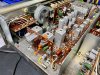
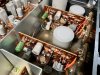
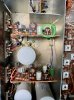
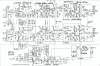
IMG_1038.jpg IMG_1039.jpg IMG_1040.jpg IMG_1041.jpg
 
Last edited:
Register to hide this ad
Since the output transistors test fine out of the unit I'll reinstall them and continue to focus on the Driver Amp components.

Btw, here were the case voltages (DC) for the output transistors:
  • TR811 70.7 V
  • TR812 35 V
  • TR806 70.6 V
  • TR805 38.3 V
I'll report back as I know everyone is busy, all good!
 
Last edited:
IIRC the 1st transistors(TR-801-802 IIRC) on the Amplifier boards are 458's. Replace them. Did you test the fuses with a meter or just do a "visual". Sometimes they'll blow inside the ends and they "look" good. Get in the habit of "TRUST, BUT VERIFY" (use the meter)! Also cover the RED PROBE all the way to the end leaving the extreme tip exposed. Cut's down on "AW SHI*'s" when it slips (and we all have those moments.)
 
Thank you, Larry, appreciate you hopping in here. I know you've got all three models of the 2000, so I couldn't ask for someone with more experience.
  • TR-801-802 were Hitachi 2sc649's (not the 458's) and I replaced them with 1845's, no change
  • Fuses checked for continuity with meter, both were functional plus I swapped them to see if that made a difference, it did not
  • If I gently tap (with a wooden probe) on VR-801 the static gets louder and I can hear the "tap tap" through the right channel, the other driver board does not react from this tapping. I cleaned it yesterday with Deoxit and exercised it (after taking notice of exactly where it was initially positioned) and the static stopped momentarily but it's back today
  • There were also a couple of the orange 458's on the protector, so I swapped those out as well
Trust but verify was one of my favorite boss's methodologies as well, always good to remember.

IMG_1048.jpg
 
Last edited:
You need to troubleshoot in an organized, logical manner.
The first thing to do is Deoxit all the controls. If that doesn't fix it, go through it with an oscilloscope and find the section where the signal is lost.
Don't change parts willy nilly.
 
Thank you, dr*audio, I'm trying to avoid the willy nilly approach, still learning, appreciate the advice.

I've used Deoxit on all of the controls, it's one of the first things I always do. I need to be more clear in stating that at the beginning of every post since it's the go-to first step for nearly ever fix on the forum.

Thanks again.
 
Got the scope out, it also only has one good channel, should be all I need.

Ran a 1K tone in via AUX ports, got a nice wave on the working channel at the base of TR-803, the dead right channel was flatlined at the same test point. I have very little experience using a scope and would appreciate learning additional test points to check next, any guidance here is much appreciated.

Also, while I couldn't hear anything on the bad right channel initially, when running the test tone through the unit I can now hear the tone through the bad channel although it's very, very low volume.

Screen Shot 2022-06-06 at 6.08.48 PM.pngIMG_1049.jpg
 
I've spent a couple hours reading through other posts on signal tracing with a scope, absorbing some knowledge. I'm going slow, being very careful and also learning hot the scope reacts to the 1K tone at different test points.

I'm getting a decent, balanced wave at the Control amp outs, assuming the issue is related to the Driver amp, will continue testing, feels like I'm making progress. I'll update when I have more details.
 
Does the 2000 have pre-out pwr-in jumpers on the back panel? I can't remember, but if so, make sure they aren't shorted to the shells and you can also pull 'em to find out if the problem is in the line section or the power section.
 
Base of TR801 looks good, wave looks strong and steady.

No jumpers on the 2000, Conrad, but great call, jumpers definitely come in handy for isolating the issue.

And just to reiterate, when testing at the base of TR803 I'm getting lots of signal out of the left channel, but really have to boost the volume to get a wave form to show up on the right channel.
 
Last edited:
TR803 is a current source and you would not see a signal on the base. Look at TR802 base.
 
Testing the base of TR802 I saw nothing on the right (bad) channel. When testing the left (good) channel the only way to see the wave form at the same test point was to crank up the Volts/Div to 10 mV and pull the x5 Mag knob out.

On TR803 the wave changed when I switched frequencies so I thought it might be the signal.
 
Apologies if it sounds obvious but do you have signal all the way from the input jacks at the back, through all the various selector, tape monitor and associated switches?
Can you confirm signal entering the preamp section, in other words?

I ask as I have lost signal in switches that I had deoxit’ed, the deoxit wasn’t able to cut through the gunk and they needed to be taken apart and physically cleaned.
 
Hey Bob, great questions. I'm a total rookie compared to the other gentlemen on this thread, so nothing is completely obvious to me yet, learning along the way.

I am currently using the AUX inputs on the back of the unit to feed a test tone in via RCA jacks coming from my phone. The signal can be heard via the headphone jack and speaker jacks, so yes, the function switch seems to be working fine. My issue is that while the left channel is working fine, the right channel has next to no signal passing along with a "bacon frying" "pish, pish, pishhhh, pish pish" sound as well. If it were only a nearly dead channel I would be more apt to continue cleaning, but the crackling leads me to believe its a component issue, we shall see. I've heard transistors and caps as well making this sound in the past but I'm not great at tracking down the source of the bad component. In the past I would have just shotgunned several components, or full boards, hoping to remedy the issue but that seldom works, so I'm slowing down and asking for assistance. Find the problem, fix the problem, then upgrade if necessary or desired.

This is also my first Sansui, so while I've felt comfortable around the likes of 330C's and STA-78, etc., I'm convinced now, for some reason, that I'm in a different realm. Happy to be patient and walk through the directions provided.
 
Hang on, lets break this down.

The schematic for your amplifier has signal coming in from the input jacks, going to the selector switch and then into the preamp pcb F1037.

Have you confirmed that you have signal, a 1kHz test tone from your phone into the aux jack, present at bases of Tr601 and Tr603 with your oscilloscope?

I.e. left and right input into the preamplifier section.
 
What might be easier is to look for the interstage coupling capacitors and test there to see where signal disappears.

For the right channel these seem to be C714, C719, C726, C812 & C818, put a stereo signal in the aux and trace it through the via these capacitors.

Compare what you find at these points with the same capacitors on the good, left, channel.

for the first pass, less chance of slipping and shorting out transistor legs this way.
 
Hey Bob, thanks again for jumping in, much appreciated!

I have the small grabber on the scope probe so I went for the transistor testing, very carefully.

I'm getting signal at the base of T603 but not at the base of T601. Double checked both, and on T603 I changed the frequency to see the wave changes, and they responded as they should.
 
Base of TR801 looks good, wave looks strong and steady.

No jumpers on the 2000, Conrad, but great call, jumpers definitely come in handy for isolating the issue.

And just to reiterate, when testing at the base of TR803 I'm getting lots of signal out of the left channel, but really have to boost the volume to get a wave form to show up on the right channel.
You have signal at the base of TR801, no need to look at TR601. You have no signal at the base of TR802 so the problem is between TR801 and TR802. Don't get distracted.
Now look at the signal on both ends of C804. If you have signal on the + side but none on the - side, C804 is bad. If you have no signal on the + side, TR801 is bad.
 
Back
Top Bottom