• The move to the new server is done. There are some software and database maintenance updates in process. This has us passing the hat around to help out. We appreciate any donations. Seriously, even a dollar helps. The payment page may be found here - https://www.audiokarma.org/support.html

Sansui 800 trouble shooting - blows speaker fuse after deoxit

driver transistors and resistors look good, so do the rest on that board. I'll order the new outputs and read up on adjusting the bias current. Thanks!
while you're waiting have you inspected for aged or cold solder joints?
--------
How about revisiting the speaker question.. I don't suggest repeating that 'combo' mix and look for a pair of rated 8Ω. or ONE pair of 4Ω

specs:
Power output: 22 watts per channel into 8Ω (stereo)
Speaker load impedance: 4Ω to 16Ω

Year: 1968 can you assess if any caps have been replaced? pics welcome... we see stuff
 
The output transistors have a mica insulator between them and the heat sink. Be careful not to damage the insulators and don't forget to use them on the new transistors. Get heat conductive grease to use on the new transistors. DON'T use the Arctic Silver stuff used on microprocessors, it's conductive. The clear silicone stuff is nice because it's less messy. Wipe off the old grease and apply new grease to the transistor, put the insulator on the transistor, then apply grease to the other side of the insulator. This ensures best heat transfer.
 
This is the safe way to hook up your 2 speakers and sub.
525x525px-LL-d5c84a28_vbattach98821.jpeg
 
For starters, blow the eff out of the pots you may have overlubed with an air can or compressor to rule that out. There may be pooled lubricant somewhere inside the pot(s) causing an issue.
 
For starters, blow the eff out of the pots you may have overlubed with an air can or compressor to rule that out. There may be pooled lubricant somewhere inside the pot(s) causing an issue.
No, the lubricant belongs inside the pots and won't hurt anything. If you try to blow it out it will just get all over everything and attract dust. Very bad advice. If there is lubricant on the board you can flush that out with alcohol or a non-residue contact cleaner.
 
No, the lubricant belongs inside the pots and won't hurt anything. If you try to blow it out it will just get all over everything and attract dust. Very bad advice. If there is lubricant on the board you can flush that out with alcohol or a non-residue contact cleaner.
Get out of here with that. Let me clarify since it wasn't obvious. Ideally, clean pots first with contact cleaner moving them back and forth, let dry. Then lube the pots with deoxit, work them back and forth, blow them out, clean any surrounding residue with contact cleaner since as much as half a bottle of deoxit was used. Blowing them out prevents any standing liquid issues within the pot (if it doesn't have a drain hole at the bottom) and it also has the effect of coating everything evenly inside the pot with deoxit better than just blindly squirting a few drops into the side hole of just one portion of the pot and hoping it's getting everywhere it needs to. There is a 0% chance this leaves you worse off than you were to begin with. I do this all the time and there is never an issue unless you carelessly leave your work a sloppy mess and don't clean up after yourself. There is also an aerosol version of deoxit which would have a similar effect to this "mess" I've described that Caig sells.. I doubt this is the reason there is an audio issue as it was likely cause by the odd wiring arrangement that was attempted, but in any event it's a better way to clean pots from my experience.
 
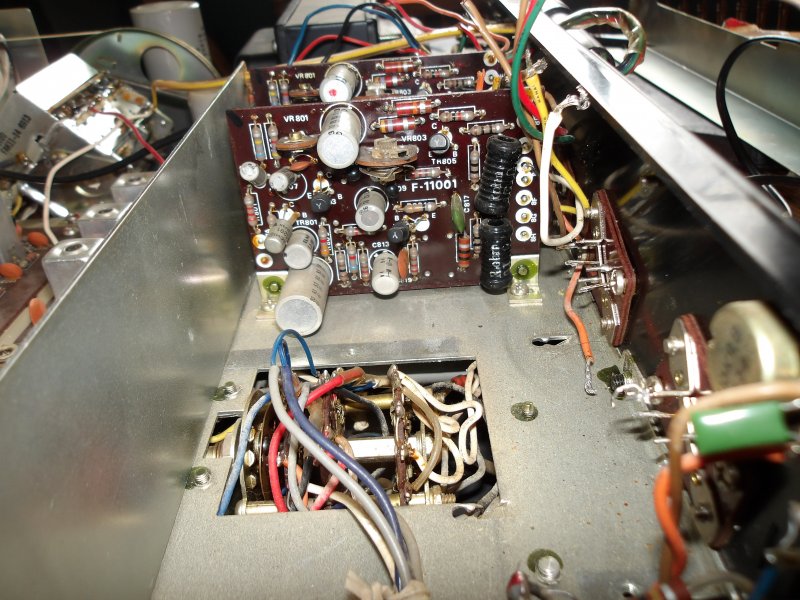
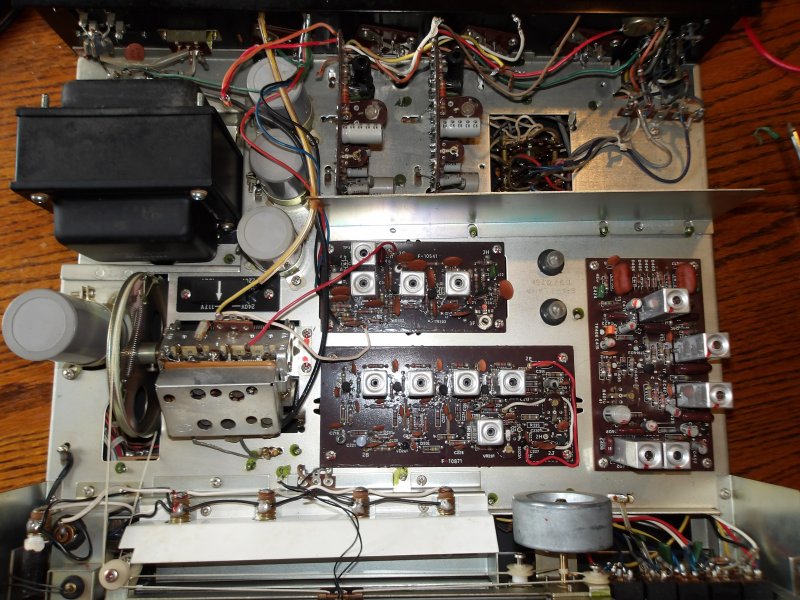
- Solder joints looked good, there are several components (and some screws) marked with red or black marker, maybe these were replaced. Picture attached.
- Thanks dr*audio for the tip about the insulators and grease
- Regarding the deoxit lube, there were little puddles of lube on the inside of the bottom cover where the pots are when I first opened it up. I think whatever excess will drain out, has. I've read mixed advice about compressed air, and I'll say it doesn't look nasty in there, so I'm inclined to leave it be.
- About the speakers, it seems likely that the speaker wiring was the issue, but I don't understand why. dr*audio, will your suggested setup work with the very low impedance speaker/sub combo I've got?

 
- Solder joints looked good, there are several components (and some screws) marked with red or black marker, maybe these were replaced. Picture attached.
- Thanks dr*audio for the tip about the insulators and grease
- Regarding the deoxit lube, there were little puddles of lube on the inside of the bottom cover where the pots are when I first opened it up. I think whatever excess will drain out, has. I've read mixed advice about compressed air, and I'll say it doesn't look nasty in there, so I'm inclined to leave it be.
- About the speakers, it seems likely that the speaker wiring was the issue, but I don't understand why. dr*audio, will your suggested setup work with the very low impedance speaker/sub combo I've got?

Yes.
 
Can always make mistakes in wiring, odds are you ended up with a load too far below 4 ohms which a lot of amp circuits will not tolerate for very long. Too much current.

About the red and black markings, the gray Elna caps are correct for the vintage. I wonder if they were part of some quality control checks. I have seen similar markings in other similar vintage Sansui units I have worked on (5000A, 3000A, 2000A). Seems all of them had them.

Working on mine tonight. Yours looks like it has seen nicer conditions in its lifetime. Figure some units blow up get stuck in attic, shed, garage, or the like for a long time. Many similar marker stripes are on mine, by the serial number mine built April 1969. Betting attic the way a number of things in mine look.
20220409_004609_HDR.jpg
 
Back
Top Bottom