• The move to the new server is done. There are some software and database maintenance updates in process. This has us passing the hat around to help out. We appreciate any donations. Seriously, even a dollar helps. The payment page may be found here - https://www.audiokarma.org/support.html

Sansui AU-11000 new project

wmac

AK Subscriber
Subscriber
I just received the Sansui Au-11000 beautiful Amplifier, which I intend to restore. Below is a picture of it
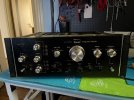
IMG_1337.jpg

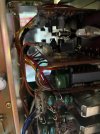
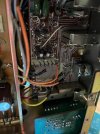
I was so happy until I opened it, then my disappointment, this must be one of the first units produced. If you look at a similar AU-11000 or Au-9900, all of them have connectors to integrate one board to the other; unfortunately, this one does not have them, as you can see in the next picture:

IMG_1350.jpg

This will take my job to another level. I will have to disconnect all the cables to remove the boards to work on them. Not to mention that every capacitor is tightly glued, which is another time-consuming task to clean all the PCBs of that glue.
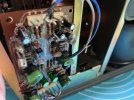
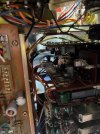
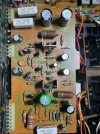
Also, the board F-2568 is soldered to the F2567, so I have to work with the 2 boards attached, as you can see:
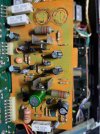
IMG_1365.jpg

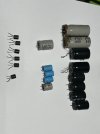
Most of the caps on the board F-2568 are replaced already, missing 2 caps that I have to clean the glue, then I will replace the transistors 2SC1313 with KSC1845, and the board F-2568 will be done.

I will post the progress and the difficulties found.
 
Register to hide this ad
I can’t imagine that this amplifier left the factory like that. It doesn’t make sense that there are JST headers with wires soldered to the pins, if you were going to solder wires you would solder them into the board, not add a header first, I think someone modified it thinking it would be better without the connectors. It has been around for over 50 years, stuff happens.

Have you compared the S/N and production date to other AU-11000s?
 
I can’t imagine that this amplifier left the factory like that. It doesn’t make sense that there are JST headers with wires soldered to the pins, if you were going to solder wires you would solder them into the board, not add a header first, I think someone modified it thinking it would be better without the connectors. It has been around for over 50 years, stuff happens.

Have you compared the S/N and production date to other AU-11000s?

The board was probably made as a sub-assembly with the header attached. It is the wiring harness that is missing the mating connector.
 
The weird thing is that all
@wmac this thread would likely generate more discussion in the Sansui forum. Shall I move it there for you?
Would you please move it? I am new and did not know where to start the thread
 
I can’t imagine that this amplifier left the factory like that. It doesn’t make sense that there are JST headers with wires soldered to the pins, if you were going to solder wires you would solder them into the board, not add a header first, I think someone modified it thinking it would be better without the connectors. It has been around for over 50 years, stuff happens.

Have you compared the S/N and production date to other AU-11000s?
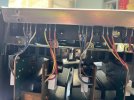
I believe that this amplifier was a prototype, it is ridiculous does not have one connector other the the power distribution, look at those pictures:

IMG_13771.jpg

IMG_1381.jpg

IMG_1380.jpg

IMG_1379.jpg

IMG_1378.jpg

This picture is the front of the amp; there is no way to work on this without removing the whole front and desoldering the board one by one.
I am really frustrated; this will take more work and time than I would like to spend, but on the other hand, it is a bit of a challenge.
 
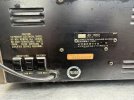
The serial number of this amp is:

235060099

I was unable to find any reference to this serial number. I would appreciate it if somebody could tell me what this is

serial.jpg
 
I believe that this amplifier was a prototype, it is ridiculous does not have one connector other the the power distribution, look at those pictures:
<<snip>>
Although there is always that possibility, in my experience we always had plenty of samples from JST et al to build prototypes and pre-production units. Also, the Japanese were very good at wire-wrapping, if they were to connect to a terminal with a bare wire it would most likely be a very production-looking wire-wrap on the pin then soldered.

Of course I can be wrong, ... I AM married, but it looks to me more like someone modifying the amp because there was some noise or a problem with the connection to one or more of those pins, ... I can see a Navy Radio Operator going the solder-only route to reduce noise (for example) which would really be a better and more reliable connection (provided there is a good mechanical connection before soldering).

JMO
 
Although there is always that possibility, in my experience we always had plenty of samples from JST et al to build prototypes and pre-production units. Also, the Japanese were very good at wire-wrapping, if they were to connect to a terminal with a bare wire it would most likely be a very production-looking wire-wrap on the pin then soldered.

Of course I can be wrong, ... I AM married, but it looks to me more like someone modifying the amp because there was some noise or a problem with the connection to one or more of those pins, ... I can see a Navy Radio Operator going the solder-only route to reduce noise (for example) which would really be a better and more reliable connection (provided there is a good mechanical connection before soldering).

JMO
Yes, it can be, but all the connectors? I have a Luxman L560 and an L-530, and the wires are wrapped around the posts, but this is really very weird.
 
Last edited:
Yes, it can be. I have a Luxman L560 and an L-530, and the wires are wrapped around the posts, but this is really very weird.
I have had several Marantz and Pioneer receivers/amplifiers and they too use the wire-wrap around the header pins, but typically these are solid-core wire and tightly wrapped using a wire-wrap tool. If this was an early production unit, you should be able to search the Sansui serial number database for AU-9900 and find out if it is at the beginning of the S/N range.
 
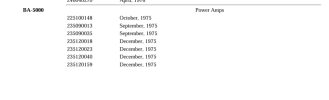
There is no such serial number starting with 235 on AU-9900 or AU-11000. The closest one I found is on BA-5000, which is a power amp.

Screenshot 2025-09-05 203932.png
 
FWIW I checked the latest ( Aug 31, 2025 ) serial # report & got these AU-11000s:

Model Equipment Type Serial Production Date
AU-11000
235060207 June, 1975
235060133 June, 1975
235060088 June, 1975
235060036 June, 1975

So it looks like they did a run of them in June
 
FWIW I checked the latest ( Aug 31, 2025 ) serial # report & got these AU-11000s:

Model Equipment Type Serial Production Date
AU-11000
235060207 June, 1975
235060133 June, 1975
235060088 June, 1975
235060036 June, 1975

So it looks like they did a run of them in June
Yes, it looks like it is Jun 1975
 
I used to own a AU-9900, that had all the wire connectors removed and the wires soldered to the pins as in your picture. But not the unbelievable soldering of those larger connectors, like the one next to the relay - that really is ridiculous. :yikes:


It seems back then(?), or more recently there was a misguided belief that you should solder all the connectors to avoid channel drop-outs and other connection problems with these amplifiers. I went through my amplifier and put back all the connectors, however in the mean time the connectors have been discontinued and as far as I know are NLA unfortunately.
 
Back
Top Bottom