• The move to the new server is done. There are some software and database maintenance updates in process. This has us passing the hat around to help out. We appreciate any donations. Seriously, even a dollar helps. The payment page may be found here - https://www.audiokarma.org/support.html

Sansui AU-11000 Restoration Attempt

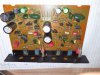
After the new caps were installed, I reassembled the amp to see if my original protection issue remained. Well good news and bad news, it clicks out of protection, then clicks again and a lovely plume of smoke comes out of a resistor on the amp driver board. I went through and tested all output transistors as well as all transistors on the driver board with the exception of the 4 that are mounted to the heatsink at the bottom of the board, and all seem to test fine. If any of you have an idea on where to go from here, that would be much appreciated.
Hi,
It appears you have a capacitor fitted incorrectly on the driver board F-2583. One of the larger caps in the middle of the board is opposite polarity to that shown in your first photo.
 
Last edited:
Hi,
It appears you have a capacitor fitted incorrectly on the driver board F-2583. One of the larger caps in the middle of the board is opposite polarity to that shown in your first photo.

Great eye, you were right!
p7lafCC.jpg


Mine
20210104_191232.jpg

Peter
 
Hi,
It appears you have a capacitor fitted incorrectly on the driver board F-2583. One of the larger caps in the middle of the board is opposite polarity to that shown in your first photo.

Bingo. Thanks alot. Not sure how I missed that.

since you are going back with a soldering iron, please remove the infamous sansui glue on the driver board F-2583.

I did try my best and got most of it off underneath the caps. I actually have an F-2580 in my unit. the later revisions had the F-2583.
 
Well it clicks over now, though it's very unstable, and will click the relay on and off whenever it feels like it. DC offset numbers are ugly, 40mV at first, now 218mV. Adjusting the pots on the board does absolutely nothing to the values. Strange.
 
I got my AU-11000 for 250 bucks a couple of years ago," didn't work very often", he said. It was dirty. Cleaned it up. Hooked up a signal generator and had to deox all switches and volume controls. Put load resistors on the outputs and found a bad coupling cap. (one channel has gone a little weak since so probably should have changed the same cap on the other channel...but I am currently using it as my
"deck" amp and my "in house" preamp and it sounds great driving my BA-5000 into my Infinity Monitor 2a's with none of the original drivers present. If anybody is scrapping a BA-5000 I would like to get some sheet metal from you. I can't imagine anyone would ever scrap a BA-5000 but if you do. HPIM1064.JPG HPIM1066.JPG
 
Well it clicks over now, though it's very unstable, and will click the relay on and off whenever it feels like it. DC offset numbers are ugly, 40mV at first, now 218mV. Adjusting the pots on the board does absolutely nothing to the values. Strange.


...did you get the bias and dc straightened out after?....did you have to change out the trimmers?
 
Bump. Any updates? @Will_Emanuel
I recently picked up an AU-11000 that needs its switches cleaned. I'm really hoping that's all it needs. Would love to hear how the rest of this restoration went or if it's still apart.
 
Finally have an update. It was thrown on the shelf about eight months ago after I got the amplifier section working and still couldn't get the relay to click over. Finally found the issue, many bad joints in the power supply were causing all kinds of issues. The Power Supply board was completely reflowed with new speaker relay, caps, and transistors.

Lfeb2IJ.jpeg

Before relay replacement and reflow

8Sjjfrb.jpeg

after reflow and defluxing.

After this I was able to get the relay to click over and everything was working flawlessly. Just needed to remember how to reassemble the thing after all these months.

ezifi04.jpeg


Reassembly in progress, before throwing the bottom cover back on

jj2q54H.jpeg


and the topside. I didn't have the time or patience with this amp to bother to fix all the molex connectors that were cut out by the previous tech. All was working well, decided to call it there and bring it up for a listen.

CqNtm9d.jpeg

Certainly a looker. Performance is quite good, probably my favorite sounding sansui above my old 990db. I still prefer my Yamaha CA-1010/2010 integrateds over it at the end of the day, but this AU-11000 certainly puts up a good fight.
 
Very nice work!

I'm an EE and have done reliability analysis in the past.
Mechanical connections are called non-gas tight connections because,
obviously, air can get into the connection and they have a large impact,
if not the largest on reliability. Was that a problem with these units?
Probably not, but I have a serious dislike for connectors.
On the other hand, I like old Harman Kardon gear and the boards plug
into the chassis with similar connectors.

If you've ever looked at wire-wrap posts, they are square with sharp corners
and when the wire wraps under strong tension it "cold welds" to the post.
These are also considered gas tight connections.
 
Very nice work!

I'm an EE and have done reliability analysis in the past.
Mechanical connections are called non-gas tight connections because,
obviously, air can get into the connection and they have a large impact,
if not the largest on reliability. Was that a problem with these units?
Probably not, but I have a serious dislike for connectors.
On the other hand, I like old Harman Kardon gear and the boards plug
into the chassis with similar connectors.

If you've ever looked at wire-wrap posts, they are square with sharp corners
and when the wire wraps under strong tension it "cold welds" to the post.
These are also considered gas tight connections.
The molex connectors were never an issue with these units from what I’m aware of. The AU-20000 I just restored used molex connections everywhere as well, and had no connection issues. I do agree with you on the HK units, those cards are great and seem to have a very solid connection. Wire wraps are great as well, but can be a bit more of a pain at times.
 
While wire wraps make very good electrical connections, they are an absolute pain when a unit needs service. Pioneer used wire wraps on almost all boards in their units. A complete royal pain to fix as you really can't remove any boards to work on them. Some of the experts over in the Pioneer forum recommend desoldering the pin rather than unwrapping the wire! That was one of many reasons I ended up selling all my Pioneer gear once I discovered Sansui. The sound of Sansui drew me in, and the intelligent designs of the internals sealed the deal!
 
While wire wraps make very good electrical connections, they are an absolute pain when a unit needs service. Pioneer used wire wraps on almost all boards in their units. A complete royal pain to fix as you really can't remove any boards to work on them. Some of the experts over in the Pioneer forum recommend desoldering the pin rather than unwrapping the wire! That was one of many reasons I ended up selling all my Pioneer gear once I discovered Sansui. The sound of Sansui drew me in, and the intelligent designs of the internals sealed the deal!
Certainly right. The pioneer units I've worked on have been a real pain working around all those wire wraps.
 
Back
Top Bottom