• The move to the new server is done. There are some software and database maintenance updates in process. This has us passing the hat around to help out. We appreciate any donations. Seriously, even a dollar helps. The payment page may be found here - https://www.audiokarma.org/support.html

Sansui AU-11000 restore extent?

tutor_turtle

AK Subscriber
Subscriber
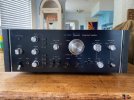
Picked up an AU-11000 for $200, complete and working.
Aside from some dirty switch contacts, it has a boatload of A726's and C1313's that are doing their usual tricks.
Is this particular model worthy of a full-boat restoration, or just fix what's broken?

I have fully restored an AU-999 and an AU-9500 (with all the advice I gleaned from this forum)
I was so impressed with the results, I can't part with either of them.
The AU-9500 is my shop rig that I listen to all day long while doing repairs, or as the test platform for 'tables, CD players, tape decks, speakers.... etc.

Any thoughts?
 
Last edited by a moderator:
Register to hide this ad
You got a AU-11000 for $200 and are asking if it's a "keeper?"

View attachment 3625635
Meaning: Do I spend 20+ hours and $100's in parts to do a total (correct) restoration? Or just make it functional?
I guess what I'm asking is how this stands on it's merits?
I get a lot of equipment coming through the shop, I can't be read-up on every make and model.
Seems folks here like it, looks worthy of going forward with a full restore.
 
You freakin' stole that.
I did have to drive three+ hours each way to pick it up.
I don't trust shipping these units without their original packaging.
It was a smokers unit, it needed serious destink-a-focation, faceplate and switch cleaning.
 
If you do a good job with a restoration, you'll quite likely want to part with one/both of your existing amplifiers. :)
I was thinking along the same lines.
It's nice to have some peer confirmation.

Now, which to baby part with....?
I'll have to conduct a serious audition once all the work is done.
 
It's already been covered, but yes you scored a real deal there, and it is absolutely worth a restoration. The AU-11000 is in the upper echelon of Sansui integrated amps, by any measure.
 
It's already been covered, but yes you scored a real deal there, and it is absolutely worth a restoration. The AU-11000 is in the upper echelon of Sansui integrated amps, by any measure.
Started the restoration today starting with the power supply regulator board. I think that already cleared up some of the rumbling noise.
Moving onto the phono EQ. Very nice phono section.
This must be a later version, as the schematics differ a little from the parts on the boards. Some larger value by-pass caps, resistors added in-line to the one of emitters on the phono section.
 
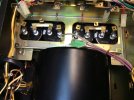
What's a good source for Nichicon Super-Through main caps?
10,000uf @ 63V (51.55mm Dia. X 75.4mm tall)
Might as well go whole hog with the mains.
 
Micheal Percy Audio - last time I ordered some capacitors was an interesting experience. That was a few years ago so things might be more the usual experience now. ;)
I've done business with him at some point in the distant past. The only thing that stands out (as I remember) was long shipping times.
It may have been other issues (communication delays??) .. can't remember. But it's been a while since I used him.

There must have been something significant that causes me avoid him as a resource if I could source the parts elsewhere.
I'm thinking the last time I used him was when I had to source Super-Through caps. He seems to be the only source for this part I can find.

That said, He does have a bewildering array of esoteric parts and gismos. The prices aren't bad either.
 
I could not find any Nichicon KG series when I restored my AU-9900 in 2020/21, so I went with Kemet ALS36H103K2C063. Looks like mouser has 10 in stock.
I haven't dissembled that section yet, I see this part has screw terminals.
How are the originals connected? Screw terminals as well?
 
I haven't dissembled that section yet, I see this part has screw terminals.
How are the originals connected? Screw terminals as well?
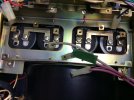
Yes, screw terminals, though the lead spacing is not the same, so a small modification is necessary. Here is a picture of the originals on my AU-9900.

IMG_2500.jpeg

Here is a picture of the replacement Kemet caps in. I had to clip the horizontal part of the connecting bar and bend the ends in slightly for the holes to match up.

IMG_2501.jpeg
 
Micheal Percy Audio - last time I ordered some capacitors was an interesting experience. That was a few years ago so things might be more the usual experience now. ;)
Michael pulled a rabbit out of his hat for me:).
It took a few days for him to get back to me, I expected that.
But in the end, he had the Nichicon Audio Grade large caps I was looking for. $22/ea. $9 shipping.
Couldn't be happier.
Thanks again Hyperion.

The AU-11000 restoration is going well.
I've been chipping away replacing all the known bad transistors 2SA726, 2SC1313...
The rumble is now almost gone, I still have the tone control boards to do.
Everyone of those known bad transistors contributed a little to the noise.

Found some leaking/bulging electrolytics too. (all the electrolytics are being replaced).
WIMA film caps where appropriate.

Protection relay had pitted contacts, that just added to the mix.

Is there a better way to measure the bias on this rig? other than pulling fuses?
My Fluke 87 IV doesn't seem to want to pass milliamps (I may have blown that fuse as well.)
I have an old school Simpson 360, that works ok, unless I accidentally exceed 100ma and blow the internal fuse. (which I'm out of)

If I measure across the ceramic bias resistors, (0.33Ω) what mili-volts should I be seeing?
If it's 50ma total, divided between two transistors that would equal 25ma. (probably not equally)
I could measure both, looking for ~8.25mv across each, and them up and divide by 2?

I worked on some ginormous Classe amps (400 watts/per channel)
The procedure was to measure across the dozen emitter resistors, add them up and divide by 12.
 
Last edited:
If you do a good job with a restoration, you'll quite likely want to part with one/both of your existing amplifiers. :)
99% done on the AU-11000 rebuild.
I ran into a little issue I hope you might shed some light on.
When I got to the driver board, F-2583, I swapped out four noisy 2SA726 (TR 1 > 4) with KSA992.
Now the offset is stuck at 430mv, both channels and adjusting VR01/02 doesn't budge it.
Bias is spot on.
Replacing the faulty devices works, but the noise is back.
I measured every device I removed, while noisy, they all test as "good".
The 726's have Hfe around 150, the 992's are closer to 400.
I bought hundreds of the 992's when I found out they are going out of production.
I am in the process of measuring every one to find the lowest gain, hoping that will fix my issue.
The board is mounted trace side out, making troubleshooting a task.

Can't find the data sheet for 2SA726 (F, G)
The reason I want it, the 726 appear to be BCE, the 992 is ECB.
I'm concerned the silkscreen may be wrong and I put my replacement in backwards.
 
Last edited:
I'm concerned the silkscreen may be wrong and I put my replacement in backwards.
It would be rare (but not impossible), for the silk screen to be wrong, but from what you say it seems like they are in backwards.

According to the Sansui provided pinout info in the SM, 2SA726 are BCE (flat towards you, legs down), whereas - as you suspect, KSA992 are ECB.

The only datasheet I can find from a search for '2SA726' is the 2SA720 datasheet, which says ECB. :(

If I have doubts like that I just use my Peak Transistor Tester to identify the pinout - problem solved.
 
Last edited:
The correct pinout can of course be determined by comparing the schematic to the trace destinations, if the Emitter for example is supposed to be connected to R? And the collector to C?, that is how I check my work before powering up.

Although schematics have been wrong, it is more likely correct than the silk-screen artwork. I suspect that you’ve already considered this but throwing it out there anyway.
 
Back
Top Bottom