• The move to the new server is done. There are some software and database maintenance updates in process. This has us passing the hat around to help out. We appreciate any donations. Seriously, even a dollar helps. The payment page may be found here - https://www.audiokarma.org/support.html

Sansui AU-70 proper output tube?

Sansuiman

Go kart Mozart, checking out the weather chart.
Subscriber
Ok, requesting assistance of the real tube gurus here, as I'm not a hardcore expert. I have a Sansui AU-70 tube integrated that's been sitting for a very long time awaiting restoration. I think I'm finally getting close to biting it off and getting the project started. But there is one issue vexxing me: everything I see in terms of "official" information on this unit says the output tubes are 7189. I'm also finding the consensus seems to be the plate voltage runs 410V, which is beyond the ratings of the 6BQ5/EL84/7189 and into 7189A territory. I'm also noting there are pinout/socket wiring differences between the 7189A specifically, and the other three aforementioned tube types that are "quasi-compatible".

So my real question is: should I be using 7189 (non-A) in this as spec'd, or is the 7189A (or most likely it's Soviet era equivalent) the preferred way to go? I'd prefer not to shorten lifespan by running tubes outside their published specs, even if only slightly. And am I correct in assuming wiring changes need to be made to the sockets if running 7189A? Finally, are the Russian 6Pi14EV directly equivalent of 7189A, or just the regular 7189 in their internal connection and corresponding socket wiring? Trying to head off any dumb problems in advance, and procure the needed tubes in advance. Thanks!
 
Register to hide this ad
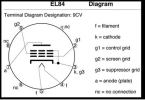
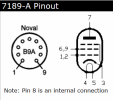
This is the difference between an EL84/6bq5/7189 socket and a 7189A

6BQ5
1775999428094.png

1775999530215.png

its not that you have to re-wire the socket for a 7189A, its that you have to make sure there isn't anything on pin 1 or 6 that will cause problems. On a 6bq5 those are not connected to anything, so sometimes they get used as tie points. On the 7189A, pin 1 is also tied to the grid, pin 6 is tied to the screen.
 
I don't have any amplifiers that use this famaily of tubes. However, from everything I've read online going back 15 years or more (data sheets and user experiences), the 6P14P will substitute for any of the variations. What kills power tubes isn't usually the voltage, but rather the dissipation. As long as idle current is set to a conservative value, they'll be reliable.

Jack
 
The basing difference seldom matters, although the 7189A could be wired so that the 7189 would not work, by wiring to the extra connections (pins 1 or 6) that are shown as "N/C" (no connection) on the 6BQ5/7189. The higher power rating of 7189A vs. the 7189 is imaginary, since it's a design maximum vs. design center rating. For that matter, the "N/C" pins 1 and 6 may or may not be connected on 6BQ5 or 7189, depending on maker and vintage. The Sovtek EL84M is same as the 6P14EV, (highest rating Russian version) and can sub for 7189 (check wiring before subbing for 7189A). The Sansui schematic shows only pins 2 and 9 connected, so no problem using 7189 or EL84M.
 
I'd just want to have a look under the socket to confirm the schematic is correct on that point. Sometimes things will be used as tie points but not called out on the schematic.

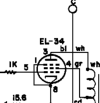
here is a well known example, Dyna ST-70. It shows the resistor landing on pin 5. In reality that resistor sits between pin 5 and 6. 6 is no connection on this tube type so no problem but the schematic doesn't give an indication where it actually lives.

1776101394441.png
 
Absolute understand the need to verify the actual connections at the socket. I was primarily concerned with making sure I chose the correct tube type to begin with as conflicting information I'd found online seemed to indicate the 7189 that was factory spec'd might not be fully up to withstanding the plate voltage on this model.

So as it stands, EL84, 7189 (or the Russian equivalent) will be suitable, and the 7189A would be an unnecessary "upgrade" assuming any decent, matched examples could even be found (which is probably the longest of shots). Not that I was considering it anyway, but it sounds like the 6BQ5 is the one that is simply not up to the job, as goes voltage requirements.
 
Its been suggested that there really is no difference between the 6bq5 and a 7189 other than the number printed on the tube. No idea how true that actually is.
On paper only, a "real" 7189 is supposed to tolerate higher plate voltages than the EL84/6BQ5. (like 350 vs 400VDC).

In reality, many tubes are labeled 6BQ5/7189. I always bias the 7189 to the same wattage as the EL84/6BQ5.
 
@gadget73, @Mr Boochie, good info. My suspicion is during the heydey of tube production there may have been a difference. Now, with limited sources of new production resulting in many relabels, probably not so much, as economies of scale dictate that one should make the least number of unique parts possible, to cover the greatest number of applications.

So, if buying new, the differences are probably minimal to non-existent. Buying NOS is where one would have to pay closer attention.
 
The basing difference seldom matters, although the 7189A could be wired so that the 7189 would not work, by wiring to the extra connections (pins 1 or 6) that are shown as "N/C" (no connection) on the 6BQ5/7189. The higher power rating of 7189A vs. the 7189 is imaginary, since it's a design maximum vs. design center rating. For that matter, the "N/C" pins 1 and 6 may or may not be connected on 6BQ5 or 7189, depending on maker and vintage. The Sovtek EL84M is same as the 6P14EV, (highest rating Russian version) and can sub for 7189 (check wiring before subbing for 7189A). The Sansui schematic shows only pins 2 and 9 connected, so no problem using 7189 or EL84M.
I didn't know that the EL84M was the same as the 6P14P-EV when I bought the EL84M's for my ST-35. I wish I had known I coukd have saved a few bucks. I'm using 6P14P-K's in two other amps.
 
something also worth noting is that the rating systems are not always the same between sheets.


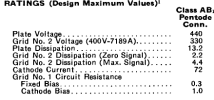
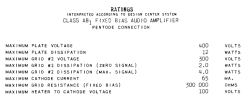
This is the Sylvania sheet for a 7189/7189A.
1776114354477.png

Tung-Sol 7189 sheet
1776114383074.png


same tube, different rating system. They aren't actually rated any differently though. You're just looking at the 10% difference between the two systems.

6bq5 is usually a design center rating. On paper its a fair bit lower even accounting for rating differences but it may be able to handle a lot more. I don't have anything that runs them that hard so I can't swear one way or the other.
 
6bq5 is usually a design center rating. On paper its a fair bit lower even accounting for rating differences but it may be able to handle a lot more. I don't have anything that runs them that hard so I can't swear one way or the other.
Another issue could be the spacing of those EL84s. They are often tightly squeezed into the chassis, leaving little air space.

For class "A" or hot AB1 amps, I usually add a fan (internal or external). This helps with the tube's life expectancy. :)
 
something also worth noting is that the rating systems are not always the same between sheets.
It is almost inconceivable to me that the element spacing capable of withstanding 350V in a vacuum will not also withstand 400V or even 600V. In addition to the rating differences @gadget73 has quoted here, it's my belief that some of the ratings (such as screen voltage) are in fact based on the current and dissipation that are likely to occur. As for anode voltage, data sheets for the Russian 6P3S-E show a rating of 250V. Some Russian guitar amplifiers run them at more than twice that voltage with no sign of distress. I can also tell you that a 6L6GB, rated for 360V anode and 270V screen can in fact function just fine at more than 400V on both elements. You just need to ensure that the rated dissipation isn't exceeded at either element.

Jack
 
Great info in the last few posts. This is the kind of stuff one only gets from those with existing expertise in the subject, and I appreciate those who know posting these "nuggets" of into that would otherwise be difficult to chase down and comprehend.
 
Great info in the last few posts. This is the kind of stuff one only gets from those with existing expertise in the subject, and I appreciate those who know posting these "nuggets" of into that would otherwise be difficult to chase down and comprehend.
Thanks! But, I feel there's something chasing us! ;)

29f789ff-92fb-4a89-aae7-9df45d17b2bc.gif
 
@Mr Boochie, and often enough it is still wrong, despite holding the sum total of all the vast knowledge it has already strip mined from the web. I'll trust first hand human knowledge and experience over it any day. Also, I don't think that the error rate of AI will improve much more than it has to this point. But that's another discussion for another forum.
 
Back
Top Bottom