• The move to the new server is done. There are some software and database maintenance updates in process. This has us passing the hat around to help out. We appreciate any donations. Seriously, even a dollar helps. The payment page may be found here - https://www.audiokarma.org/support.html

Sansui G-7500 - Convert 230V to 110V

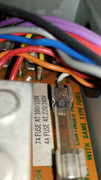
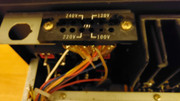
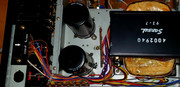
Update: checked voltage with selector at 220v, plugged in to 120v with the 7A fuse and as suggested it is about 50% @32vdc. I inspected the power supply and selector wiring for any signs of past modifications. The receiver appears to be in very clean original factory condition. Factory wire ties still neatly in place, no signs of any repairs or modifications. Power supply p/n matches what should be there.

So with that, I went ahead and changed the selector to 120v and updated the fuse to 7Amp (fast blow).

Findings:
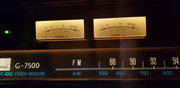
  • Display lights are much brighter - this is a very noticeable difference
  • Sound at low volume with loudness on is about the same, cant say I can hear a big difference. Maybe the bass is a bit tighter, highs a bit brighter, but not by much.
  • Sound at high volume with loudness off is a big difference. It goes much louder with no distortion. Only went up to about 50% volume and it was too loud for me, but sounded super clear.
  • The system runs noticeably warmer, not hot or over heating, but much warmer than when it was set to 220v.
I still wonder if the fact that this unit was running at 50% power for the past 40 years might have been good for it? Heat is the enemy of electronics, so the fact that it ran cool all this time, I would think you might have less deterioration of the components, pcbs and solder joints? Was there any harm in running it like this? I'm really not sure, just curious to understand the impact (good or bad). Its going to stay at the 120v setting with the 7A fuse, I know that is what it was designed to run at.

I would love to hear your thoughts on this!

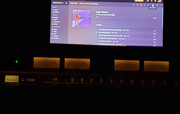
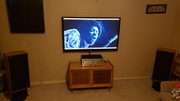
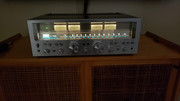
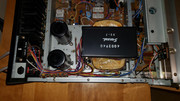
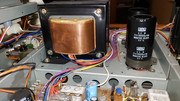
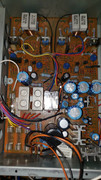
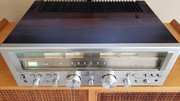
I have attached some photos of the system, you can see it is very clean and in very good condition.
 
Last edited:
Yes, I'm shocked it functioned close enough to normal all this time that it was never checked and corrected before. Really difficult for me to see how it could do so with the input voltage 100V low. Even more surprised the dial lamps weren't so dim before that nobody suspected a problem.

Granted, Pioneer had the dimmer feature on some of their receivers, and while I don't think that halved the voltage to the final lamps, it was a significant difference in brightness but still usable, so maybe it wouldn't have looked that out of sorts. Did the tuner work correctly? I'd expect that to be more sensitive to supply voltage issues owing to the ICs utilized especially in the FM portion
 
I still wonder if the fact that this unit was running at 50% power for the past 40 years might have been good for it?
No, would not be a problem at all, it would be worth checking the Bias though, just make sure thats in spec.

Yes, it will run hotter, but that is to be expected as finally after all these years the regulated supply circuits are now having to do some work, which they are designed to do.
 
I did not think to check the FM and YES, it is MUCH better. I never really listen to the radio, but was disappointed I did not receive more stations when I first hooked up. I had it hooked to a large TV antenna in my attic, so I thought it should have pulled in a lot of stations. Now it picks up a ton of stations and sounds much better.

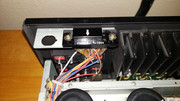
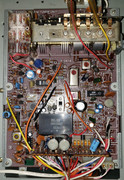
However, AM never worked and still does not.. Just a consent buzz sound that does not change as you move the dial. Any ideas on this? I see there is a switch on the tuner board (see photo), any ideas what this is for? I don't care too much about AM, but would like to understand if it has an issue or I am doing something wrong..

Thanks!
 
Last edited:
If you are referring to the small slide switch, that is for selecting FM de-emphasis, and has nothing to do with AM. It should not be changed regardless, unless the unit is used in an area with 25 microsecond de-emphasis, and that isn't the case anywhere in North America to my knowledge.

In many places it is difficult or impossible to get decent AM reception now due to piss-poor lighting system ballasts, switching power supplies and various computer equipment emitting so much electrical noise it pretty well kills the AM band with interference. I suppose filtering of some kind could be employed to overcome this, but the last time I heard anything worthwhile on the AM band was 25-30 years ago.
 
If you are referring to the small slide switch, that is for selecting FM de-emphasis, and has nothing to do with AM. It should not be changed regardless, unless the unit is used in an area with 25 microsecond de-emphasis, and that isn't the case anywhere in North America to my knowledge.

In many places it is difficult or impossible to get decent AM reception now due to piss-poor lighting system ballasts, switching power supplies and various computer equipment emitting so much electrical noise it pretty well kills the AM band with interference. I suppose filtering of some kind could be employed to overcome this, but the last time I heard anything worthwhile on the AM band was 25-30 years ago.

Thanks. Yeah, its probably been 25 years since I even heard an AM station, guess I was just curious if there was something wrong so good to know it not an issue with the receiver itself.

I think I will stick with my FLAC files from my computer, which sound fantastic on this G-7500 with the Ditton 44's. Feel very fortunate to have this vintage system.
 
No, would not be a problem at all, it would be worth checking the Bias though, just make sure thats in spec.

Yes, it will run hotter, but that is to be expected as finally after all these years the regulated supply circuits are now having to do some work, which they are designed to do.

Thanks. I will check the bais as you suggest, want to be sure it is in spec.
 
I seems mind boggling to hear that all those components were able to function well enough to work acceptably at ~ half power. Who would have thought . . .

Certainly glad to learn that you got over the hurdle so easily, and that the G-7500 is so clean. My understanding is that age will deteriorate the electrolytics with or without power, so you need a plan to replace them, especially the ones in the signal path. The single turn 100Ω trimmer pots would be next on my list. Carefully note the pin connections for the wipers so that the replacements will adjust the Bias & DC Offset IAC with the instructions in the SM. (Do this as a favor to future owners.) Multi turn Bourne style trimmers are good choices.

Good Listening - - -
 
unless the unit is used in an area with 25 microsecond de-emphasis, and that isn't the case anywhere in North America to my knowledge.
Not quite, 25µS is the Dolby FM demphasis.
The two options on that switch are 50µS and 75µS, America is 75µS.
Europe and in fact Australia and New Zealand is 50µS.

If you were to switch it to 50 it would have more top end as its not applying enough De-emphasis...
 
^ correct you are. For some reason I was thinking of Dolby FM when I posted that, which was different again from both N American and European/Aus/NZ standards for FM stereo broadcasting. Dolby FM of course is a dead '"standard" that never got that much traction even at the peak of its popularity. Kind of like HD Radio now in a way.

Many high end receivers of the mid 70's to very early 80's were Dolby FM equipped, and I do wonder what the licensing fee paid to Dolby Labs was at the time. Probably added at least a slight noticeable increase to the price tag given the licensing cost and additional decoder IC'S needed to support that functionality.

Like quadraphonic, it is little more than a footnote and artifact of HiFi history now in 2019. Quad, however, still has a small but dedicated group of fans who keep the dream alive. I'd be one of them.
 
...Like quadraphonic, it is little more than a footnote and artifact of HiFi history now in 2019. Quad, however, still has a small but dedicated group of fans who keep the dream alive. I'd be one of them.
Keep the dream alive. :thumbsup:
 
I seems mind boggling to hear that all those components were able to function well enough to work acceptably at ~ half power. Who would have thought . . .

Certainly glad to learn that you got over the hurdle so easily, and that the G-7500 is so clean. My understanding is that age will deteriorate the electrolytics with or without power, so you need a plan to replace them, especially the ones in the signal path. The single turn 100Ω trimmer pots would be next on my list. Carefully note the pin connections for the wipers so that the replacements will adjust the Bias & DC Offset IAC with the instructions in the SM. (Do this as a favor to future owners.) Multi turn Bourne style trimmers are good choices.

Good Listening - - -

Thanks. I do plan to recap this G-7500 and will look into the trim pots as you suggest.

I plan to recap my Ditton 44 speakers, then a KENWOOD KA-3500 that I use for my desktop system. It's a simpler system to get some experience on as I have never done a complete recap before. Depending on how that goes, I'll tackle the G-7500 or find a good local repair technician I trust with it.
 
Thanks for confirming on the fuse being a fast blow, that is what I thought, but wanted to be sure.
I read a lot of conflicting comments on this topic with some stating slow blow if it is in the power circuit as the in rush current would blow a fast blow fuse when you power on. And that you should use fast blow on the driver circuits. The F-2980 is both the power and driver board, but only need to change the power fuse for the 230V to 120V conversion.

And yes, it is 120V, not 110V....
Thanks.
It actually depends on the service load at that time at that location...the average AC Voltage is apx. 117VAC...
 
It actually depends on the service load at that time at that location...the average AC Voltage is apx. 117VAC...

Maybe where you live DD, but around here in NE. FL. the line voltage hovers around 122 volts most of the yr. since moving here in 1989.
And 120 v nominal has been the norm since the middle seventies everywhere I`ve lived in FL.

And only dips down to near 117 v is during sustained very cold weather, or very hot weather temperatures, due to extensive air to air HVAC grid loading.
 
Maybe where you live DD, but around here in NE. FL. the line voltage hovers around 122 volts most of the yr. since moving here in 1989.
And 120 v nominal has been the norm since the middle seventies everywhere I`ve lived in FL.

And only dips down to near 117 v is during sustained very cold weather, or very hot weather temperatures, due to extensive air to air HVAC grid loading.

...Well Bill...it appears Michigan uses a lot of power on the grid. I do ask that you take note of the potential variables...I did mention depends on where you are at and the time of day.

Thanks for sharing...enjoy my Friend and be safe.
 
Back
Top Bottom